One of the things the Federal Government has consistently preached is diversifying the Nigerian economy. At several, for a in Nigeria and abroad, President Muhammadu Buhari and top officials of his administration have spoken passionately about diversifying the economy.
Not left out of the diversification campaign has been the private sector. The economy’s slide into recession occasioned by falling oil prices and the attendant foreign exchange supply crisis have forced Nigerians to begin to think of new ways of generating revenue. Interestingly, Buhari was recently quoted as saying that falling oil prices had made Nigeria a poor country.
Buhari, who spoke while receiving the United Nations Population Fund’s (UNPF) Executive Director and Under Secretary-General of the United Nations, Prof. Babatunde Osotimehin, at the Presidential Villa, Abuja, had said that the sharp fall of oil price from $100 to $37 and the floating between $40 and $45 had made Nigeria to suddenly become a poor country.
Expectedly, his comments generated mixed reactions from Nigerians. Many wondered why the president hinged the wealth of the country on the price of oil. They were worried that the president failed to appreciate Nigeria’s diverse potential in different sectors.
That the president based his outlook on the economy on the price of oil raised a strong challenge for his administration to now begin to walk its talk in its avowed quest for diversification.
There are actually nations that don’t have petroleum resources but are among the leading economies of the world. In the early days of his administration, Buhari had urged Nigerians to embrace agriculture as a viable means of supporting the economy. Speaking while receiving the president of the International Fund for Agricultural Development, (IFAD) Kanayo Nwanze, in Abuja in August 2015, Buhari was quoted as saying: “It’s time to go back to the land.
We must face the reality that the petroleum we had depended on for so long will no longer suffice. We campaigned heavily on agriculture, and we are ready to assist as many that want to go into agricultural ventures.” But one year later, it seems the president has lost enthusiasm about agriculture as a viable means of attaining economic prosperity.
At the meeting with Osotimehin, he was quoted as saying that commitment to accountability and transparency by his government had made Nigerians not to know that there was “severe shortage.”
What Nigerians had expected to hear was how his administration had diversified the economy by opening up new areas of prosperity. The Buhari’s administration ought to take the recession as an opportunity to seek out innovative ways of boosting the economy. In a nation of over 150 million people, talents and workable ideas cannot be in short supply.
In fact, the president’s party, the All Progressives Congress, (APC) had during electioneering, rolled out a document it titled ‘APC Manifesto: An Honest Contract With Nigeria.’ In the document’s section on agriculture, APC had listed 19 promises through which it pledged the revamping of the Nigerian economy. So far, a number of those promises have not been met.
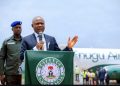
A report by Forbes recently warned that China had identified Africa as the most viable place for agriculture and was investing heavily in agribusiness on the continent. While declaring open the 55th Annual General Meeting of the Nigerian Association of Chambers of Commerce, Industries, Mines and Agriculture (NACCIMA) a year ago, Buhari had vowed to make agriculture a business.
“Agriculture must cease from being treated as development programme; Agriculture must be treated as business. Our goal will be to pursue government supported private sector agriculture value chain to make agriculture more productive, efficient and competitive.
To provide enough food for domestic supply and create jobs through agriculture value chain,” Buhari said. Director General, Budget Office of the Federation, Ben Akabueze, had in July 2016 told a distinguished gathering of the Lagos Business School Alumni Association at a dinner in Abuja that government would treat agriculture as the ‘new oil.’
Akabueze, who listed agriculture and solid minerals as the most viable alternatives to oil, had lamented that less than half of Nigeria’s over 79 million hectares of Nigeria’s arable land mass was being cultivated. He gave an example of Ethiopia as an economy built on agriculture. Akabueze, who said Ethiopia’s economy was growing at an average of 11 per cent, said the East African country had surpassed Nigeria in many aspects of agriculture.
Expectations are high that with Buhari, a well known farmer and believer in animal husbandry as boss, government cannot pay lip service to mechanised farming.
Nigeria needs to export more farm produce to balance the economy while the oil market rumbles and tumbles. Nigerians await the realisation of Buhari’s pledge to drive economic growth through agriculture. It is no longer fashionable to lament the nation’s fortunes. It is time to use agriculture as a key tool of diversifying the Nigerian economy. The time to act is NOW!