Will the government go the whole hog?
According to the latest National Bureau of Statistics (NBS) Price Watch report, the average price of petrol or Premium Motor Spirit (PMS) across the country for the month of November was N139.8 per litre. The report also noted that the product sold at higher prices in major oil states. For instance, the product sold at N187.50 in Akwa Ibom State, N146.59 in Abia, N139.57 in Rivers, N126.30 in Imo, N140.40 in Cross River state, whereas the same product sold at N91.50 in Katsina State, N91.33 in Bauchi and N91.33 in Ogun State, which was the lowest in all the 36 states.
Unfortunately, the situation has changed dramatically in recent weeks as the fuel crisis which has more or less blighted the year worsened across the country, subjecting Christmas travellers to harrowing experiences. Aside the fact that motorists were spending the nights at petrol stations, PMS was selling from between N150 to N250 per litre, even in some of these stations whose operators had adjusted their pumps to make a kill. And quite naturally, the cost of transport has shot up astronomically.
Last week, the Revenue Mobilisation Allocation and Fiscal Commission (RMAFC) urged the Federal Government to remove fuel subsidy because it had become a burden on the nation’s economy. “It has become a major fiscal and financial burden to the nation and should therefore be discarded totally since the intended targets, the poor and middle income class, were often denied the benefits,” said the commission’s statement which reflects the position of most critical stakeholders.
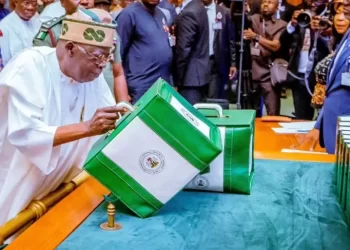
However, there is yet no clear direction from the government on the way forward. In his budget speech to the National Assembly last week, President Muhammadu Buhari said he had “directed the Petroleum Products Pricing Regulatory Agency (PPPRA) to adjust its pricing template to reflect competitive and market-driven components. We believe this can lower input costs and attain efficiency savings that will enable PPPRA to keep the selling price for all marketers of petrol at N87 per litre for now.”
What that means in essence is that the regime of subsidy, with all the associated problems, remains while “government is working very hard to end these shortages and bring fuel to the pumps all over the country”, said President Buhari. But the question remains as to how.
Incidentally, just a few days before the presidential budget presentation, the Shehu Musa Yar’Adua Foundation’s Oil Revenue Tracking Initiative (ORTI) had convened a roundtable on Fuel Subsidy in Nigeria to provide a forum for government, sector experts and civil society groups to discuss policy options and recommendations. With stakeholders drawn from the federal government (representatives of the Minister of Budget and National Planning), NEITI, the media and the civil society, the session held against the background that Nigeria’s fuel subsidy scheme has presented a reform challenge for every administration since its introduction in 1973.
Some of the presentations from government and industry experts included fiscal impact of subsidy scheme and its political and economic implications. While several options were considered drawing from the experiences of other countries, two broad ones emerged: One, gradualism, in which case government maintains price controls, but reduces or phases out the subsidy using a tapering or ratcheting formula; Two, the big bang approach by which government removes price controls and abolishes subsidy. That, it would appear, is the option that appeals to the Buhari administration.
However, considering that this option, which has been tried 17 times in the last 42 years, has proved to be unsuccessful, we hope the Buhari administration has done its homework well. If the past four weeks were any guide, it is to show very clearly that those described by the president as “market speculators” can easily game a subsidy regime that retains all its rent elements.