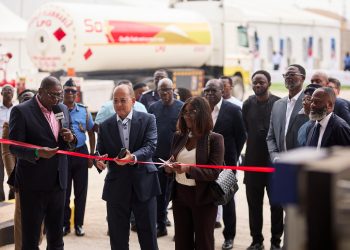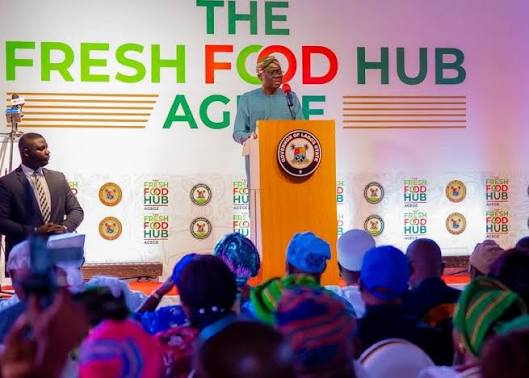
The Lagos State Government on Wednesday inaugurated a new food hub in Agege as part of efforts to reduce post-harvest losses, improve food distribution, and bring more organised trading to the state’s sprawling food economy.
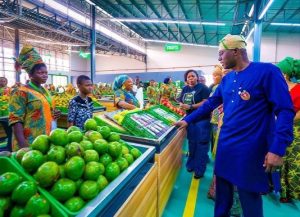
The Lagos Fresh Food Hub, located at Pen Cinema, is designed to accommodate between 350 and 400 vendors and provide storage and trading facilities for farmers, aggregators, wholesalers, retailers and other participants in the food supply chain.
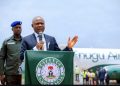
Inaugurating the facility, Governor Babajide Sanwo-Olu said the project was part of a broader strategy to address the structural problems affecting food supply in Lagos rather than relying solely on increased food production.
Sanwo-Olu said more than 70 per cent of the food consumed in Lagos was produced outside the state, meaning that it travelled through long, fragmented supply chains before reaching consumers.
According to him, the arrangement exposed residents to high transportation costs, post-harvest losses, inadequate storage, supply disruptions and price volatility.
“When our administration began to rethink the food system of Lagos in 2021, we were guided by a simple but fundamental reality: feeding Lagos is not a production challenge alone.
“It demands the transformation of the entire food system,” he said.
The governor said the Agege facility was designed as part of a network of food hubs intended to improve the movement of produce from farms and aggregation centres to markets and consumers.
He said the state’s food strategy was anchored on the success of the Lagos Central Food Systems and Logistics Hub at Ketu-Ereyun, Epe, which he described as the flagship project of the administration’s food systems transformation agenda.
The Epe hub, he said, was designed with cold and dry storage facilities, processing and repackaging centres, quality-control laboratories, warehouses, logistics bays and digital trading platforms, with capacity to service more than 1,500 food trucks daily and handle over 1.5 million metric tonnes of food annually.
Sanwo-Olu said construction of the Epe facility was at an advanced stage and would be completed before the end of his administration.
He said the central hub would, however, need supporting facilities closer to consumers to effectively serve Lagos, hence the development of mid-level hubs such as those in Mushin, Abijo and now Agege.
The governor said the Mushin Fresh Food Hub, inaugurated in December 2023, had recorded more than N4bn in transactions across 228 market days, with over 850 registered vendors and more than 7,000 direct and indirect jobs created.
“Today, we proudly add Agege to that network. This hub is strategically located to serve Agege and its neighbouring communities, while strengthening the wider food-distribution network across Lagos,” Sanwo-Olu said.
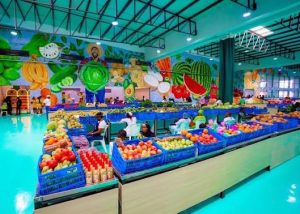
The Agege facility occupies about 7,000 square metres and has a 4,000-square-metre trading floor, according to the project brief presented at the ceremony.
It also has about 1,200 square metres of dry storage with capacity for approximately 800 metric tonnes of produce and cold storage capacity of about 300 metric tonnes.
The facility includes a dedicated seafood section, parking for between 80 and 90 vehicles and 10 electric vehicle charging points.
The project developers estimate that the hub could facilitate more than N5bn in food transactions annually based on its trading capacity and projected volume of produce.
However, despite Wednesday’s commissioning, the hub will not begin full operations immediately.
The project brief said full operations were expected to commence in about six weeks to allow for the onboarding of traders and the completion of the operational, logistics and governance systems required for daily trading.
The facility is being operated under a 351-page framework covering operator selection, produce reception and quality control, storage and inventory management, sanitation, waste management and use of trading spaces.
The framework is also intended to improve the government’s visibility into the food supply chain by tracking the source and volume of produce entering the hub, the quantity stored and points at which losses occur.
The government said traders would retain control of their commercial relationships, including pricing and payment arrangements, while the hub management would provide the infrastructure, operating rules and oversight.
Sanwo-Olu also linked the hub network to the Produce for Lagos programme, launched in July 2025 alongside a N500bn Offtake Guarantee Fund.
He said the programme was designed to shift agricultural production from a supply-led model to one driven by guaranteed demand, allowing farmers in Lagos and partner states to produce for an organised market rather than relying on uncertain buyers after harvest.
“This addresses the two critical challenges farmers face: financing and market access,” the governor said.
“It reduces distress sales, improves incomes, and encourages greater investment in agricultural production.”
The state government is also developing additional hubs in Opebi and Bombata, while locations have been identified in Ikorodu, Apapa, FESTAC and the Lekki axis.
Sanwo-Olu said the long-term objective was to establish structured food hubs across all local governments and local council development areas in Lagos.
The administration is also linking the infrastructure programme with investments in agricultural production and skills.
The governor said more than 125,800 farmers and fishermen had been trained in modern agricultural practices, while over 4,000 young people had been trained under the Lagos Agripreneurship Programme.
He added that the Lagos Rice Mill in Imota had produced more than 250,000 50kg bags of Eko Rice in the past year, including the recently introduced fortified variety.
The Agege project is being developed with Origin Tech Group as project ‘ideator’ and developer, working with the Lagos State Government to establish the hub-and-spoke food distribution model.
The model is intended to reduce the pressure created when food trading, storage and logistics compete for limited road space while also providing cleaner and more organised environments for traders.
The Commissioner for Agriculture and Food Systems, Abisola Olusanya, said the objective was not to replace Lagos’ existing commercial relationships but to provide infrastructure that would allow them to operate more efficiently.
She said the Agege hub was deliberately located at Pen Cinema because of the area’s longstanding importance as a commercial and transport centre.
Olusanya said the facility was designed to give different participants in the food chain specific benefits, from dependable market access for farmers and aggregators to storage and logistics for traders and cold-chain operators.
For consumers, she said, the hub would provide access to a wider range of fresh produce in a cleaner and more organised environment.
Sanwo-Olu further added that the success of the facility would ultimately depend on its users.
“To the traders, farmers, and aggregators who will work here: this facility was built for you, and its success now rests in your hands,” he said.
He added that the government’s objective was to create a food distribution system capable of making Lagos more resilient against disruptions in supply while improving affordability and reducing waste.
“These are not isolated projects. They are interconnected components of one integrated strategy, moving food efficiently from farm to aggregation centre, from aggregation centre to market, and from market to the dining table,” the governor said.