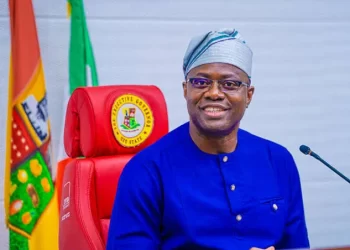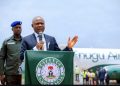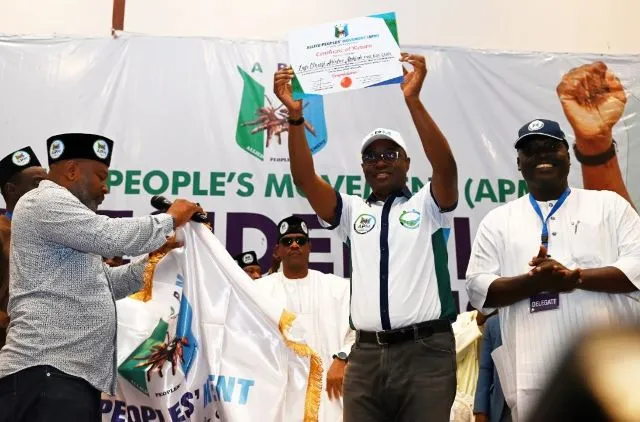
Presidential Candidate of the Allied Peoples Movement (APM) and Governor of Oyo State, Engr Seyi Makinde, on Thursday announced former Director-General of the Department of State Services (DSS), Lawal Musa Daura, as his running mate for the 2027 presidential election.
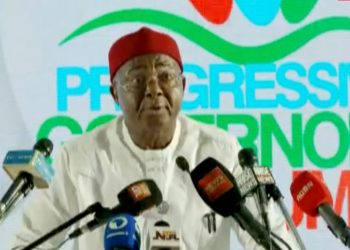
Makinde made the announcement at the elective National Convention of the APM held at the Rilwanu Adamu Square, Government House, Bauchi, where he also declared that the task before the opposition ahead of the 2027 general election was bigger than merely winning power.
He said the central challenge was to give Nigerians a genuine choice about the future of the country and demonstrate, with measurable plans and records, how an alternative government would improve their lives.
“As we approach 2027, therefore, I believe the task before all of us is bigger than winning an election. It is to give Nigerians a real choice about the future of their country,” Makinde said.
Congratulating the new national officers elected at the convention, the Oyo State governor said the APM had, within a short period, emerged as an opposition party to reckon with.
He urged the new leadership of the party to work with other opposition political parties towards presenting a credible alternative to Nigerians in 2027, stressing that a viable opposition remained indispensable to the survival of democracy.
“As I said during the Ibadan Declaration in April this year, the presence of credible opposition is what sustains democracy.
“So, our new leaders must be ready to work with other opposition parties to ensure that we give Nigerians a credible alternative in the 2027 general election,” he said.
Makinde said the coming campaign season would inevitably feature political slogans, promises and declarations by candidates but argued that Nigerians should demand more from those seeking to lead them.
According to him, the 2027 election should be about measurable outcomes rather than government announcements, policies and promises that do not translate into improvements in the lives of citizens.
“The 2027 election must be an election about outcomes. For too long, we have measured governance by announcements. We are presented with policy after policy, rather than evidence of whether those policies have made people’s lives better,” he said.
Using the experiences of ordinary Nigerians to illustrate his point, Makinde said economic policies should ultimately be measured by citizens’ purchasing power rather than official statistics.
“When our mothers go to the market, they don’t experience economic policy as a statistic. They experience it in what their money can buy. How much rice, beans and gari they can take home,” he said.
He added that young Nigerians would judge employment policies by their ability to secure productive work and build independent lives, just as farmers would assess agricultural policies by their productivity, access to markets and whether farming had improved their economic condition.
On security, Makinde said the effectiveness of government should not be determined by the number of security meetings held by officials but by whether Nigerians could live and pursue their livelihoods without fear.
“Families do not judge security by the number of meetings government has held. They judge it by whether they can travel, farm, work and sleep with their two eyes closed,” he said.
The APM candidate said the defining question of the 2027 election should therefore shift from what government claimed to have done to what had actually changed in the lives of Nigerians.
“The question before Nigeria in 2027 should not simply be: What has government done? It should be: What has changed for Nigerians?” he said.
He added that opposition candidates must equally subject themselves to scrutiny by explaining what they would do differently and the measurable improvements Nigerians should expect if they were elected.
Makinde said his administration had applied the same principle in Oyo State by focusing not merely on projects announced by government but on their impact on the people.
He identified poverty reduction, job creation, education, healthcare and security as some of the major issues that should dominate the 2027 political conversation.