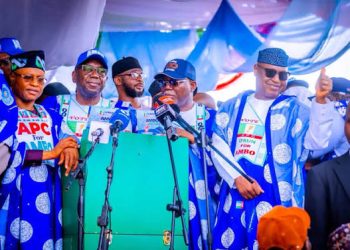
Barely two weeks after the elections that produced a new president and members of the National Assembly, voters head to the polls once again on Saturday to elect those who will govern them at the state level. The governorship and state Houses of Assembly elections offer the Independent National Electoral Commission a unique opportunity to improve on its last showing by producing an outcome that will not only be free, fair and credible but, will also be deemed to be so.
Although the last elections were generally commended and accepted to be above board by many Nigerians and members of the local and international monitoring teams, it would be self-delusional for INEC to think that its performance in the March 28 elections was faultless and without blemish. On the contrary, the elections fell short of expectations in many areas, as attested to by the long list of issues that cropped up. These issues need to be revisited and addressed now if the electoral body is desirous of improving on its outing of a fortnight earlier.
Chief among these was the issue of logistics, which has over the years become a seemingly insurmountable challenge to INEC. Year in, year out, the complaints have always been about elections starting late in many places because INEC has been unable to get materials to the voting centres on time. The last elections were not different. In some areas in Lagos, voting did not start until late in the night because of the late arrival of materials. There were also some places where elections were deferred till the following day. Even when officials were on the ground, in some instances, there were no requisite materials for them to work with; these are not good for the image of INEC.
The resolve of Attahiru Jega, the INEC chairman, to introduce technological innovations to help reduce the high incidence of vote rigging and other forms of rascality usually associated with elections in Nigeria presented its own peculiar challenges. While some of the operators of the smart card readers in some places failed to show a mastery of the use of the gadget, apparently due to inadequate training, reports in some other places showed an outright failure of the gadget itself. A good example of this was in Bayelsa State where the President, Goodluck Jonathan, and his wife, Patience, could not pass the card reader test after repeated attempts. They were only accredited at the fifth attempt.
But in some other places, dubious politicians were not willing to give the card reader a chance at all. The reason for this is not far-fetched, though; with the card reader, it was difficult for people who wanted to use other people’s Permanent Voter Cards to do so successfully. (There were reports of politicians buying off the cards from their owners in the run-up to the elections.) Since the card reader also has a way of recording and transmitting data to INEC headquarters, it also has the tendency to discourage mass thumb-printing, another ugly type of electoral fraud very common in the country.
Perhaps the most worrisome were the reports in some parts of the country of the collusion of some power-drunk politicians with some compromised INEC officials and security agents to withhold result sheets from voting centres with a view to later using these authentic documents in their possession to allot votes which, of course, would not be a reflection of the voting pattern in such places. Also of grave concern were reports of underage voters, a clear violation of the law which specifies that only Nigerians of 18 years of age and above are eligible to take part in voting.
There is no doubt that the introduction of the PVC and card readers succeeded to a great extent in reducing malpractices and according credibility to the elections, but things could have been much better if these pitfalls were eliminated altogether, or, at best, reduced to the barest minimum. Despite the reports of the card reader malfunctioning, it was discovered that only about 0.25 per cent of such incidents were recorded across the nation, according to INEC’s account. By any standard, this represents a pass mark. But efforts must be made to ensure that a higher percentage of efficiency is recorded in the governorship and state assembly elections.
Beyond that, INEC has to ensure that the card reader is more widely used in these elections, as it stated on Tuesday. In fact, on no account should elections be allowed to hold in places where card readers are completely jettisoned. Failure to insist on card readers would amount to taking two steps backward after already taking a step forward. It will be taken for granted that INEC would use the two weeks interval between the two sets of elections to get its act together.
On the issue of logistics, it must think up a better idea of getting materials to election venues on time. Since 1999, when Nigeria returned to civilian rule, many elections have been held. Each new election is supposed to be an improvement on the previous ones. So, it will be difficult for Nigerians to continue to condone mediocrity from INEC, especially over an assignment for which it had four good years to prepare.
Whatever arrangement is made this time should be more firm and concrete. If need be, the transporters should be insured so that they do not lose their vehicles in the event of their being attacked while travelling to deliver electoral materials. For the success of these elections, no stone should be left unturned.