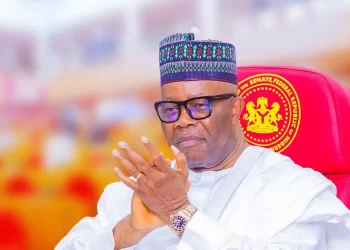
The Federal Inland Revenue Service says it will crack down on tax evaders by denying access to banking facilities for individuals and companies that fail to join its register.
The Chairman, FIRS, Mr. Sunday Ogungbesan, told a forum in Lagos on Friday that there were more than 440,000 companies in the country but only about 120,000 were paying taxes.
Ogungbesan said it was difficult to track the financial activities of those who did not pay taxes, most of whom said their firms were not active.
“We are collaborating with the central bank to enforce compulsory registration with the tax authority by companies and individuals before they can access their bank accounts,” Ogungbesan said.
The tax identification numbers were introduced for corporate bank accounts in 2012 but some firms whose accounts pre-date the system are currently not obliged to have one.
“There is a need to review our tax laws,” said Ogungbesan, adding that they were not stringent enough to deter evaders.
According to him, the service was given a revenue generation target of N4.5 trillion in 2015 and has so far generated N2.667 trillion. He said that the estimated collection for July 2015 is N404billion. This, he said, is 106 per cent of the monthly target of N381.02 and brings total collection to date up to N2.374.18 trillion against the target of N2.667.13trillion, and improves collection percentage to 89 per cent.
He said that the target for VAT was N1.283 trillion and the service has so far been able to generate N390.36 billion as VAT into the federation account. He said the target was set with the hope that as from July the VAT rate will rise to 10 per cent. Ogungbesan said “oil has not been doing well, government expects the non-oil sector to provide the relief being sought. Governance must continue; this is paramount in the minds of every one.
If we can not pay salaries, it is a big problem for the country; my record shows that we have 450,000 corporate entities in this country, how many of them are contributing taxes, into the coffers of government, only about 125, 000. So the rest 300, 000 plus, where are they? You can not find them; they are portmanteau companies. The law says if you are registered within six months you must commence business.
“The same law which said you must commence business has not provided the infrastructure upon which you can rest. If a company is registered and stays for years without doing business and becomes operational ten to fifteen years later, it will be required to pay return charge fee of N25, 000 for each of the year it did not operate as penalty. This kind of law does not promote investment.
“There is the need to intervene, and amend the complex laws that inhibit interest in promoting investment in the country. The thinking is that all those in the informal sector are not paying taxes, it is only those in formal employment that are paying. Can this be true?
When the local government comes to the market to allocate stores, the woman in the store pays N2, 000 per month. Is that not tax she is paying? All those sundry levies being collected by states, they have more than sixty levies on these businesses what do you call that? They are taxation in one form or another.
“It is true they are not paying adequate taxes, some body that should be paying N60,000 is giving you N2, 500. The limitation and the challenges we have is that we do not know who these tax payers are and where they are operating from. The fact is that the Federal Inland Revenue Service which every one is quick to refer to is only administering the Federal Capital Territory, not the entire country and so that makes it difficult for us.
“When we compute tax-to-GDP ratio, every now and then you hear Nigeria is doing only about 7.5 per cent, whereas other countries in Africa are reporting about 19 per cent. “Yes they are partially correct but they forget that the various levies at the local and state levels, including the personal income taxation administered by state governments are not captured.
If you include them in the tax figure, Nigeria will be doing close to 17.5 per cent. It is still not enough because the bench mark is 20-22 per cent. We are not assessing ourselves correctly. “The quick win is, why not increase the rate of VAT from 5-10 per cent? Can we do it now? If you see how far we have gone this year in revenue generation you will see that VAT would have increased by July, that is the target they gave us but we have not been able to do it.
We are consulting as we speak to you, we will also speak to the academic community, the students, we will speak to labour. “I will tell you first and foremost that we in Nigeria do not pay the classical VAT, which anyone may settle for. The first is the income VAT, is just a matter of taking all the incomes of production and solve them into mathematics and then the value such as income, labour, entrepreneurial, the increase in these element from the previous year record is value added.
This can be conveniently calculated with proper records and book keeping” he said. He added that Nigeria needs to adopt a central tax payment. He said that there are a lot of benefits in this type of tax collection system that will enhance the revenue generation of the different levels of government in Nigeria. He also said that collaboration will go a long way in non-oil revenue drive of the country.
“We are collaborating with all the banks to ensure that even individuals without TIN cannot do businesses with the banks. So what is the idea of this centralisation of tax system, is about helping states to collect their tax revenue, not keeping the revenue, because the constitution says every state shall keep its revenue, but the constitution did not say each state shall collect its own revenue.
“It is easier if I can have an MOU so that FIRS can help them do the collection. We have the staff; FIRS has six thousand staff, check it out with any of the states,” he said.