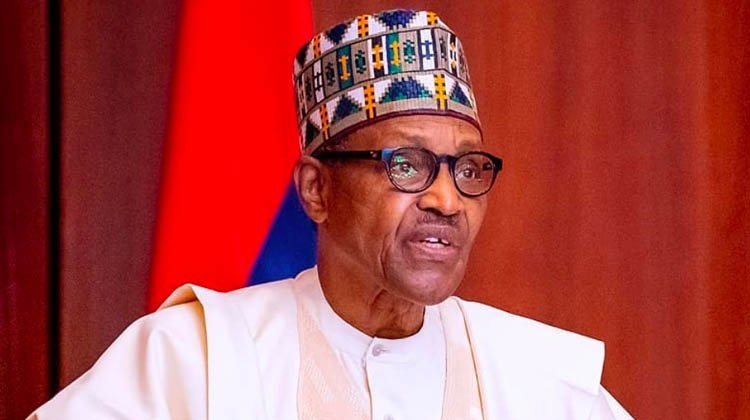
President Muhammadu Buhari has asked the Senate to approve another N2.3trillion ($6.18bn) external loan.
Buhari’s requests were contained in different letters addressed to the President of the Senate, Dr. Ahmad Lawan, and the House Speaker, Hon. Femi Gbajabiamila.
The letters were read at Tuesday plenary by the two presiding officers.
The president said the request for the N2.3 trillion loan to finance the 2021 budget deficit was in line with the provisions of Sections 21(1) and 27(1) of the Debt Management Office (Establishment, Etc.) Act, 2003 (DMO Act), which states that no external loan shall be approved or obtained by the minister unless its terms and conditions shall have been laid before the National Assembly and approved by its resolution.
According to him, the loan will enable the federal government to fund critical infrastructural projects in power, transportation, agriculture and rural development, health, education, among others.
He said the loan would be sourced from a combination of multilateral and bilateral lenders, as well as from the International Capital Market (ICM) through the issuance of Eurobonds.
According to him, from recent trends in the ICM, it is now possible for Nigeria to raise funds, and this explains why the federal government is proposing that the new external borrowing in the 2021 Appropriation Act should include issuing Eurobonds in the ICM.
He estimated that Nigeria may be able to raise $3 billion or more, but not more than $6.183 billion (the amount provided in the 2021 Appropriation Act) in a combination of tenors between five-30 years.
He said the outcome would, however, be determined when Nigeria approached the market.
The letter read in part: ”The purpose of this letter is to request for a resolution of the National Assembly to raise the sum of N2,343,387,942,848.00 (about $6,183,081,643.40 at the budget exchange rate of $1.00/N379) provided as new external borrowing in the 2021 Appropriation Act (Item No. 330) to part-finance the budget deficit of N5.602 trillion. The right honourable speaker may wish to recall that the 2021 Appropriation Act provides for N4,686,775,885,696.00 as new borrowings (item No. 328) to part-finance the 2021 fiscal deficit, of which 50 per cent or N2,343,387,942,848.00 (about $6,183,081 ,643.40 at the budget exchange rate of $1.00/N379) is specified as new external borrowing.
”The Senate President and right honourable Speaker may also wish to note that the allocation of N2.343 trillion to new external borrowing in 2021 Appropriation Act is consistent with Nigeria’s debt management strategy, which seeks amongst other objectives, to moderate ‘debt service costs by accessing relatively cheaper external funds, and free-up space in the domestic market for other borrowers.”
For concurrent approval of donor fund projects, the president, in the second letter, said the projects would be financed through sovereign loans from the World Bank, African Development Bank (AfDB), French Development Agency (AFD), Islamic Development Bank, China Eximbank, China Development Bank, European Investment Bank, European ECA, KfW, IPEX, AFC, India EximBank and lnternational Fund for Agricultural Development (IFAD).
Buhari explained that the projects and programmes in the borrowing plan were selected based on positive, technical and economic evaluations as well as the contributions they would make to the socio-economic development of the country, including employment generation and poverty reduction.
The letter reads: ”Senate President and the right honourable Speaker may also wish to know that all the listed projects form part of the 2018 2020 external borrowing plan and covered both the federal and state governments’ projects and are geared towards the realisation of the Nigeria Economic Sustainability Plan that cut across key sectors such as infrastructure, health, agriculture and food security, energy, education and human capital development and COVlD -19 response efforts.
”A summary of some key projects in each of the six geopolitical zones and a summary on the expected impacts on the socio-economic development of each of the six geo-political zones are attached herewith as Annex II and III.
Given the importance attached to the timely delivery of the projects listed in the proposed borrowing plan and the benefits both the federal and state governments stand to gain from the implementation of same, I hereby wish to request for the kind consideration and concurrent approval of the House for 2018 2020 federal government external borrowing (rolling) plan to enable the projects to become effective.”