By Blaise Udunze
Nigeria’s latest fake government agencies scandal has moved beyond an embarrassing case of impersonation. These absurd scenarios have exposed something far more disturbing, bringing to the fore the weaknesses in the country’s machinery of government.
The recurrence is alarming, as the Independent Corrupt Practices and Other Related Offences Commission has now uncovered a second allegedly fictitious government agency. This time, it is said to be operating from within the premises of the Office of the Secretary to the Government of the Federation. President Bola Tinubu has ordered the arrest of the alleged promoter and the suspension of three federal permanent secretaries pending investigation.
The new organisation, called the National Brands Development and Made-in-Nigeria Special Project Office, was allegedly allocated office space within the OSGF without presidential authorisation. ICPC Chairman Musa Aliyu said the discovery emerged from the broader investigation into the earlier Presidential Foreign Intervention Promotion Council scandal and alleged weaknesses in public-service procedures.
This should worry every Nigerian. Not simply because a man allegedly created a fake government institution. But because two allegedly fake government institutions were able to acquire the appearance of legitimacy from within the government system itself.
That raises a much bigger question. This is to say, if the government can identify and condemn a fictitious agency for being unnecessary, unauthorised and fraudulent, what about the many legitimate agencies whose functions overlap with those of other government institutions and which the Oronsaye Report already recommended should be abolished, merged or returned to ministries? That is the uncomfortable question this administration cannot avoid.
The Oronsaye Report, submitted more than a decade ago, identified the proliferation of federal agencies as a major source of bureaucratic duplication and cost. It recommended reducing 263 statutory agencies to 161, abolishing 38, merging 52 and reverting 14 to ministerial departments.
Nigeria’s problem, therefore, is not merely that fake agencies can emerge. It is that the government has created an environment in which the boundaries between ministries, agencies, councils, committees, special projects and intervention offices can become so crowded and confusing that even the state itself appears vulnerable to institutional impersonation. The PFIPC case illustrates this perfectly.
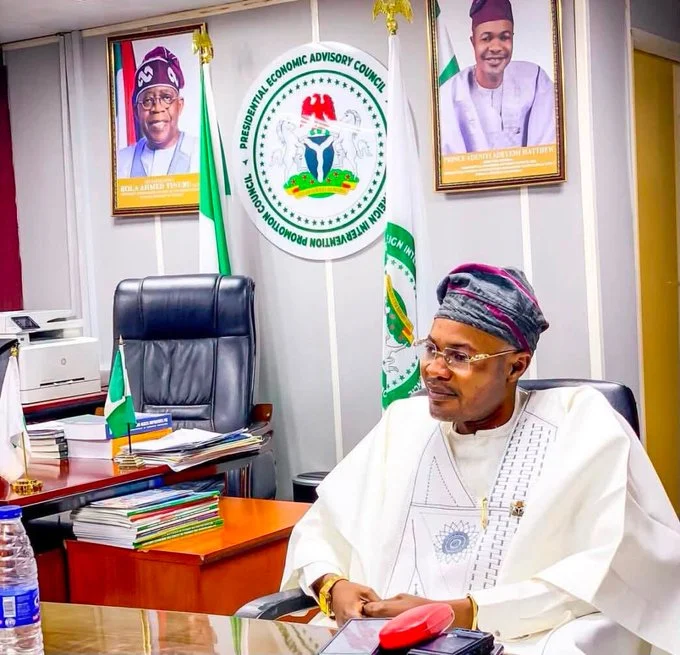
According to ABC News Australia, PFIPC appeared remarkably authentic. One of the most concerning issues in this embarrassing incident is that it reportedly had an office inside the Federal Secretariat, a website carrying government imagery and social-media platforms. Not to mention the funding and even approval to recruit more than 300 employees. This further revealed a huge lacuna in the government space, as its purported director-general, Adeniyi Adeyemi, reportedly interacted with senior government officials, regulators, ministers and foreign diplomats.
That is not what a simple roadside scam looks like. It is what happens when institutional verification mechanisms fail.
Even more revealing is the fact that the Nigerian Investment Promotion Council reportedly raised concerns in 2025 that PFIPC appeared to operate at “cross-purposes” with it. That point deserves particular attention.
If the Nigerian Investment Promotion Council, the legitimate government institution responsible for promoting investment, could reportedly identify an organisation operating in the same space, why did it take so long for the wider government system to shut it down?
That question goes straight to the heart of the problem. Nigeria does not merely have an agency-proliferation problem. It has a verification, coordination and accountability challenge.
And the latest discovery makes that problem even harder to dismiss. According to ICPC, the second allegedly fake institution was not merely operating somewhere outside government. It was allegedly given office accommodation inside the OSGF itself. Currently, it is said that three permanent secretaries have now been suspended. This, it was said, would enable the commission to investigate how the organisation gained access to government premises and what roles officials may have played.
The government deserves credit for acting decisively once these discoveries came to light. The President ordered an investigation into PFIPC. He has now ordered the arrest of the promoter of the second alleged fake agency and suspended three permanent secretaries.
But decisive action after discovery is not enough. By every ethical standard, the fact remains that good governance is not only about catching wrongdoing. For certainty, it is also about designing systems that make wrongdoing difficult in the first place.
And this is where the Tinubu administration should thoroughly face uncomfortable questions. Who authorises an agency to occupy Federal Government premises? Who verifies the legal instrument establishing such an institution? Who confirms that an alleged presidential appointment is genuine? Who checks whether a purported government agency already duplicates an existing institution? Who authorises recruitment? Who verifies websites, official seals, letterheads, budgetary allocations and bank accounts?
Who monitors the use of government office space? Who reconciles the list of legally established agencies with those physically operating inside government buildings? Also, if these controls existed and functioned effectively, how did two allegedly fictitious institutions get this far?
The ABC investigation makes the issue even more troubling. PFIPC reportedly had an office, funding, government-looking branding and access to officials, while its purported head moved through government circles for years.
The lesson is obvious, and this is to say that a government can have too many institutions and still have too little institutional control. That is the irony Nigeria must confront.
The Oronsaye Report was never simply about saving money by reducing the number of agencies. It was about making government coherent. When multiple institutions perform similar functions, accountability becomes blurred. When accountability becomes blurred, responsibility becomes difficult to establish. When responsibility becomes difficult to establish, institutional loopholes emerge. And when loopholes emerge, individuals can potentially exploit the appearance of government authority.
That is why the latest scandal should not become another isolated corruption story. It should become the beginning of a complete audit of Nigeria’s federal government architecture.
Every ministry, department, agency, commission, council, authority, special-purpose office and intervention structure should be subjected to a simple test: Who created you? Under what law or presidential instrument? What exactly is your mandate? Which ministry supervises you? Which agency performs a similar function? How much public money do you consume? How many people do you employ? What measurable results have you produced? Why must you exist as a separate institution?
If an institution cannot answer those questions convincingly, its continued existence should be questioned and not just shut down, but everyone behind this despicable act should be penalised. This is where the PFIPC scandal intersects directly with the Oronsaye Report.
The PFIPC is being investigated because the government says it was not a legitimate government institution. But legitimacy alone should not be the end of the conversation. An agency can be legally established and still be unnecessary. It can be legitimate and still be duplicative. It can have a statutory mandate and still be inefficient. It can have a board, offices and employees and still be consuming money that could be better deployed elsewhere.
That is the distinction Nigeria must now confront. The government should not wait until an agency becomes “fake” before asking whether it should exist. The more important question is whether it adds sufficient public value to justify its cost.
This is particularly important at a time when Nigerians are being asked to endure difficult economic reforms, higher taxes, increased living costs and reduced purchasing power in the name of rebuilding the economy.
It is difficult to persuade citizens that government is serious about fiscal discipline when the public sector continues to carry layers of institutions whose mandates overlap.
Every unnecessary agency has a cost. Every board has a cost. Every director-general has a cost. Every permanent office has a cost. Every official vehicle has a cost. Every administrative department has a cost. Every workshop, retreat, consultancy, travel programme and procurement structure has a cost. And ultimately, the Nigerian taxpayer pays for all of it.
The government’s response should therefore go beyond the PFIPC investigation. It should include a comprehensive implementation of the Oronsaye recommendations and a fresh institutional audit covering agencies created or expanded since the report was submitted.
The objective should not be indiscriminate job losses. It should be institutional consolidation. Where two agencies perform substantially similar functions, merge them. Where a function belongs naturally within a ministry, return it to the ministry. Where an agency has become obsolete, abolish it. Where a council merely duplicates the work of an existing agency, eliminate the duplication. Where presidential committees have become permanent bureaucracies, review their necessity.
And where new agencies are proposed, the government should first demonstrate that the existing machinery cannot perform the function.
Most importantly, Nigeria needs a single authoritative register of government institutions that is publicly accessible and continuously updated. No agency should be considered legitimate simply because it has an office, website, official-looking letterhead or people occupying government buildings.
Its legal foundation should be independently verifiable. Its leadership should be verifiable. Its funding should be traceable. Its mandate should be publicly available. And its relationship with existing institutions should be clear.
The PFIPC saga demonstrates what happens when these boundaries become non-transparent. The second alleged fake agency demonstrates that the problem may be wider than one individual.
The suspension of three permanent secretaries makes the issue even more serious because it suggests that the investigation must examine not only alleged outsiders but also internal government processes and possible official facilitation. ICPC has specifically said it is examining how the new entity obtained access to government premises and the roles played by officials. That is precisely where the investigation should go.
But it must go further. Nigeria should investigate not only who allowed fake agencies into government but also why the government has created an environment in which so many institutions perform overlapping functions in the first place.
There is a danger that the country will treat PFIPC and the National Brands Development and Made-in-Nigeria Special Project Office as isolated scandals.
That would miss the larger lesson. The scandal is not only that fake agencies existed. The scandal is that they reportedly looked sufficiently real to operate within the government ecosystem.
And if a fake institution can look real, the reverse question is equally important: How many real institutions have become functionally indistinguishable from one another? That is the unfinished business of Oronsaye.
Nigeria does not need more government structures. It needs a government structure that Nigerians can understand. It does not need more agencies simply because every new problem demands a new institution. It needs existing institutions to work.
The Tinubu administration therefore faces an important test of credibility. It can investigate PFIPC, arrest alleged perpetrators and suspend officials. That is necessary.
But it can also seize this moment to undertake the much harder task of cleaning up the entire architecture of government.
That means confronting agencies, commissions, councils and parastatals that have survived for years despite duplication, inefficiency or obsolete mandates.
No selective reform. No sacred cows. No politically convenient exemptions. If an alleged fake agency can be shut down because it lacks lawful authority, then every legitimate agency should be required to demonstrate why its continued existence is necessary.
If an institution duplicates another, explain why both are needed. If it cannot demonstrate value, merge it. If it has no compelling reason to remain independent, return its functions to the appropriate ministry. If its mandate has expired, abolish it.
Nigeria has spent too long creating institutions to solve problems while failing to reform the institutions it already has.
The PFIPC scandal and the discovery of another alleged fake agency inside the OSGF should therefore become more than a corruption investigation. They should become a governance wake-up call.
The question is no longer simply: How did fake agencies enter Nigeria’s government system? The more important question is: Why has Nigeria’s government system become so institutionally crowded, poorly coordinated and administratively porous that fake agencies can acquire the appearance of legitimacy?
The answer lies partly in the same problem identified by Oronsaye more than a decade ago: too many institutions, overlapping functions and insufficient institutional rationalisation.
Nigeria cannot afford to keep treating that problem as someone else’s responsibility.
If this administration truly wants to reduce the cost of governance, it should finish what Oronsaye started. Audit the agencies. Merge the duplicates. Abolish the redundant. Strengthen the necessary. Tighten the controls. Publish the evidence.
Because the ultimate scandal is not simply that a fake agency existed. It is that Nigeria’s system of government is apparently porous enough to make the fake look real. And that is a governance problem, not merely a fraud case.
Udunze, a journalist and PR professional, writes from Lagos via [email protected]