By Azuka Onwuka
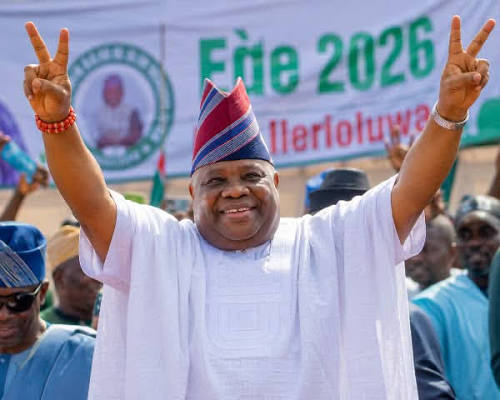
Over the weekend, Governor Ademola Adeleke won a second term as governor of Osun State in a contentious election. He polled 511,067 votes against 444,815 for the APC’s Bola Oyebamiji, winning 19 of the state’s 30 local government areas. INEC declared him the winner on Sunday, a little over 24 hours after polls closed on August 15. A stranger who saw or heard of the election figures may assume it was a simple case of an election and a result. But what happened before the election gave a serious cause for concern and further helped to dampen the spirits of Nigerians about the nature of democracy in Nigeria.
The result deserves attention because of the circumstances under which it emerged. Before and during the election, there were reports of attacks on party offices, clashes involving rival supporters, and arrests that opposition figures considered politically motivated. Some party members were reportedly injured, while several people lost their lives in election-related violence before the actual voting day. As usual, the top parties blamed each other as the aggressors.
Adeleke fought this election from outside the party that first brought him to power. He defected from the PDP to the smaller Accord Party, a platform that had never won a governorship in Osun before now. Running under an untested banner against the machinery of a ruling party was already a huge disadvantage. What made this contest remarkable is what happened alongside it.
Ten days before the actual day of voting, the EFCC placed a “Post No Debit” restriction on an Osun State Government account with FirstBank, the same account used to pay civil servants. Adeleke called it unconstitutional and politically timed. He noted that no court order backed the freeze. The EFCC said it was investigating suspicious fund movements tied to an earlier probe into ecology and intervention funds.
Whatever the merits of that investigation, the timing is hard to separate from the calendar. A state government’s payroll account does not usually get frozen by coincidence ten days before its governor faces voters. Adeleke later said President Bola Tinubu personally intervened to have the freeze reversed. But that raised other questions: If the president can unfreeze an account with a phone call, why did the freeze happen in the first place? Should the bank account of a state government be frozen without the knowledge of the President? Should the President intervene in the operations of a supposedly independent agency like the EFCC?
Then came the controversy involving Senator Francis Fadahunsi. In a video that circulated widely, the APC lawmaker representing Osun East was heard telling supporters, in Yoruba, that they should kill Accord Party members wherever they found them. The backlash was swift enough that police invited him for questioning. His media office issued a statement explaining that the comment was “purely political and metaphorical,” and merely urging voters to “kill Osun Accord with votes, not violence.”
In addition, Fadahunsi said his own community had suffered killings of APC members before his comment, which is a separate and serious claim in its own right. Political violence in Osun in the run-up to this election did not run in one direction only, and a fair accounting has to hold that. But a sitting senator telling a crowd to kill their political opponents, however the clarification is dressed up afterwards, is not language any democracy should shrug off. Words like that carry weight precisely because of the status of the person saying them, and walking them back after the video spreads is not the same as never saying them.
Furthermore, the Osun State Government, through Governor Adeleke, publicly said before the election that it had lost trust in the then Commissioner of Police, Ibrahim Gotan. The government accused him of bias, cited alleged raids on the homes of top state officials (including the Secretary to the State Government) without proper warrants, and formally demanded his redeployment.
Put those episodes next to each other, and you see a pattern. At the end of the day, Adeleke won. There is something to admire in that. A governor who defected to a small party, faced a frozen payroll account, and campaigned under the shadow of a death threat against his own supporters still convinced a majority of Osun voters to back him. That is a genuine achievement, and it belongs to the people who voted for him as much as to Adeleke himself.
But step back from Osun and look at the bigger picture, because this is not really a story about one state. Tinubu and the APC spent years in opposition insisting that Nigerian democracy needed to mature, that power should change hands peacefully, that institutions should serve the country rather than whichever party controls them. It is fair to ask what happened to that conviction once the APC became the ruling party in 2015. The APC does not need to win Osun to remain Nigeria’s ruling party. It already holds the numbers nationally and in most states. Chasing every remaining opposition stronghold by whatever means available is not the behaviour of a party confident in its mandate. It is the behaviour of a party that has decided winning matters more than how the win is achieved.
Many Nigerians fear that political competition is becoming less tolerant. Complaints about pressure on opposition figures, aggressive attempts to expand the dominance of the ruling party, and the use of federal institutions during politically sensitive periods have increased the people’s suspicion. Some individual accusations may be questionable, but the accumulation of such controversies influences public perception.
Perception deserves attention because democracy depends heavily on trust. Citizens don’t see what happens within institutions before decisions are taken. Therefore, they merely judge fairness through actions, inactions, results, and words. Once they start losing confidence in public institutions and policies, even when governments take legitimate positive actions, they find it hard to believe them.
This is why the outcome of the Osun election carries great significance. Before election day, many voters and those outside Osun State assumed that the result of the election was a fait accompli, based on the federal might that was witnessed and the fact that Adeleke was running under the banner of a small party. When the results produced a different outcome, they proved that public participation can still overcome widespread pessimism.
Nobody should underestimate the psychological effect of that. When citizens conclude that the winner of an election is predetermined and that voting is pointless, democracy weakens. It reduces participation, increases cynicism, and normalises political disengagement. Osun interrupted that dangerous pattern. The election made Nigerians remember that organised citizens can still influence political outcomes despite intimidating circumstances. Such reminders become important whenever public confidence drops.
Nigeria has now run 27 unbroken years of civilian rule, longer than any stretch since independence. Before then, the longest stretch of democracy Nigeria had had was five years and three months (October 1, 1960 to January 15, 1966). When we tried again in 1979, it lasted even shorter: four years and three months. The next attempt produced local government leaders, governors and legislators, but when it came to the president in 1993, the election was annulled, leading to a stillborn republic.
Therefore, 27 years of unbroken democracy is a huge achievement for Nigeria. That milestone should mean something is settling into place, that each election year should feel a little less violent and tension-soaked than the last. Instead, a lot of Nigerians watching Osun this month came away more frustrated than reassured, and the frustration is not really about who won. It is about the desperation, violence, threats, corruption, and tension that accompany every election.
A ruling party that is secure in its majority should be the last one reaching for these tactics. That it reached for them anyway, and still lost the state, says something about the strength of Osun voters’ resolve, which has reminded the country that voters still possess enormous power whenever they refuse to surrender that responsibility. It also says something less flattering about where the party in charge of Nigeria’s democracy currently sees its limits.
X: @BrandAzuka