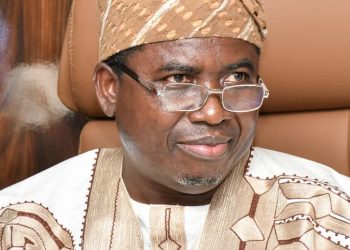
Nigeria’s 15th Chief Justice and most Senior Justice of the Supreme Court, Justice Walter Samuel Onnoghen has finally settled down at his duty post as the substantive Chief Justice following his confirmation by the Senate and subsequent inauguration by Acting President Yemi Osinbajo on March 7. Justice Onnoghen is from the Southern part of the country.
His inauguration on March 7 came 30 years after the highest judicial office of the Chief Justice of Nigeria (CJN) was occupied by another southerner, Justice Ayo Gabriel Irikefe. However, Justice Onnoghen who was also decorated by the Acting President with the national honour of the Grand Commander of Order of the Niger (GCON), as customary with the inauguration of CJNs, is assuming the position at a crucial time in the nation’s history.
His leadership of the third arm of government is coming at a time when many have lost confidence in the judiciary. It is obvious that the judiciary is on trial following a series of allegations of bribery and corruption dogging it, robbing it of confidence reposed in it.
Many of its judicial officers are facing corruption charges in different courts while others are being investigated on sundry allegations of corrupt practices.
There is no doubt that Justice Onnoghen assumed the leader-ship of the judiciary at a time public perception about its integrity is at the lowest ebb. The turbulence which eventually culminated in the arrest and subsequent trial of some of the judges, including two serving Justices of the Supreme Court, began in 2016. Today, the hope for the common man has been completely eroded; justice is now for the highest bidder.
This is the judiciary the 15th CJN is inheriting even though he is seen as part of the rot in the judiciary having been a Justice of the Supreme Court since 2005. It is on record that no fewer than 25 judges were on the radar of the anti-graft agencies before the retirement of his predecessor, Justice Mahmoud Mohammed, on November 10, 2016.
Apart from pervasive corruption that had held the judiciary by the jugular, cases of unhealthy delays in justice delivery system including high cost of litigation – which has equally made the courts more exclusive of the rich, demand urgent attention.
No doubt, all eyes are now set on Justice Onnoghen, who had while overseeing the judiciary in an acting capacity, exhibited a handful of hope-inspiring qualities.
Some of such actions included but were not limited to his directive to judges to fast-track hearing on pending high-profile corruption cases as well as his decision to award substantial punitive cost to be personally paid by lawyers who encourage their clients to file frivolous suits. With the seeming corruption in the judiciary, how far can the CJN go towards sanitising the system?
This is a major task before Justice Onnoghen. Although Onnoghen while unfolding some of his agenda for the judiciary assured that independence of judiciary would continue under his watch, there are many reasons the CJN must use his position to revive the judiciary and restore its lost glory.
Also, it is our expectation that the perceived problem of delay in justice delivery system should be tackled head on by ensuring that the National Judicial Council (NJC) live up to its constitutional duty not only in terms of discipline its officers but injecting fresh blood into the system.
It is of equally important for the CJN to ensure computerization of the Supreme Court to fast-track justice delivery system with a view to accelerating e-filing process in order to ensure an easy and efficient filing process of cases and individual profiles.
Justice Onnoghen, as a matter of fact, should commence a complete overhaul of the judiciary by rebuilding the sector from the scratch and completely reinvent the system.
His tenure must be seen as taking the judiciary to a threshing floor and shaking off the cabbages the system has gathered over the years. Notwithstanding its present image, it is time the CJN lifted it out of that mud and revive its pride of confidence.
We want the CJN to begin a new growth of ability which would make Nigerians to think of the judiciary as a credible institution and trustworthy – devoid of betrayal as our expectation is for him to show Nigerians that the judiciary is in for a major overhaul.
He must be ready to not only step on, but fearlessly crush those dirty big toes that have continued to stain the hallowed temple and reposition the NJC to become more vibrant at wielding the big stick against errant judicial officers.
This feat is no doubt attainable only if the CJN is ready to etch his name on the sands of time as this would not only strengthen and raise the hopes of people that something radical is about happening in the system but would end up building their trust once again.