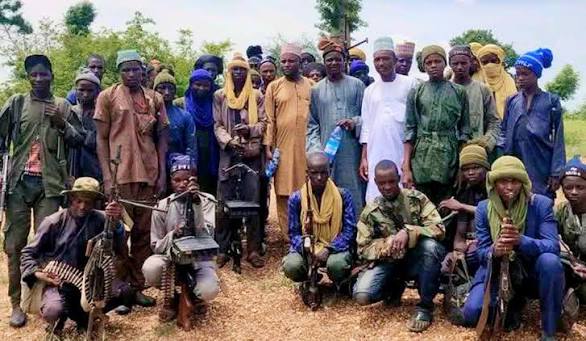
A new international report has cast a harsh spotlight on Nigeria’s worsening internal security crisis. Authored by the United States Commission on International Religious Freedom, the report estimates that about 30,000 armed Fulani militants are operating across the country. That is a frightening figure, equivalent to more than 30 fully equipped army battalions.
More disturbing is the fact that after years of massacres, mass displacement, and the destruction of entire communities, Nigeria still appears unable or unwilling to stop them.
According to the report, these outlaws operate in groups of up to 1,000 fighters and rank among the deadliest non-state actors responsible for religious freedom violations in the country.
Yet beyond the statistics lies a troubling question Nigeria has consistently refused to confront honestly: Why has this violence persisted for so long?
For years, the attacks have been framed as “farmer-herder clashes,” a phrase that suggests mutual aggression between two competing groups.
But the scale, organisation, sophistication, and recurring pattern of many of these assaults point to something far more sinister than disputes over grazing routes or retaliation for stolen cattle.
One of the deadliest atrocities in Plateau State’s history illustrates the point. In the early hours of March 7, 2010, between 2 a.m. and 3 a.m., residents of Dogon Nahawa and neighbouring villages south of Jos were asleep when armed Fulani militants descended on them.
By dawn, an estimated 500 people—mostly women, children, and the elderly—had been slaughtered in their homes or hacked down in surrounding bushes where they sought refuge.
Since then, similar massacres have occurred repeatedly across Nigeria’s Middle Belt, particularly in Plateau and Benue states.
Thousands have been killed. Entire communities have been uprooted. Vast stretches of once-thriving agricultural land have been emptied of their indigenous inhabitants, many of whom now endure the misery and indignity of overcrowded and under-resourced IDP camps.
The evidence increasingly suggests that these attacks are not merely about cattle.
Reports indicate that many communities attacked and abandoned by fleeing residents are subsequently occupied by others.
On New Year’s Day in 2018, Fulani herders massacred 72 people across three local government areas of Benue State.
An AI search assessment estimates that more than 50 villages across Plateau State—particularly in Bokkos, Barkin Ladi, Riyom, Bassa, and Mangu LGAs—have reportedly been renamed and settled by Fulani herders after their original inhabitants were driven away.
Whether every such claim can be independently verified is beside the point. What remains indisputable is that large numbers of communities have been emptied, while many displaced residents have never returned to their ancestral lands.
Equally striking is the absence of reports of Fulani settlements being similarly seized and occupied by others.
Benue State provides another grim illustration.
Between late February and early March 2016, more than 500 people were reportedly killed in Agatu. Former Senate President David Mark said about 7,000 people were displaced during the attacks.
On April 24, 2018, suspected Fulani militia attacked St. Ignatius Catholic Church in Ayar-Mbalom, Gwer East LGA of Benue State, killing at least 19 worshippers and two priests.
The massacre reinforced fears that some of these assaults target communities not only for where they live, but also for who they are.
Footage even showed the attackers wearing the robes of their victims.
Just weeks earlier, on March 4, 2018, suspected Fulani militias reportedly killed 26 people in Omusu, Okpokwu LGA of the state.
The consequence of repeatedly failing to halt these cycles of violence—and of the near-total absence of arrests and successful prosecutions—has been impunity.
When perpetrators face no consequences, violence becomes self-perpetuating.
Amnesty International reported in 2025 that more than 200 villages in Benue State had been attacked and sacked by gunmen, displacing at least 450,000 people. The worst-hit LGAs include Ukum, Logo, Katsina-Ala, Gwer West, Gwer East, Apa, Agatu, Kwande, and Guma.
The economic consequences are equally staggering. Estimates suggest that Nigeria loses between $13 billion and $14 billion annually to violence linked to attacks on farming communities. The losses stem from destroyed crops, abandoned farmlands, damaged property, disrupted livelihoods, and massive internal displacement.
Yet successive governments have failed to address the root causes of the crisis. Security agencies often appear reactive rather than preventive. Arrests are rare. Convictions are rarer still.
Open grazing must be confronted honestly. Modern livestock production across the world is based on ranching, not endless migration across farmlands and communities.
Benue State enacted an anti-open grazing law in 2017. Several southern states followed suit. Sadly, enforcement has been inconsistent, weak, and frequently politicised. As a result, the laws have largely failed to achieve their intended objectives.
Nigeria must move decisively toward ranching. Cattle ownership is a profitable business, and those who profit from it should invest in modern methods of animal husbandry rather than perpetuating a primitive, unsustainable, and effectively zero-cost model.
No private business enterprise should be allowed to impose such a devastating human and economic burden on the rest of society.
More fundamentally, Nigeria must demonstrate that no group is above the law. Communities cannot continue to be attacked, emptied, and occupied without consequences. Citizens cannot be expected to surrender ancestral lands through violence, fear, and intimidation while the state looks the other way.
The USCIRF report should serve as a wake-up call. Nigeria is bleeding, not from a natural disaster, but from a prolonged failure of governance, security, and justice.
Security forces must protect vulnerable communities. Perpetrators must be arrested and prosecuted. Anti-open grazing laws must be enforced. Ranching must become the norm.
The country cannot continue to normalise mass killings, displacement, and land seizures as unfortunate headlines in the news cycle.
The bleeding must be stanched before more communities disappear from the map, and more Nigerians lose faith in the state’s ability to protect them.