By Paul C Nwabuikwu
Many Nigerians celebrated the failure of former minister of power Bayo Adelabu, the Band A Minister, to clinch the APC governorship nomination in Oyo State with the glee of children screaming “up NEPA!” after months of sweaty darkness. A friend remarked that it was the best news to come out of the country’s endless and underachieving power reform programme in years. The comment was a bit harsh but also understandable given the context. Like food rotting in the fridge during power blackouts, decades of epileptic power supply have soured the minds of many Nigerians against public officials promised much and delivered little.
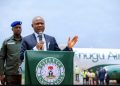
Things had looked much brighter for Adelabu when he decided to seek greener political pastures after almost three years in office. The pudgy, gregarious scion of the Penkelemesi political dynasty had left for Ibadan with fanfare after resigning as minister. He had departed in a blaze of glory, heralded by supporters and sycophants, to seek his party’s nomination to serve the good people of Oyo State as governor after two unsuccessful previous attempts.
His success seemed like a foregone conclusion. Many believed he would be third time lucky. He was a largely unknown quantity outside Oyo during his first two efforts. But this time he was more prepared, more visible, more confident. With federal might on his side, the backing of many big wigs and the intimidating profile and resources conferred on him by “Abuja”, the governorship was in the bag.
But the forecasts turned out to be too optimistic. Adelabu’s prospects before the primaries turned out to be wildly overstated. His loss was described as “crushing” by more than one commentator. Senator Sharafadeen Alli got 578,143 of the votes cast. Senator Abdulfatai Omotayo Buhari was a distant second with 32,265 votes. Only 19,193 delegates entrusted their votes to Adelabu who lost to Alli by a staggering 558,950 votes. It was, electorally speaking, the equivalent of massacring one person.
Many explanations have been offered for Adelabu’s abysmal performance. But perhaps the best summary is that Alli had done the hard work and captured the party structure while Adelabu was being hailed as “Incoming governor” and “Your Excellency” by contractors and sycophants in Abuja. He is not the first candidate to learn the hard lesson that Abuja money and profile cannot do the necessary magic if a home boy with deep pockets has already secured the support of critical party operatives and charmed the hearts of the locals who have enjoyed many bowls of Amala with him. There is a simply psychological explanation for this. People tend to trust people they know, not those who parachute in with promises at the last minute. Beyond money, this factor also explains the success of charismatic corrupt and incompetent local politicians over better qualified fresh politicians with “plenty grammar”.
The theory that Adelabu’s political progress was halted by the curses of Nigerians is a rather dubious one. If curses were that effective, we would have cursed our way to a better country. But to the helpless victims of an uncaring system, the idea that their anger is more powerful than the National Grid which collapsed about two dozen times while Adelabu was power minister is understandably an attractive one.
The rejoicing over the former minister’s loss, in all honesty, was a bit unfair. Adelabu did not invent Nigeria’s power problems. Power cuts have been a depressing constant for many decades, crippling the productivity of businesses and making life a misery for families. From available evidence, Adelabu was determined to make a difference when he arrived. And he made many promises to show he was serious about turning things around. He declared that within six months, Nigerians would start seeing significant improvement in power supply. He assured that under his watch, the collapse of the grid would gradually become a thing of the past. He pledged to electrify industrial clusters and agricultural hubs.
But his biggest promise was that supply would hit 6,000 megawatts, a feat that he later claimed that he achieved in his resignation letter but which Daily Trust said in a special investigation did not happen. According to the paper: “While generation approached the 6,000MW mark, it did not surpass it based on verified industry records…. Average generation capacity rose to 4,922MW in Q4 2023 shortly after Adelabu assumed office from 4211.44MW in Q3, 2023. It dropped to 4,249MW in Q1 2024, recovered to around 5,296MW by Q4 2024 and then about 5,430MW in Q3 2025 before declining to approximately 4,089MW by March 2026.” In other words, nearly cannot kill a bird.
But the legacy that will haunt Adelabu and define his tenure is the multi-band payment policy which many Nigerians consider a wickedly designed initiative that has worsened the crisis of public trust in government and left consumers with bigger bills and less than the advertised value.
The plan sounded like a great idea: move energy pricing from blanket subsidy pricing to a new structure, a hierarchical model (bands A to E) in which big men and big women consumers (and rich firms and factories) will be rewarded with extra hours and charged a higher price per unit for the privilege. According to the official communication, the objective was “to increase revenue for Discos, enable them to strengthen their networks, provide more power to high-paying customers, and ultimately improve power reliability nationwide.”
The road to hell – and frustration – is paved with good (official) intentions. Incentives that were supposed to sweeten the deal for higher paying customers have largely not materialized. For instance, DISCOs have largely ignored the requirement that they cannot charge Band A customers in Abuja, Lagos and other cities N209.50 per unit if they don’t meet 20 hours per day target. The policy also states that “if a DisCo misses the committed service level for a Band A feeder (distribution line) for seven consecutive days, the feeder is automatically downgraded.” That requirement, to a quote a popular pidgin expression, “don enter voice mail”. Those in charge of the system have not kept their end of the bargain and the Band A customers, the only customers paying non-subsidized bills have suffered the most. I should know. I’m a victim.
But unlike Adelabu’s gubernatorial aspirations, there is a light at the end of the tunnel for Band A victims. And the light is powered by solar energy which has become the new refuge for unhappy high net-worth consumers who can afford to squeeze out a few extra millions to purchase any of the numerous solar packages peddled across the country. The number of Nigerians who are frantically reducing their dependence on the grid is increasing daily and the trickle may soon become a flood. It’s the ultimate vote of no confidence on the system left behind by Adelabu and his predecessors. There was an interesting social media story recently about a customer in Lagos who was penalized by the local DISCO for the crime of sabotaging the DISCO’s revenue projections by investing in solar energy! Embarrassed by the report, the DISCO quickly apologized and promised to make amends. But the incident is more evidence that the future is solar and Band A victims are the warriors who are fighting hardest to achieve that future. Adelabu will deserve a huge part of the credit when it happens – even if that wasn’t his intention.
Nwabuikwu is a member of THISDAY Editorial Board