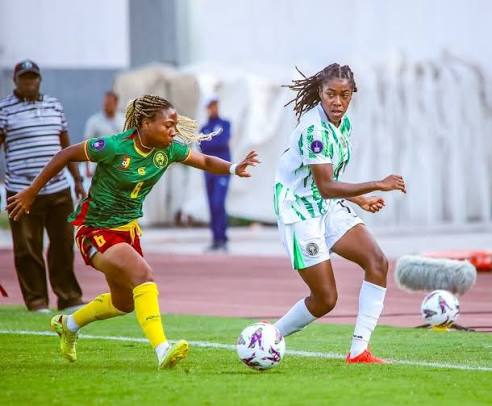
Cameroon secured a place in the semi-finals of the 2026 Women’s Africa Cup of Nations after defeating defending champions Nigeria 1-0 in their quarter-final clash in Casablanca on Sunday.
Myriam Maéva Nyadjou Wamen scored in the 19th minute to give the Indomitable Lionesses the lead at the Larbi Zaouli Stadium.
Nigeria dominated much of the latter stages of the first half and continued to press for an equaliser after the restart but were unable to break through Cameroon’s defence.
Cameroon goalkeeper also made a crucial save from close range in the second half to deny the Super Falcons an equaliser.
The defeat ended Nigeria’s title defence and denied the defending champions a place in the semi-finals.
The result also means Nigeria will not secure the automatic qualification ticket for the 2027 FIFA Women’s World Cup in Brazil that is reserved for the four WAFCON semi-finalists.
Nigeria had entered the quarter-final as defending champions and had dominated their previous meetings with Cameroon at the WAFCON, including a 1-0 quarter-final victory in 2022.
The Super Falcons had also reached the knockout stages at every centralised edition of the competition and were seeking a record-extending 10th appearance at the Women’s World Cup.
Cameroon will advance to the semi-finals, where they will face Morocco, who defeated South Africa 2-1 in their quarter-final.
Meanwhile, Super Falcons’ 1-0 quarter-final defeat to Cameroon does not completely end their hopes of qualifying for the 2027 FIFA Women’s World Cup.
However, the four losing quarter-finalists, including Nigeria, still have another opportunity to remain in the qualification race, according to FIFA.
Here is how Nigeria can still qualify:
1. Nigeria must win the African play-off
Following their defeat to Cameroon, the Super Falcons will join the other three WAFCON quarter-final losers in an African play-off for the two places allocated to Africa at the FIFA Women’s World Cup Play-Off Tournament.
Nigeria must win its play-off match to secure one of those spots and keep its 2027 World Cup qualification hopes alive.
The remaining WAFCON quarter-final result will determine the teams that join Nigeria in the play-off race.
2. Nigeria must then negotiate the intercontinental play-off
The two African teams emerging from the play-offs will join eight other nations from the remaining FIFA confederations in the World Cup Play-Off Tournament.
According to FIFA, the tournament will feature 10 teams: two each from Africa, Asia, Concacaf and South America, alongside one representative each from Oceania and Europe.
3. The Falcons must win their play-off pathway
The intercontinental tournament will be played in two phases, with the first phase scheduled for November and December 2026 and the final phase set for February 2027.
FIFA explained the format, saying, “The six teams will be drawn into three paths, with a direct knockout match to determine the final three teams qualifying for the FIFA Women’s World Cup 2027. Teams from the same confederation will not be permitted to be drawn in the same pathway.”
Nigeria would therefore need to win its assigned knockout pathway to secure a place at the 2027 World Cup.
The new qualification format gives Africa more opportunities to reach the expanded 32-team Women’s World Cup.
Brazil will host the 2027 tournament, while the competition has been expanded to 32 teams.
Africa has four direct places through the WAFCON semi-finals, while two additional African teams will get another chance through the intercontinental play-off tournament.
For the Super Falcons, the defeat to Cameroon has therefore complicated their route to Brazil but has not ended it.
Nigeria must now regroup, successfully negotiate the African play-off and then win its pathway at the intercontinental tournament to book a place at the 2027 FIFA Women’s World Cup.