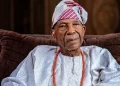
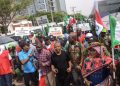
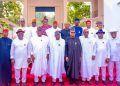
Recently Col. Abubakar Umar Dangiwa (retd) warned the Federal Government not to use military option in quelling militancy in the Niger Delta.
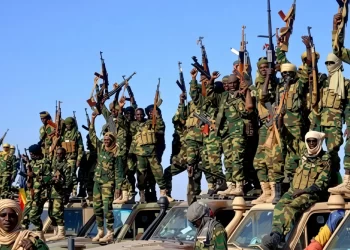
The intervention of the former military governor of Kaduna State is not only timely but necessary at a time the government is seriously considering resorting to the use of force in dealing with the militants who have been responsible for destroying oil and gas installations and facilities in the Niger Delta with its attendant consequences for the Nigerian economy. President Muhammadu Buhari had said he would treat the militants like Boko Haram, the terrorist group that had held the country, specifically the North East, to ransom in as many years.
The president first made this assertion in April in a meeting with the Nigerian community during his visit to China where he said that saboteurs and those who destroy oil and gas installations in the Niger Delta region would be treated like Boko Haram should they persist in their sabotage.
Buhari among other things said: “…Whoever is caught will not be spared. The government is still being dared, but those who are sensible should have learned a lesson. Those who are mad, let them continue in their madness. I am aware that in the last two weeks, the national grid collapsed a number of times.
I hope this message will reach the vandals and saboteurs who are blowing up pipelines and installations. We will deal with them the way we dealt with Boko Haram.”
Just last month Buhari reiterated his threat while holding talks with Japanese Prime Minister Shinzo Abe during the sixth Tokyo International Conference on African Development in Nairobi, Kenya. Obviously, this was an attempt to send reassurances to the international community, especially foreign investors, that their investments in Nigeria would be secure. He also used the opportunity to assure his audience of security in the Gulf of Guinea, which is a hotbed of piracy and gun running.
To further accentuate the threat of the military option, the army also re-echoed the president’s tough stance on the issue of the militancy in Niger Delta. “The military will employ all available means and measures within its rule of engagement to crush any individual or group that engages in the destruction of strategic assets and facilities of the government in the Niger Delta or any other location and they will stand to regret the consequences of their actions.
The whole world has seen what they are causing in terms of economic terrorism against the nation and would be treated as criminals in line with the laws of the land.” These are weighty statements of intent not to be taken lightly. So, it is against this backdrop that the intervention of Umar, a respected former military officer, is timely.
That a former officer like the president is the one making the call for dialogue and negotiation is crucial. Umar knows what is at stake and is in a position to counsel the president whose frustration at the incessant sabotage of pipelines and installations can be understood. An all-out military action will only exacerbate an already volatile situation.
The terrain where the militants operate in the creeks is so treacherous that it will be difficult if not outright impossible to engage them. If the military uses air bombardments, at some point during the engagement they will have to involve ground troops and that is where the danger lies. At any rate, would air bombardments discriminate between the militants and innocent civilians?
The collateral damage will be colossal. One which the government should be seriously bothered about. We also note that equating the militants with Boko Haram is a contentious issue. The militants are not terrorists properly so called, so talking about treating them like Boko Haram should not even arise.
There are issues of justice, equity among others at play. Their lands have been devastated and degraded after many years of oil exploration without a corresponding increase in their living conditions.
Therefore, it is easy to conclude that government is only interested in ‘pacifying’ the restive Niger Deltants only to the extent that, that action will allow it to continue carrying out its economic activity of oil exploration. So like Umar noted, objective Nigerians and the international community are not likely to support the use of military option in crushing militancy in the Delta.
His clincher is that the creeks of the Niger Delta are saturated with oil and that the deployment of heavy explosive materials there will lead to a massive conflagration comparable to Dante’s allegorical inferno. So, we aver that the best and only option is to dialogue and negotiate with the militants.
Although there will be those among them who may be recalcitrant, continuing government effort in this regard will ultimately yield the desired result. We implore President Buhari to continue to explore all peaceful means to resolve the Niger Delta crisis as difficult as this may be.