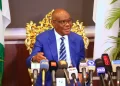
The House of Representatives says it traced 58 bank accounts and 39 workers to the alleged fake Director-General of the Presidential Foreign Intervention Promotion Council (PFIPC).
The House ad hoc committee investigating the council disclosed this on Wednesday during its sitting, saying preliminary financial information showed that more than 30 of the accounts were apparently operated in the names of about nine agencies, companies, foundations or related entities.
The committee, chaired by Yusuf Gagdi, said the accounts were linked through Bank Verification Number and other identifying details associated with Prince Adeniyi Adeyemi, who was presented as Director-General of the purported organisation and was also referred to in some records as Adeyemi Matthew.
It, however, cautioned that it had not concluded that every identified account, entity or transaction was unlawful, saying it was still reconciling registration records, account mandates, beneficial ownership information, signatories and transaction histories.
The discovery formed part of wider findings presented by the committee following the House resolution of July 8, 2026, which mandated it to investigate the circumstances surrounding the inclusion of the PFIPC in the Federal Budget Framework.
The committee said the investigation had uncovered evidence suggesting that the purported organisation was not established by any law or valid government instrument, despite its efforts to present itself as a federal institution.
According to the lawmakers, about 39 persons were paraded or represented as employees of the organisation across junior, intermediate and senior cadres.
The committee said it was investigating how the workers were recruited, the appointment letters and identity cards issued to them, salaries and allowances allegedly paid, as well as claims that some people were required to pay money as a condition for securing employment.
It said it would distinguish between persons who may have been deceived into believing that the organisation was genuine and those who knowingly participated in or benefited from its activities.
The committee’s findings indicated that the alleged network extended beyond the PFIPC, with more than 12 entities identified as being directly or indirectly associated with Adeyemi.
Among those listed were the Confederation of United Nations Youths, FCT Investment Promotion Agency and Public-Private Partnership, FCT Investment Promotion Council and Public-Private Partnership, Foreign Investment Promotion Agency, United Nations Youth Global Agency, United Nations Youth Global Foundation, World United Nations Youth Global Foundation, World Entrepreneurship University Limited, World Enterprise University Limited, FCT Investment Promotion Act, FCT Promotion Agency and Olubadan of Ibadan Foundation.
The similarities in their names, objectives, management structures, signatories and bank-account relationships, the committee said, had raised concerns that multiple organisations may have been created or deployed using government, international, investment, educational, charitable or United Nations-related identities.
It said investigators were determining whether the entities were used to create artificial credibility, solicit funds, obtain investments, secure government recognition and facilities or induce members of the public to part with money.
The lawmakers also said a company had alleged that Adeyemi induced it to pay about N400 million in four instalments after representing that it would receive a contract involving the renovation, furnishing or improvement of a residence purportedly allocated to him as Director-General.
The company allegedly told the committee that its representatives were taken to a residential property in Abuja and informed that it was the purported official residence.
The committee said it was tracing the payments, identifying account holders and beneficial owners, and verifying the ownership and status of the property.
It said the allegations, if established through competent investigative and judicial processes, could disclose offences including fraudulent misrepresentation, obtaining money by false pretence, impersonation, conspiracy and forgery.
Beyond the financial trail, the committee said it found no valid Act of the National Assembly, gazetted enactment, Presidential Executive Order, administrative instrument or other lawful authority establishing the PFIPC.
It said no competent federal authority produced an authentic record showing that the organisation was created, approved or authorised.
The committee also found that documents used to project the organisation as a government institution contained substantial evidence of fabrication, forgery, mutilation and impersonation.
One of the documents examined was a purported presidential appointment letter for Adeyemi as Director-General, allegedly signed by the Chief of Staff to the President, Femi Gbajabiamila.
But the State House, according to the committee, confirmed that no such appointment was made or approved by the Presidency and that Gbajabiamila neither issued nor signed the letter.
The purported letterhead was also found not to be an authentic State House letterhead, while its reference number, format, language and administrative features were said to be inconsistent with official correspondence.
The committee similarly found that a purported approval for the take-off of an entity described as the Presidential Economic Advisory Council did not emanate from the Presidency, State House or any competent federal authority.
It also examined a document described as Presidential Executive Order No. 5 of February 24, 2026, but said evidence indicated that it was not an authentic Executive Order and was neither issued nor approved through lawful presidential processes.
Another document presented as an Act of the National Assembly establishing the organisation was also found not to have been enacted by Parliament, passed by both chambers, assented to by the President or gazetted.
The committee said portions of a document relating to another institution appeared to have been electronically altered, mutilated or substituted to create the impression that the National Assembly had enacted legislation establishing the purported organisation.
The investigation further uncovered a letter dated November 7, 2024, purportedly sent by the State House to the Office of the Accountant-General of the Federation seeking an administrative code for the PFIPC.
The letter allegedly bore the name of Akambi Adewale, described as a director in a purported State House directorate.
The State House, however, told the committee that the office and directorate did not exist in the form represented and that no officer known as Akambi Adewale served in the stated capacity.