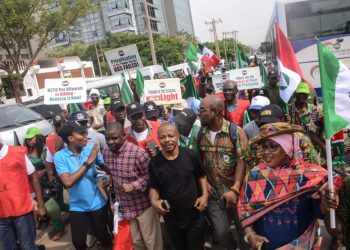
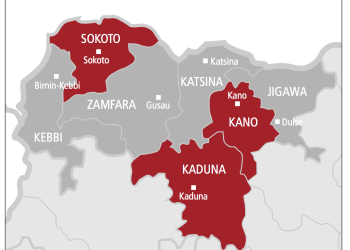
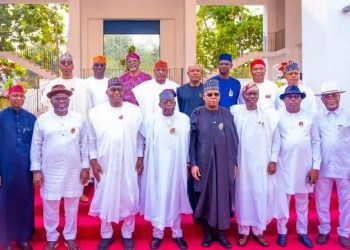
After the lightning and thunder which marked the recent clash between the Nigerian Labour Congress (NLC) and the Kaduna State Government, it is commendable that both sides have bowed to the pressure following the mediation of the Federal Government.
The Kaduna State Government would now do the first things first before it disengages workers it no longer needs their services. NLC members on their part have accepted that an employer who has the power to hire also retains the power to fire. The principles behind these accepted methods of doing these things ought not require the mediation of the Federal Ministry of Labour & Employment before they should have occurred to both sides.
The Kaduna State Governor, Nasir El-Rafai, is a man who has made a name for himself for his tendency to apply logic and common sense to his actions even when they are manifestly self-serving. The NLC often acts as if it is the conscience of the masses even when we know that it is as self-serving as other vested interests because it is indeed a vested interest. In the United States, labour is assumed to be not holier than any of the other disreputable lobbying groups with dark money, campaign funding for their favourite legislators and other candidates. And when the NLC warning strike reached fever pitch, both sides exhibited the usual arrogance of power which often reveals power abuse and rights violations and spotty observance of due process.
The word “strike” has since lost its meaning in Nigeria. In other lands, any day a worker is on strike is a day he or she doesn’t get paid by his or her employer. In other words, NLC members would already have made a mental note that their paycheck for this month would be short of the four days they were on strike. It is part of the unnatural work culture in Nigeria for workers to get paid while they are on strike. In other lands, ‘no work no pay’ is not a slogan. It is a principle of life and existence. To sustain a long strike, a labour union has to do detailed planning to take care of its members and their families for the duration. It was thus not shocking that Libya’s late leader, Col. Muammar Gadhafi, clandestinely spent millions of pounds funding the British labour strikes of the 1970s. It is for this reason that strikes are declared only after elaborate arrangements to ascertain the true wishes of the workers who would have to vote publicly to leave no one in doubt and to remove the appearance of coercion or undue influence. But our lackadaisical if not unethical culture of doing things makes us dispense with these necessary safeguards, which explains why the Academic Staff Union of Universities (ASUU) could behave the way it does and go on strike for years without consequences, ripping apart the nation’s university calendar and frustrating students and pushing their parents to look elsewhere for their children’s education.
As for Gov el-Rufai and the NLC, all’s well that ends well. NLC chieftains apparently are no more declared wanted for crimes of economic sabotage and may still be admitted to Kaduna State. The governor’s anxiety about spending all the state’s resources in paying the salaries and pensions of civil servants is entirely justified. The civil service is a part, albeit, a small part of the state. Labour’s argument that the cost of governance should be trimmed must be appreciated as valid. If the state government could reduce its number of overpaid special assistants and expensive advisers, to say nothing of consultants, only then would the dismissal of public service employees be contemplated.
The argument is sound that the most important function of the government is the provision of infrastructure and the enabling environment to mobilise individual citizens to use their innate abilities and talents to thrive. This is why most advanced economies tend to emphasise smaller bureaucracies, leaner government staff, and adequate provision of human services — health, education, training, utilities — which tend to facilitate the life and activities of ordinary citizens. Of all the unsavoury tales connected with the Kaduna warning strike is the allegation that the Kaduna State Government hired hoodlums to disrupt the protests of the labour people.
We very much think that this is not the case, and that el-Rufai should prove that he has no hand in that sordid act by instituting an investigation to unmask all those who took part in that violent act. Unless that is done, the suspicion could linger that the government has taken the low road of lawlessness to protect itself, which must be condemned because it remains an indelible stain on Gov el-Rufai’s records.