Scientists have validated more local plant as antidotes to snake venoms.
Top on the list are: African locust bean (Parkia biglobosa); Cashew (Anacardium occidentale); Neem tree (Azadirachta indica); Mango (Mangifera indica); Indian Tamarind (Tamarindus indica); English wild custard apple (Annona senegalensis), Velvet bean or Cowhage (Mucuna pruriens), Turmeric (Curcuma longa), Plantain (Musa paradiasica).
Until now, snakebite poisoning remains a public health hazard in tropical countries. Viper snakes are among the most common types of venomous snakes, which are responsible for many envenoming and deaths in most tropical areas.
Several studies have shown that the risk of snakebite to people in the rural region of tropical countries, where most people engage in agricultural, pastoral, and other outdoor livelihoods, is moderate to high.
In Nigeria, the Fulani herdsmen are more at risk because of their agro-pastoralist lifestyle. Their village settlement positions make it more difficult for them to assess antiserum, the only treatment available for snakebite.
But the usage of snake venom antisera has its own drawbacks. Due to its high cost and lack of availability of antisera makes it difficult for the rural patients to access. Further, due to its storage difficulty and short expiry, its use is restricted.
Snake venom antiserum or AVS has administration problem, the exact dosage is also a current problem. AVS administration is often associated with hypersensitivity reactions (early and late), which need further medical attention.
There are various medicinal plants, which have been used in folk and traditional medicines against snakebites especially among the Fulani herdsmen of Northern Nigeria. But till date no such drugs are available in the market, which possess anti snake venom activity.
African locust been (Parkia biglobosa)
A study published in the journal Toxicon and titled “The anti-snake venom activities of Parkia biglobosa (Mimosaceae) stem bark extract” noted: “Snake bites in rural Nigeria are commonly treated with plant extracts. We have studied the ability of one such traditionally used plant (Parkia biglobosa, Mimosaceae) to reduce the effects of two snake venoms (Naja nigricollis, and Echis ocellatus) in several experimental models. A water-methanol extract of P. biglobosa stem bark significantly protected the chick biventer cervicis (cbc) muscle preparation from N. nigricollis venom-induced inhibition of neurally evoked twitches when it was added to the bath three-five minutes before or after the venom.
“The extract also reduced the loss of responses to acetylcholine (Ach), carbachol and potassium chloride (KCl), which are normally blocked by N. nigricollis venom, and significantly reduced the contractures of the preparation induced by venom. P. biglobosa extract (75, 150 and 300 microg/ml) significantly protected C2C12 murine muscle cells in culture against the cytotoxic effects of N. nigricollis and E. ocellatus venoms. The extract protected egg embryos exposed to lethal concentrations of E. ocellatus venom for more than 12 hour and completely blocked the haemorrhagic activity of the venom at concentrations of five and 10 microg/1.5 microl. P. biglobosa extract (400 mg/kg) did not protect mice injected i.p. with 5 and 2.5 mg/kg of E. ocellatus and N. nigricollis venoms, respectively. It, however, protected 40 per cent of the mice from death caused by E. ocellatus venom after the extract and venom were pre-incubated for 30 minutes before injecting the mixture.”
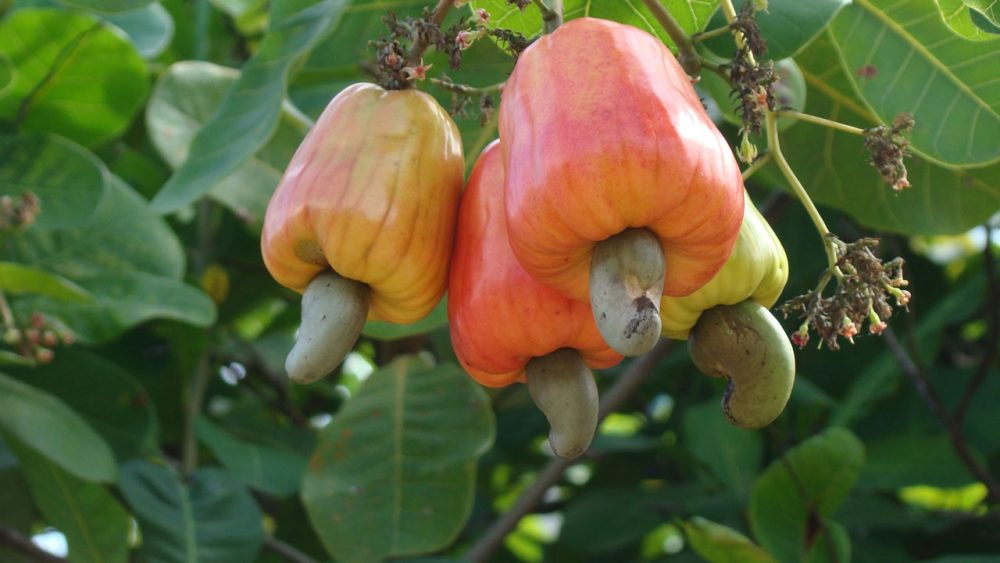
Cashew tree (Anacardium occidentale)
Also, scientists have demonstrated the anti-ophidian properties of Anacardium occidentale bark extract. The study published in the journal Immunopharmacology and Immunotoxicology demonstrated the ability of Anacardium occidentale bark extract to neutralise enzymatic as well as pharmacological effects induced by Vipera russelii venom.
According to the study, the extract neutralised the viper venom hydrolytic enzymes such as phospholipase, protease, and hyaluronidase in a dose dependent manner. These enzymes are responsible for both local effects of envenomation such as local tissue damage, inflammation and myonecrosis, and systemic effects including dysfunction of vital organs and alteration in the coagulation components.
The researchers concluded: “In addition, extract neutralised the pharmacological effects such as edema, hemorrhage, and myotoxic effects including lethality, induced by venom. Since, it inhibits both hydrolytic enzymes and pharmacological effects; it may be used as an alternative treatment to serum therapy and, in addition, as a rich source of potential inhibitors of hydrolytic enzymes involved in several physio-pathological diseases.”
Neem tree (Azadirachta indica)
Scientists have also demonstrated the inhibition of snake venom enzymes and anti-venom adjuvant effects of Azadirachta indica leaf extracts.
The study published in European Journal of Medicinal Plants evaluated the inhibitory effect of Azadirachta indica leaf extracts on Naja nigricollis Reinhardt venom enzymes and screens for their antivenom adjuvant effects. A. indica leaf was collected, authenticated and extracted using 95 per cent methanol followed by fractionation using hexane and ethyl acetate. The venom enzymes inhibition assays was evaluated using in vitro methods, while, adjuvant effect was screened using Albino rats.
The results revealed that both the hexane and the ethyl acetate fractions showed capability of inhibiting the venom enzymes significantly when compared with the venom controls in varying degrees of efficacies. For the adjuvant effect, no significant effect of the venom at the administered dose was observed on bleeding time, clotting time, defibrinogenating and haemorrhagic effects compared to the normal control. However, the size of necrotic lesion and the percentage haemolysis were significantly higher in the venom control rats. Both the hexane and the ethyl acetate fractions significantly mitigated these effects in the treated animals. The degree of protection was about three folds more than when the antivenin was used alone.
The researchers concluded: “Finally, these findings would be of importance in the area of drug development with a view to actualizing the substitution or enhancing the effect of conventional snakebite therapeutic options.”
Indian tamarind (Tamarindus indica)
Another study published in the journal Phytotherapy Research demonstrated the anti-snake venom properties of Tamarindus indica seed extract.
The study evaluated the effect of Tamarindus indica seed extract on the pharmacological as well as the enzymatic effects induced by V. russelli venom. Tamarind seed extract inhibited the PLA, protease, hyaluronidase, l-amino acid oxidase and 5’-nucleotidase enzyme activities of venom in a dose-dependent manner. These are the major hydrolytic enzymes responsible for the early effects of envenomation, such as local tissue damage, inflammation and hypotension.
According to the study, furthermore, the extract neutralised the degradation of the Bbeta chain of human fibrinogen and indirect hemolysis caused by venom. It was also observed that the extract exerted a moderate effect on the clotting time, prolonging it only to a small extent. Edema, hemorrhage and myotoxic effects including lethality, induced by venom were neutralised significantly when different doses of the extract were pre-incubated with venom before the assays. On the other hand, animals that received extract 10 minutes after the injection of venom were protected from venom induced toxicity.
The researchers concluded: “Since it inhibits hydrolytic enzymes and pharmacological effects, it may be used as an alternative treatment to serum therapy and, in addition, as a rich source of potential inhibitors of PLA, metalloproteinases, serine proteases, hyaluronidases and five cent-nucleotidases, the enzymes involved in several physiopathological human and animal diseases.”
Mango (Mangifera indica)
Scientists have also demonstrated the anti-venom potential of aqueous extract of stem bark of Mangifera indica against Daboia russellii (Russell’s viper) venom.
The study was published Indian Journal of Biochemistry and Biophysics.
Mangifera indica has been used against snakebite by traditional healers. However, there is paucity of scientific data in support. In this study, the scientists evaluated the anti-venom potential of aqueous extract of stem bark of M. indica against D. russellii venom-induced pharmacological effects such as life myotoxicity, edema, LD50 etc. The extract inhibited the phospholipase, protease, hyaluronidase, 5’nucleotidase, ATPase and alkaline phosphomonoesterase activities with varying IC50 values. It significantly inhibited both metalloproteases and serine proteases activities.
Further, the extract significantly reduced the myotoxicity of the venom, as evident by the reduction of serum creatin kinase and lactate dehydrogenase activities. Though the extract completely inhibited in vitro PLA2 activity, it was unable to completely inhibit in situ hemolytic and in vivo edema-inducing activities, usually brought about by PLA2s. In lethality studies, co-injection of the venom pre-incubated with the extract showed higher protection than the independent injection of venom, followed by the extract in the mice. However, in both the cases the extract -a cocktail of inhibitors significantly increased the survival time, when compared to that of mice injected (i.p) with the venom alone.
These results encourage further studies on the potential use of cocktail of inhibitors in improving the treatment of snake envenomation. Further, this study substantiates the use of M. indica as an antidote against snakebite by the traditional healers.
Wild custard apple (Annona senegalensis)
Commonly called English wild custard apple, Annona senegalensis belongs to the plant family Annonaceae.
In Nigeria, it is called umm boro in Arabic-Shuwa; ewura in Berom; boili in Fula-Fulfulde; ououd on Goemai; kmijirihi in Gwari; gwándàr daájiì and tàllàfà màraàyú in Hausa; uwu in Idoma; ukpokpo in Igala; uburu-ọcha in Ibo; ngónówù in Kanuri; oguoto in Yekhee; àbo and arere in Yoruba.
A recent study has scientifically validated the folklore use of Annona senegalensis in the treatment of snakebite by farmers and herdsmen in Northern Nigeria.
The researchers from Department of Biochemistry, Faculty of Science, University of Maiduguri, Borno State, found that the root extract of Annona senegalensis possesses potent snake venom neutralising capacity and may provide protection against the toxicity posed by the Bitisarietans venom and could be used for therapeutic purposes in case of snakebite.
The study titled “Effects of aqueous root extract of Annona senegalensis on Bitisarietans venom protease and phospholipase A2 activities” was published in the Journal of Pharmacology and Biomedical Sciences.
Another study published in the Journal Ethnopharmacology has demonstrated the effect of Annona senegalensis root bark extracts on Naja nigricotlis nigricotlis venom in rats.
The researchers noted: “The potency of the methanol extract of the root bark of the plant was tested against cobra (Naja nigricotlis nigricotlis Wetch) venom in rats. The extract was also tested on brine shrimp (Artemia saline Leach).
The activity of the extract against the venom induced mortality, occurrence of toxic signs, activity on liver enzymes as well as its ability to reverse experimentally induced increase in body temperature were evaluated.
“Results indicated that the extract caused reduction in the induced hyperthermia and directly detoxified the snake venom used by 16-33 per cent. It, however, failed to restore the biochemical functions (sGOT and sGPT) of the liver. The extract exhibited an LC(50) of 232.7 microg/ml in the brine shrimp test.”
According to The Useful Plants of West Tropical Africa, volume 1, “A bark infusion forms a mouth-wash to relieve toothache, and in the Zambesi region root-bark is used as an antidote to snakebite. Leafy twigs and bark are used by Fula of Senegal against sterility. They also consider the bark to be a galactogogue (induce breast milk production) for both humans and animals.
“The roots are sold in Hausa markets in Northern Nigeria and are used in the treatment of venereal diseases, the patient feeding for five or six days on a pap made by boiling the root with guinea-corn meal and native natron.”
Natron is a natural mixture of sodium carbonate decahydrate (a kind of soda ash) and about 17 per cent sodium bicarbonate (also called nahcolite or baking soda) along with small amounts of household salt (halite, sodium chloride) and sodium sulfate. Natron is white or without color when it is pure.

Velvet bean (Mucuna pruriens)
Botanically called Velvet bean or Cowhage, Mucuna pruriens belongs to the plant family Fabaceae. In Nigeria, it is called Agbala or Agbaloko in Ibo and Werepe in Yoruba.
Recent studies have found that Mucuna pruriens leaves are more effective than the standard drug, anti-venin, for curing snakebite.
The study published in the International Journal of Biochemistry Research & Review is titled “Anti-venom Activity of Mucuna pruriens Leaves Extract Against Cobra Snake (Naja hannah) Venom.”
The researchers from Bingham University Nassarawa and Federal Polytechnic, Nasarawa State, investigated the anti-venom activity of Mucuna pruriens leaves extract against cobra snake (Naja hannah) venom.
The mice were randomly grouped into six groups (A, B, C, D, E, and F) of five rats each. Group A served as the normal control (no induction), and the mice in the group were given normal saline (1ml/kg/body weight).
Turmeric (Cucuma longa)
Researchers in a study published in the journal Toxicon have demonstrated the antivenom and biological effects of ar-turmerone isolated from Curcuma longa.
They concluded: “A potent antivenom against snakebite was isolated from Curcuma longa, a plant commonly used in traditional Brazilian medicine. The fraction consisting of ar-turmerone neutralised both the hemorrhagic activity present in Bothrops jararaca venom, and the lethal effect of Crotalus durissus terrificus venom in mice. Immunological studies demonstrated that this fraction also inhibited the proliferation and the natural killer activity of human lymphocytes.”

Plantain (Musa parasidiaca)
Another study published in the Journal of Ethnopharmacology has demonstrated the neutralising properties of Musa paradisiaca juice on phospholipase A2, myotoxic, hemorrhagic and lethal activities of crotalidae venoms.
The study examined the interaction of Musa paradisiaca extract (MsE) with snake venom proteins. Phospholipase A2 (PLA2), myotoxic and hemorrhagic activities, including lethality in mice, induced by crotalidae venoms were significantly inhibited when different amounts of MsE were mixed with these venoms before assays. On the other hand, mice that received MsE and venoms without previous mixture or by separated routes were not protected against venom toxicity. Partial chemical characterization of MsE showed the presence of polyphenols and tannins and they are known to non-specifically inactivate proteins.
The researchers concluded: “We suggest that these compounds can be responsible for the in vitro inhibition of the toxic effects of snake venoms. In conclusion, according to our results, using mice as experimental model, MsE does not show protection against the toxic effects of snake venoms in vivo, but if was very effective when the experiments were done in vitro.” – Guardian.