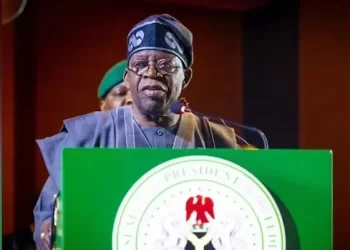
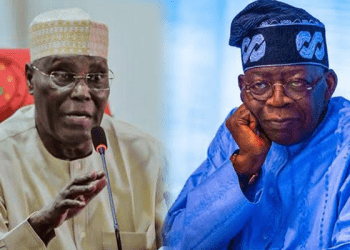
President Bola Tinubu, the Independent National Electoral Commission (INEC) and the All Progressives Congress (APC), yesterday, told the Supreme Court why it should not admit as evidence Tinubu’s certificate that was released to the candidate of Peoples Democratic Party (PDP), Alhaji Atiku Abubakar, by the Chicago State University (CSU).
According to them, Atiku did not meet the requisite condition precedent to enable the apex court to admit the documents in evidence.
They spoke before the seven-man panel of the Supreme Court, led by Justice Inyang Okoro, which reserved its judgment on the appeals filed by Atiku Abubakar; and the Labour Party (LP) presidential candidate, Mr. Peter Obi, to nullify Tinubu’s election after all the parties adopted their briefs of argument.
Other members of the apex court panel that heard the matter were Justices Uwani Abba-Aji, Lawal Garba, Ibrahim Saulawa, Adamu Jauro, Abubakar Tijjani and Emmanuel Agim.
This happened on a day the Allied Peoples Movement (APM) withdrew its appeal against Tinubu, following the panel’s dismissal of the case as frivolous.
Atiku and Obi are challenging INEC’s declaration that Tinubu of the APC was the valid winner of the February 25 presidential election.
They are praying the apex court to set aside the September 6 judgment of the Presidential Election Petition Court (PEPC), which dismissed their petitions that the election was rigged in favour of the ruling party.
Aside from challenging President Tinubu’s eligibility to participate in the contest, both Atiku, who came second and Obi, who came third, maintained that Tinubu did not secure the majority of valid votes cast during the election to be declared the winner.
Obi and the LP, through their team of lawyers, led by Dr. Livy Uzoukwu, SAN, urged the court to uphold their appeal and set aside the judgment of the PEPC.
Obi, in his 51 grounds of appeal, maintained that the PEPC panel erred in law and thereby reached a wrong conclusion when it dismissed his petition.
He said that the panel wrongly evaluated the proof of evidence he adduced before it and occasioned a grave miscarriage of justice when it held that he did not specify polling units where irregularities occurred during the election and the figures of votes or scores that were allegedly suppressed or inflated in favour of President Tinubu and the APC.
He insisted that the PEPC overlooked evidence that established that President Tinubu was previously indicted and fined the sum of $460, 000 in the USA over his involvement in a drug related case.
“Imposition of a fine is not limited to a criminal conviction, as the word, in law, includes a civil forfeiture,” Obi further argued in his appeal and urged the court to overturn Tinubu’s victory.
Atiku urged the apex court to admit fresh evidence he obtained from the CSU, which he said would establish that President Tinubu tendered a forged certificate to the INEC, in aid of his qualification to participate in the election.
His lead counsel, Chief Chris Uche, SAN, noted that though the 32-page document, released on the orders of Judge Nancy Maldonado of the District Court of Illinois, Eastern Division, Illinois, US, and handed over to his client on October 2, was not pleaded, he urged the court to admit it in evidence, in the interest of justice.
Uche, SAN, stressed that the issue surrounding the certificate that Tinubu purportedly obtained from the CSU, was weighty, saying there is need for the apex court to focus on doing substantial justice in the matter, instead of rejecting the evidence on the altar of technicalities.
However, a member of the apex court panel, Justice Emmanuel Agim, drew the attention of Atiku’s lawyer to the fact that depositions that accompanied the fresh evidence he sought to tender, were made in the chambers of a private legal practitioner in the US and not in the court.
“I expected the school to write, disclaiming the documents. Does the stenographer have the legal authority to administer oath?
“We are dealing with a matter that touches on the national interest of this country,” Justice Agim noted.
Responding, Atiku’s counsel said the legal system in the US is different from that of the English legal system practiced in Nigeria.
He admitted that though the depositions were made in the law chambers of Atiku’s American lawyer, he said the choice of the venue was based on the agreement of the parties, with approval of the court.
Uche added that Tinubu, who was duly represented by his lawyers, did not raise any objection about where the depositions were made.
He argued that such depositions were usually more effective than letters from the CSU authorities regarding the authenticity of Tinubu’s academic records.
At this juncture, head of the panel, Justice Okoro, noted that there are two conflicting letters from the CSU — one authenticating Tinubu’s certificate and the other, discrediting it.
“Now, which of them should the court rely on?” Justice Okoro queried.
Uche, SAN, explained that it was due to the discrepancy in the certificate that Tinubu claimed to have obtained from the school and the one that was released to one Michael Enahoro-Ebah, who testified as a witness before the PEPC, that his client decided to approach the CSU for clarification.
Tinubu, addressing the court during the proceedings, through his team of lawyers, led by Chief Wole Olanipekun, SAN, argued that the foreign depositions that Atiku relied on to apply for the certificate to be admitted in evidence, were done in a private law chamber in the United States of America, USA.
His words: “In the USA, we have their rules, these depositions are not even admissible in their own courts! We have highlighted those rules in our counter affidavit. My lords, this is aside from the fact that the depositions were not done in the court, but in private chambers.”
More so, Olanipekun argued that the 180 days period allowed for the hearing of the petition that Atiku and his party filed to nullify the outcome of the 2023 presidential election, had since elapsed.
He said it would, therefore, be wrong for the apex court to admit a fresh evidence at the stage of appeal, adding that Atiku ought to have joined the Independent National Electoral Commission, INEC, as an interested party in the US proceedings.
“The Court of Appeal is a tribunal. The First Schedule to the Electoral Act 2022 as well as section 285 (13) of the 1999 Constitution, as amended, is very clear.
“They merely went on a fishing expedition in the US. The evidence they are seeking to tender is not at large. It cannot be compartmentalized in any way.
“Even Alice in Wonderland knew where she was going. At least she was told where she was going. My Lords, this is an application that we believe is in Wonderland. It has no merit. The courts are bound by the law. The law is to be interpreted as it is and not as it ought to be,” Tinubu’s lawyer argued.
Also, INEC, through its lawyer, Mr. Abubakar Mahmoud, SAN, urged the court to reject Atiku’s plea to be allowed to tender the CSU certificate, insisting that the time allowed for hearing of the petition had expired. Counsel to the APC, Mr. Akinola Olujimi, SAN, argued that Atiku’s application lacked merit and ought to be dismissed.
He contended that the requirement of the law was that there must be an order of a court in Nigeria before the CSU could be approached to release the certificate.
“Order 20 Rules 6 and 7 of FHC Rules, made provision for obtaining of depositions from foreign jurisdictions.
“They omitted that very fundamental step,” Olujimi, SAN, argued.
Counsel to Atiku and the PDP, Chief Chris Uche, SAN, argued that the apex court, as the custodian of the Constitution, should overlook technicalities and do justice in the matter by admitting the fresh evidence.
He maintained that the fact that the 180 days had elapsed should not tie the hands of the court.
Earlier, Justice Okoro had stressed that the case was of great public importance.
However, he wondered if the evidence Atiku was seeking to tender before the court was not geared towards establishing an allegation that has elements of crime.
Justice Okoro noted that there were contradictory documents relating to the said CSU certificate. “This is a criminal offence which ought to be resolved beyond reasonable doubt.
So when you see this kind of discrepancy, I don’t know how we can resolve it.
“This is a serious matter. It is not admitting the document that is difficult, but after that, what do we do with it?
“Are we going to draft a charge and ask someone, did you forge these documents? That notwithstanding, we are here to do justice and there is no room to cover anything,” Justice Okoro added. The panel, thereafter, reserved its judgment till a date to be communicated to the parties. – Vanguard.