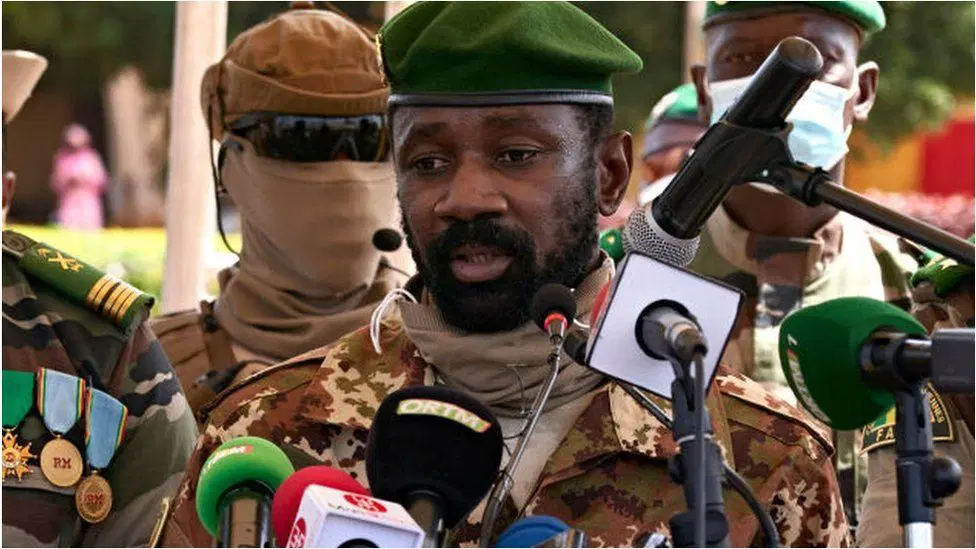
Mali’s military government on Tuesday dissolved the West African country’s political parties, according to a presidency decree, the latest attempt to clamp down on the opposition since the junta seized power.
Opposition parties have feared the move for weeks, banding together into a hundred-party coalition to demonstrate in a rare act of open defiance since back-to-back coups in 2020 and 2021 brought the army to power.
Hours after junta chief General Assimi Goita approved the suspension of a political party’s charter, a step on the road to dissolution, the authorities announced the dissolution of “political parties and political organisations”.
Read out on national television, the decree likewise bans “all meetings of members of political parties and organisations of a political character”.
Yet junta officials working for the Malian state’s political and administrative institutions “may pursue their mission without having to identify themselves as representatives of political parties”, the decree added.
The latest act of repression comes on the recommendation of a national assembly organised in late April, which was all but boycotted by the opposition.
Besides the suspension of the political parties’ charter approved by Goita earlier on Tuesday, which allowed for the parties’ dissolution, the April assembly also proposed handing the junta chief a five-year renewable presidential term without a vote.
Since the coups, a welter of retaliatory measures, legal proceedings and the dissolution of a swathe of associations have considerably weakened the Malian opposition.
Citing the risk of disturbances to public order, the junta had already suspended all political party activities on May 7, a ban which drew fire from the opposition and calls for repeal from UN experts.
That squeeze on civic space comes against a backdrop of demands by the authorities for the country to unite behind the military, which had originally committed to hand power back to civilians by March 2024 but has since reneged on that promise.
Since 2012, Mali has been mired in violence carried out by jihadist groups affiliated with Al-Qaeda and the Islamic State group, as well as other criminal organisations.
Fearing dissolution, a coalition of roughly 100 parties recently formed to demand an end to junta rule by December 2025, calling for “the establishment of a timetable for a rapid return to constitutional order”.
In a rare act of protest against the junta, the movement drew several hundred people for a demonstration in the capital, Bamako, in early May.
However, Malian Director General of Territorial Administration Abdou Salam Diepkile disagreed.
“The repeal of this law does not call into question the existence of political parties,” Diepkile told public broadcaster ORTM.
He said the decision was in line with the desire to “stop the proliferation of political parties” in the country.
Some Malians seem to agree with him, as many went onto the street recently to declare their support for the government’s actions.
Former justice minister Mamadou Ismaila Konate described the dissolution as an attempt to “systematically demolish political countervailing powers” in Mali.
Human rights organisations and UN experts have criticised the junta’s increasing restrictions on political activity, warning that the suppression of opposition parties could further destabilise Mali, which has been grappling with jihadist violence and political turmoil since 20122.
Some media practitioners in Mali who spoke to Daily Trust in separate interviews said the atmosphere was tense.
The journalists who wouldn’t want their names in print for fear of attack said the regime was planning to stifle all opposition to its hold on power.
“The news broke just two hours ago. For the moment, there has been no reaction from political parties or politicians. Now we can say that we are officially in a dictatorship,” one of them said.
The junta had suspended French television channel TV5 Monde for a reportage on the May 3 demonstration, which the authorities argued “lacked a commitment to impartiality”, according to a ruling from Mali’s communications regulator.
TV5 Monde has previously fallen foul of the junta, which suspended the channel for three months last year.
Other media from former colonial power France, including France 24 and Radio France Internationale, have been banned permanently. – Agency report.