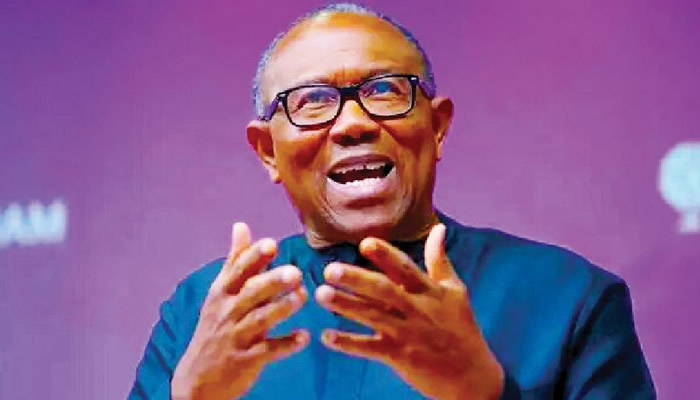
The National Democratic Party (NDC) presidential candidate, Peter Obi, has criticised the Federal Government’s handling of the education sector, arguing that the failure of the policy separating junior and senior secondary schools reflects years of poor funding and weak leadership rather than flaws in the policy itself.
Obi stated this on X on Friday while reacting to the Federal Government’s decision to phase out the policy after acknowledging that it had failed to improve learning outcomes.
“The Federal Government has finally admitted to its poor management of the education sector. Recently, the Minister of Education acknowledged that the policy separating junior and senior secondary schools has failed to improve educational outcomes. This is evident in recent examination results,” Obi wrote.
Citing examination statistics, he noted that only 38.32 per cent of candidates passed both English Language and Mathematics in the 2024 West African Senior School Certificate Examination, while about 32 per cent passed the computer-based WASSCE in 2025.
According to him, the persistent poor performance underscores a deeper crisis in Nigeria’s education system.
“This admission is tragic because education is the most vital contributor to human capital development, which forms the foundation for growth and economic development of any society. We cannot overcome economic stagnation without prioritising education, healthcare and job creation to lift millions of unemployed youths out of poverty,” he said.
Obi argued that Nigeria’s investment in education remains inadequate, pointing out that the sector received ₦3.52tn in the 2026 budget, representing only 6.17 per cent of total expenditure, below UNESCO’s recommended benchmark of 15 to 20 per cent.
“This low allocation indicates a failure to recognise education as a driver of sustained economic growth,” he stated.
The former Anambra State governor also lamented reports that Nigeria failed to sponsor students to international science competitions because of inadequate funding.
“It is heartbreaking that the government can sponsor hundreds to irrelevant international conferences yet fail to support its brightest students on the world stage,” he said.
Obi maintained that the education crisis was not caused by the structure separating junior and senior secondary schools but by the government’s inability to properly implement and finance the system.
“The Minister’s admission reflects a broader failure of public leadership. The issue is not the JSS/SSS policy itself, but the lack of commitment to properly fund, manage, and deliver quality education,” he said.
Highlighting his record in Anambra State, Obi said his administration transformed education through sustained investment in infrastructure and technology.
“In Anambra State, we proved that committed leadership can transform educational outcomes. Through effective funding, oversight, provision of laptops, generators, internet connectivity, and other learning aids, we turned the sector around.
“Our effort in providing computers across all secondary schools, both public and private, was recognised by HP Africa, which declared that Anambra had procured the largest number of laptops for school children of any subnational government in Africa,” he added.
He urged the government to prioritise investment in education, healthcare and job creation, warning that neglecting those sectors would have long-term consequences.
“As I have always said, failing to do the right things is equivalent to abusing society, and the society we abuse today will take its revenge on us and our children tomorrow. A New Nigeria is POssible,” Obi said.
His comments come after the Minister of Education, Dr Tunji Alausa, announced that the Federal Government would phase out the policy separating Junior Secondary Schools from Senior Secondary Schools after data showed that more than 20 million pupils dropped out before reaching the senior secondary level.
The minister said the policy had failed to achieve its objectives, citing the imbalance between about 80,000 public primary schools and only about 15,000 junior secondary schools nationwide, which has contributed to overcrowding in JSS facilities and high dropout rates.