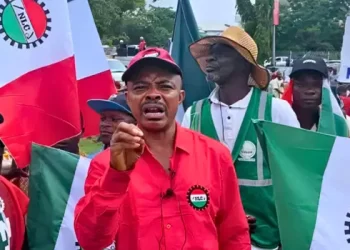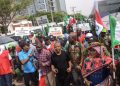
Nigerians on Tuesday staged a protest in Abuja, calling on the Federal Government and security agencies to take urgent steps to address the worsening insecurity across the country.
The protesters, operating under the banner “Nigerians Unite Against Terror,” marched peacefully from the Federal Ministry of Women Affairs to the National Assembly, carrying placards and chanting solidarity songs as they demanded stronger action against banditry, terrorism and kidnapping.
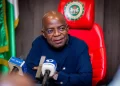
Addressing journalists at the National Assembly complex, the convener of the protest, Isah Abubakar, stated that bandits do not care about party or faith.
“There are major highways where, after 5 p.m., people are afraid to travel. Those who are trapped, kidnapped, or killed are not just members of APC, PDP or any other party — they are Nigerians,” he said.
Abubakar stressed that the government’s first duty is to protect its people, but that lasting security will require everyone’s involvement.
“We have a right and a duty to demand accountability from those charged with our safety. We need real, proactive measures to protect our children, keep women safe in their homes and farms, and reclaim our rural communities from criminals.
“The citizens who are trapped, kidnapped or killed on these roads are not just members of one political party or another; they are Nigerians. The bandits do not care about your religion, tribe, political party or background. This is a collective tragedy affecting us all,” he added.
He called on service chiefs and lawmakers to act with urgency and sincerity, and urged citizens to join with the government in restoring peace and security across the country.
Another protest leader, Austin Okai, urged retired military officers and former heads of security agencies to contribute their expertise toward addressing the country’s security challenges.
“We are calling on our former military and security leaders to step forward and collaborate. We must secure the country first before we can talk about politics,” Okai said.
He warned that continued insecurity could undermine democratic activities and political participation across the country.
“No political party can successfully hold a rally or mobilise voters if the people they are gathering cannot return to their homes safely,” he said.
According to him, supporters of different political tendencies must unite in confronting insecurity because the threat affects everyone.
Okai cited the recent abduction of a political party chairman in Kebbi State as evidence that no group is immune from the activities of criminal gangs.
He also called on the National Assembly to strengthen its oversight role by ensuring accountability in the management of security funds.
“The National Assembly has a constitutional mandate to demand strict accountability. That is the essence of democratic checks and balances,” he stated.
While advocating reforms in the security sector, Okai cautioned against establishing state police and forest guard structures without adequate training, equipment and funding.
“The only leverage these bandits have over our communities is their weaponry. If we create state police or forest guards but fail to train and arm them properly, we are sending them to their deaths,” he said.
He stressed that any plan to decentralise policing must be accompanied by modern equipment, professional training and effective collaboration with federal security agencies.
“If we are going to establish state police and forest guards, there must be rigorous training, standardised modern weaponry and seamless synergy with federal security agencies,” Okai added.
The protest ended peacefully after representatives of the National Assembly received a petition from the demonstrators and assured them that their concerns would be presented to the leadership of both chambers for consideration.