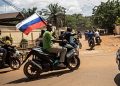
Demonstrations are subject to authorisation in Senegal, with authorities refusing to give the green light for many opposition rallies in recent years.
Unauthorised protests often descend into violent clashes. Security forces repressed demonstrations which took place on Friday.
Throssell said at least three young men were killed and 266 people, including journalists, were reportedly arrested across the country.
The Aar Sunu Election (Let’s protect our election) collective, which includes some 40 civil, religious and professional groups, had called for a peaceful rally in the capital Dakar on Tuesday at 1500 GMT.
But one of the organisers, Elymane Haby Kane, told AFP he had received an official letter from local authorities in Dakar saying the march was banned as it could seriously disrupt traffic.
“We will postpone the march because we want to remain within the law,” said Malick Diop, coordinator of the Aar Sunu Election collective.
Authorities on Tuesday also suspended mobile internet access for the second time this month, with the communications ministry citing “the dissemination on social networks of several subversive hate messages that have already provoked violent demonstrations”.
Access to mobile data had already been restricted eight days earlier when parliament backed Sall’s decision to postpone the election. It was later restored on Wednesday.
The decision to cut access was a repeat of a move last June when Senegal’s government restricted mobile internet amid high tensions.
The measure has become a common response to curb mobilisation and communication via social networks and is strongly condemned by rights activists.
Sall said he postponed the election because of disputes over the disqualification of potential candidates and over fears of a return to unrest seen in 2021 and 2023.
Parliament backed Sall’s suspension of the election until December 15, but only after security forces stormed parliament and removed some opposition lawmakers who opposed the bill.
The vote paved the way for Sall — whose second term was due to expire in April — to remain in office until his successor is installed, probably in 2025.
Senegal’s opposition has decried the move as a “constitutional coup” and suspects it is part of a plan by the presidential camp who feared defeat at the ballot box.
It has denounced the delay as a move to extend Sall’s term in office, despite him reiterating that he would not stand again.
The United States and the European Union have called on the government to restore the original election timetable.
Sall, who has been in power since 2012, is now seeking a way out of the turmoil.
Media reports have raised the possibility of dialogue with the opposition, including anti-establishment firebrand Ousmane Sonko, who fought the state for more than two years before being imprisoned last year.
Some have suggested the possibility of an amnesty for Sonko, his imprisoned second-in-command Bassirou Diomaye Faye and for people detained during unrest in 2021 and 2023.
The government has not commented on the reports.
Sall has said he wants to begin a process of “appeasement and reconciliation”.
But the rhetorical olive branch raises a host of questions, including whether it will be accepted by the likes of Sonko and Faye and what it means for their fate. – AFP.