By Kola Ibrahim
The Buhari government claimed to have embarked on expansionary budgets, despite adverse economic conditions, as a way of spurring development and economic growth. Indeed, between 2015 and 2018, the government’s actually-implemented budget size was N23.38 trillion. But these budget sums should be situated within the existing economic situations.
At N306 to a dollar, the value of the budgets (both the approved and actual) are actually less than presented. For instance, the 2016, 2017 and 2018 actually-implemented budgets of N5.36 trillion, N6.46 trillion and N6.8 trillion respectively translate to $17.6 billion, $21.2 billion and $22.3 billion in dollar term, compared to $21 billion (at N197/$1) spent in 2014. This means that the actual budgetary spending in 2014 in dollar terms was more than what was spent in 2016 and 2017 years of ‘expansionary’ budgets and almost at par with what was spent in 2018.
When we even factor inflation – which grew from 9 percent in May 2015 to 17.55 percent in 2016, 15.37 percent in 2017 and 11.35 percent in May 2019 – into the equation, then it will be glaring that the actual values of Buhari government’s supposed expansionary budgets were actually lower than those of previous government. This does not imply that the Jonathan government’s budgets actually benefitted majority of the population; indeed a significant percentage of the funds found their ways into private pockets of politicians and big business people with uncompleted budgets littering the country. But this reality put a big question mark on the sincerity of the Buhari government towards development. This means, for example, that the so-called capital votes are really less than the 2014 vote.
Currently, in dollar terms, the Buhari government has borrowed $35 billion – N 10.68 trillion (about 65 percent increase since 2015) as at first quarter 2019, with the government paying as much as $18.9 billion (N5.806 trillion) for debt servicing between 2015 and 2018, an amount that is more than the total capital spending, more than 80 percent of total deficit, and more than half of what the government borrowed, all within the same period. In fact, the total spending on debt servicing is far more than the combined budgets for education, healthcare and water resources within this period (2015-2019). This means that the federal government is either borrowing to pay interests on debts (service debt) or paying more interests than spending on development. In the 2017 fiscal year, the government spent N1.8 trillion to service debts while it spent N1.5 trillion for capital votes i.e. debt servicing was more than capital votes by over N300 billion.
The Buhari government, rather than stop this drift to the abyss, has rather worsened it with its unparalleled appetite for debts. Currently the debt servicing to total implemented budget is around 40 percent, which poses problem for the country in the short or long term. The government is of course basing its borrowing appetite on a more elusive debt to GDP ratio, which is more virtual than debt-to-budget or debt servicing-to-budget.
It is true that austerity, as an economic term, involves cutting government’s spending, especially budgets, as a way of reducing or eliminating deficits. This is usually carried ot during economic downturn like recession, or when government’s debts or public debts are unsustainable, and government has to offset the debts, or reduce public capacity to borrow, or assume private debts and force austere living on the majority. In any case, austerity will mean attack on the working people and the poor, who have no buffer or absorber for economic shocks. This is why underfunding of social services (and their commercialization or privatization), higher taxes for the poor, high unemployment and exploitation of the working people (through salary cuts, attacks on pensions, casualization, etc.) usually accompany austerity policies. On the other hand, the rich and capitalist class (or investors), use the opportunity to recoup lost profits through greater exploitation of working class, and exploiting government’s austerity to take more from public till.
However, that the Buhari government is not implementing a shrinking budget or austere budget nominally does not mean that instruments of austerity are not being deplored. It does not also mean that the expansionary budgets have benefited the working people. What we have seen is the government implementing some form of austerity programmes for the poor as reflected in hike in fuel prices, electricity tariffs, school fees across the country, currency devaluation, stagnated salaries, and now through hike in VAT, and other sundry levies and taxes; not to mention the planned increase in fuel price.
While it is true that there have been nominal increases in budgets for education and healthcare, this, as noted above, does not necessarily reflect real increase when devaluation and inflation are factored in. But a closer look at the implemented budgets shows that there has been lower allocations to education and healthcare between 2016 and 2018, than pre-Buhari era. For instance, capital vote for education utilized in 2011, 2012, 2013 and 2014 were N28.5 billion (55%), N47.6 billion (86%), N36.2 billion (50%) and N20.7 billion (40%) respectively. On the other hand, the utilized capital votes for 2015, 2016, 2017 and 2018 were N13.1 billion (56%), N20.8 billion (59%), N31.6 billion (55%) and less than 45% respectively. This means that in nominal value, real value and percentile implementation, capital education spending was worse off under Buhari than previous period.
While the recurrent expenditures increased under Buhari government, this is lower, as percentage of total budgets and when inflation and devaluation are factored in, than under Jonathan/PDP government. Between 2011 and 2014, the average budget to education was 10.4 percent, but between 2015 and 2018, under Buhari government, the average was 9.0 percent. And worse still, percentage implementation, while poor under PDP and APC, was worse under APC.
In fact, in real value, education and health budgets have shrunk as noted earlier. Moreover, most of the capital spending have not resulted in any significant improvement in facilities across educational institutions. According to Punch newspaper editorial (3/5/2019), between 2016 and 2019, a meagre N475.3 billion was allocated to the 21 federal teaching hospitals, an average of N22.6 billion for each hospital for the three years (or N7.5 billion per year for each hospital).
According to the editorial, only N8 million is allocated to the OAUTH as monthly statutory running cost, while the teaching hospital spends N13 million on monthly electricity bill and N5 million to buy diesel. UNNTH, which was allocated N5.5 million monthly allocation, spends N18 million on electricity. This means that health services will have to be commercialized the more in these health institutions, or quality of health service delivery will fall. This is already happening, as health service fees have increased in these institutions while two children wards on OAUTH have been closed down.
While government claimed to wanting to build or rebuild 10, 000 primary health institutions, which ordinarily should lead to massive employment of medical doctors and health workers, the former health minister, Isaac Adewole was recently quoted to have asked medical graduates to go into farming, while labour minister public stated that Nigeria had adequate number of doctors, even when doctor to citizens ratio is around 1:6400 as against WHO recommended 1:600. This is one of the signs that the government is paying lip service to many of its programmes and budget items, especially the capital aspect.
Consequently, the cost of running educational and health institutions have increased as a result of inflation and devaluation. There has not been any rise in income of workers, neither has there been massive employment drive in the social service sector, which would have been a pointer to any real increase in spending. When all this is placed alongside introduction of various belt-tightening policies (fuel price increase, electricity tariff hike, etc.), it will be clear that austerity policies have been introduced in the social service sector, even when nominal government spending seemed to have increased.
While it is true that low revenue made many aspects of the budgets difficult to implement, the fact that the proposed capital items in the budgets and the aspects of the budgets implemented did not reflect in any improvement shows that the so-called spending are aimed at nominally increasing GDP as a way of showing fake growth and exit from recession. The latest employment report from NBS showing consistently growing unemployment, four quarters after officially exiting recession (unemployment is expected to have eased out or gone back to pre-recession period at this stage) is a pointer to the fakeness of the so-called expansionary budget. Therefore, we must dig deeper than the textbook definitions.
The main areas where the huge budgets have gone to are debt servicing and capital expenditure especially on government bureaucracy (office buildings, furniture, military hardware, etc.), roads and rails. Aside the fact that many of these projects are funded through loans, the effects of these projects on the economy in terms of spending is minimal. According to government’s chest-beating data, more than 1,262 km of roads have either been constructed or rehabilitation in the three and half years of Buhari government. Also, more than N3 trillion has reportedly been spent on capital projects, with about half of this going to roads.
Yet, according to government, this only generated less than 79, 000 jobs (mostly part-term or casual jobs associated with construction industry), while most of the roads projects, especially the crucial ones are not completed or half completed.
The effects of this ‘huge’ spending on roads and rails on other sectors of the economy has been minimal or infinitesimal. The banking sector is still not strong enough (even though the bank investors rake in billions in profits), government’s independent revenue and tax collection has not improved reflecting the poor performance of private businesses, employment generation remain anemic, etc. It is therefore not out of place to state that the huge capital outlay on roads and rails, aside being funded through loans (and many of the projects handled by foreign companies) are aimed at enriching the few in corridors of power and big business, under the guise of developing the country or stimulating the economy. Given the Buhari government’s façade on fighting corruption, the rotten capitalist political and business classes, have surely found a new means of massive looting of public resources.
The summary of all this is that the Buhari government, with the hike in fuel prices, devaluation of naira, hike in electricity tariffs, government-instigated inflation, huge debt overhang and debt servicing, and actually shrinking budgets (masked as expansionary budgets), has introduced austerity measures/policies through the backdoor. This is bound to worsen in the coming period as the government try to wriggle out of the problems it created in the first instance: create the illusions of expansionary budgets, funded mostly through huge borrowing, but introduce anti-poor policies that undermine purchasing power, while enriching the rich few in the corridors of power and big business.
The government has already announced plans to increase Value Added Tax (VAT), while there is the possibility of another hike in fuel price, even as government, through its agents (minister, NNPC officials, etc.) doublespeak on this. The specter of this is reflected in the fact that interest payment on existing debt is now around 60 percent of revenue; while in 2019, projected budget deficit is put at N3.8 trillion, but as government revenue continue to shrink, this deficit may be higher. Government, according to 2019 budget, is projected to borrow N1.4 trillion to cover recurrent expenditure (debt and non-debt) alone. In this scenario, government will be making effort to unleash more austerity measures on the poor people.
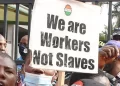
Labour movement and other social forces must be prepared to resist these austerity policies which will be heightened in the coming period.
* Kola Ibrahim, an author, labour activist and social/public policy consultant, write this piece via [email protected].
This write-up is an edited excerpt from his latest book, FIVE THESES ON NIGERIA’S 2019 ELECTIONS AND THE BUHARI/APC GOVERNMENT (RSP BOOKS, 2019).