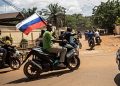
Some 200 West African soldiers, mainly from Nigeria and Ivory Coast, are in Benin to support the government following Sunday’s failed coup, Benin’s foreign minister says.
The attempt was foiled after Nigeria deployed fighter jets to drive the mutineers out of a military base and state TV headquarters, where they had declared a takeover.
This is the first time that officials have said how many foreign soldiers were deployed to the country, although it is not clear if some have been withdrawn since Sunday.
Benin’s Foreign Affairs Minister Olushegun Adjadi Bakari on Thursday said some of the regional troops sent to help had remained in the country “as part of the sweep and clean-up operation”.
A manhunt for those involved in the plot is underway, with the leader of the failed coup said to be taking refuge in neighbouring Togo.
The rebel soldiers justified their actions by criticising President Patrice Talon’s management of the country, complaining first about his handling of the “continuing deterioration of the security situation in northern Benin”.
The West African regional bloc, Ecowas, deployed troops from Nigeria, Ghana, Sierra Leone, and Ivory Coast to secure key installations and prevent any resurgence of the violence.
Nigeria, Benin’s large neighbour to the east, said its soldiers had reached there on Sunday, describing the coup attempt as a “direct assault on democracy”.
A coup too far: Why Benin’s rebel soldiers failed where others in the region succeeded
An Ivory Coast security source told AFP news agency that 50 soldiers from the country had been sent as part of the regional deployment.
“There are currently around 200 soldiers present, who came to lend a hand at the end of the day to the Beninese defence and security forces as part of the sweep and clean-up operation,” said Bakari, while addressing journalists in Nigeria’s capital, Abuja, on Thursday.
Bakari, who was speaking alongside Nigeria’s Foreign Affairs Minister Yusuf Maitama Tuggar, said that by the time the Beninese forces called for help, the coup “was already a failure”.
“When we started discussions for the intervention of Nigeria and the others, under ECOWAS protocol, our military had already pushed them back,” he added.
According to Bakari, what was required was “precise aerial back-up to carry out a surgical operation that targeted the enemy’s key positions without risking civilian casualties”.
Tuggar said that fast diplomatic, military, and intelligence actions between Nigeria and Benin had helped to foil the coup.
Discussions are continuing over how long the regional forces would remain, but Bakari said any decision “will be taken in close collaboration with Benin’s defence and security forces, who have demonstrated their bravery”.
It is not clear if the French special forces, who also reportedly helped loyalist troops thwart the coup, are still in Benin.
Under intense pressure after a string of successful coups in the region, Ecowas is signalling that it is no longer willing to watch democratically elected governments be toppled by the military.
Bakari praised Ecowas as “an important tool that allows us to defend democracy and the values of democracy in our regional space”.
Benin’s army has suffered losses near its northern border with insurgency-hit Niger and Burkina Faso in recent years, as jihadist militants linked to Islamic State and al-Qaeda spread southwards.
Talon, who is regarded as a close ally of the West, is due to step down next year after completing his second term in office, with elections scheduled for April.
Plotters misjudged the national mood and Benin’s neighbours learnt from past errors
Had the coup attempt in Benin been successful, it would have become the ninth to take hold in the region in the last five years alone.
Just a few days after soldiers took power in Guinea-Bissau while a presidential election vote count was still underway, leaders of the West African grouping Ecowas rapidly concluded that Sunday’s attempted overthrow of Benin’s President Patrice Talon was one destabilising step too far.
In support of his government, Nigerian warplanes bombarded mutinous soldiers at the national TV and radio station and a military base near the airport in Cotonou, the largest city.
Ecowas also announced the deployment of ground troops from Ghana, Nigeria, Ivory Coast and Sierra Leone to reinforce the defence of constitutional order.
This is a region that has been shaken by repeated coups since 2020, and which little more than 10 months ago, saw the putschist regimes in Mali, Burkina Faso and Niger completely withdraw their countries from Ecowas – the Economic Community of West African States – of which they had all been founding participants 50 years ago.
So, faced with the prospect that yet another civilian government might be overturned by discontented soldiers, the presidents of the remaining Ecowas member states rapidly reached the conclusion that the attempted coup in Cotonou could not be allowed to succeed.
Having fought off early morning putschist attacks on Talon’s home and the presidency offices, loyalist forces had already reaffirmed government control across the city, locking down the main central administrative district.
But it was proving hard to break down the last-ditch resistance of rebel troops who had shown they were ready to use lethal force without regard for civilians.
In response, Nigeria’s President Bola Tinubu, Benin’s eastern neighbour and much the largest military power in the region, authorised air strikes, while Ecowas leaders decided to dispatch ground troops the same day.
Among those sending forces is Ghana’s President John Mahama, who leads a resilient democracy but has made friendly diplomatic overtures to the Sahelian military regimes.
In acting so quickly, Ecowas has perhaps learned a lesson from its misjudged response to the 2023 coup in Niger.
On that occasion, it was not practically organised to intervene militarily in the hours after the elected head of state, Mohamed Bazoum, had been detained by coup leaders – the only moment, perhaps, when a rapid commando raid to rescue him and secure key buildings might have had any chance of success.
By the time the bloc had threatened intervention and begun to plan it, the chance had gone: the new junta had consolidated control over the Nigérien army and mobilised popular opinion in its support.
Faced with the prospect of intervention becoming full-scale war, and under strong domestic popular pressure to avoid any such bloodbath, Ecowas leaders backed off – opting to rely on sanctions. And when those also proved counter-productive, they settled for the diplomatic path alone.
This time around, in Benin, the situation was quite different: Talon was still in full control, even if some would-be putschists were still resisting. So he, as the internationally recognised president, could legitimately request support from fellow member countries in the regional bloc.
And this seems to have had popular support in Cotonou.
Many Béninois citizens do have grievances against the current government, notably over the exclusion of Les Démocrates, the main opposition party, from the forthcoming presidential election.
But there is a strong culture in Benin of trying to achieve change through political and civil society action, rather than force.
Béninois are rightly proud of their country’s role as the pioneering instigator of the wave of peaceful mass protest and democratisation that swept across francophone Africa in the early 1990s.
BTV Benin soldiers dressed in army uniform appeared on national TV to announce suspension of the country’s constitution.BTV
Most of the soldiers who appeared on state TV early on Sunday morning are on the run
While the complaints against Talon aired by the would-be putschists during their brief appearance on national television are widely shared, there has been absolutely no sign of any popular support for their attempt to get rid of the government by force.
So Benin represented a particularly favourable context for a forceful Ecowas intervention in defence of constitutional civilian rule.
Indeed, if anything, the coup plotters are likely to become the target of growing public anger as news of casualties circulates. At least one civilian – the wife of Talon’s key military adviser – was killed.
In recent days, two top military officials abducted during Sunday’s failed coup attempt have been rescued, but security forces are still searching for the coup leader, Lt Col Pascal Tigri and other plotters.
This was just the latest in a string of coup attempts across the region, though most of the others have succeeded.
They have all occurred in a context of fragility and pressure in West Africa at a time of Islamist violence across the Sahel, now spreading into the northern regions of many coastal countries.
There is disenchantment with traditional political elites. Even where economies are growing, there is a desperate shortage of jobs and viable livelihoods for the region’s rapidly growing young population.
However, while the regional context is widely shared, the driving factors for the coups are often local – specific to each country.
The lack of popular support for the Cotonou putschists stands in stark contrast to the mood on the streets of Conakry, the capital of Guinea, in September 2021, when the special forces commander, Col Mamady Doumbouya, led the overthrow of then-President Alpha Condé.
Like Talon, Condé had first been democratically elected but later secured re-election in questionable conditions, and presided over a significant erosion of political freedoms. Yet in Guinea, Condé had presided over violent abuse on a far greater scale than in Benin.
In addition, Condé had then strong-armed his way to a third term aged 83. In contrast, the 67-year-old Talon has promised to step down next April, albeit having adjusted the electoral rules to almost guarantee an easy victory for his chosen successor, Finance Minister Romuald Wadagni.
Another key difference is Condé’s deeply disappointing economic track record, whereas Talon has presided over strong growth and improving services.
Further north, the wave of coups in the Sahelian countries in recent years was also driven by local conditions.
In Mali and Burkina Faso, military commanders had grown frustrated with the weak leadership elected presidents were providing in the campaign against Islamist insurgents. In both countries, troops had repeatedly suffered brutal losses while their civilian governments appeared incapable of mobilising the extra weapons or sometimes even food that the troops needed.
There was also deep resentment at France’s inability to bring the jihadists to heel, despite the high-tech weaponry at the disposal of its forces then deployed across the Sahel.
Also in Mali, some nationalist sections of political and military opinion were frustrated with the functioning of a 2015 peace agreement with former Tuareg separatists in the far north, overseen by UN troops. Hardliners even accused French forces of actively preventing Bamako from deploying national army units to the north.
In Niger, the circumstances surrounding the 2023 putsch were equally distinctive.
President Bazoum’s political support had been eroded by his very publicly close partnership with France, and particularly his request that Paris provide troops to defend the north-western border from incursions by Mali-based jihadists.
However, his vocal support for judges probing a corruption scandal in defence procurement also risked alienating powerful elements of the military.
The coup that followed soon afterwards in Gabon, in August 2023, was similarly the product of local frustrations. In this case the opaque management of election results that saw an implausible victory awarded to President Ali Bongo, in frail health after a slow recovery from a stroke.
So, circumstances vary widely. And recent events confirm the trend.
The region certainly does face a real crisis of security and, in many countries, politics or development too.
But national conditions are often the major driver for each upheaval or coup attempt.
Many suspect the military takeover in Guinea-Bissau aimed to forestall a possible opposition election victory.
Whereas the Benin rebels seem to have been motivated by a mix of army grievances, and broader political and economic complaints.
But they strikingly misjudged the popular appetite in Cotonou for any violent or radical system change. – BBC.