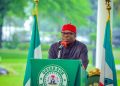
Deputy Senate President, Senator Ike Ekweremadu, has described the Independent National Electoral Commission (INEC), as a threat to the 2019 general elections in the country.
Ekweremadu, who spoke in Abuja yesterday against the background of the Saturday’s governorship poll in Osun state which the electoral body declared inconclusive, said what transpired in Osun last weekend was a clear indication that INEC would be a clear threat to the February 2019 elections.
According to him, the fast-declining independence of the election management body as well as vote-buying syndrome and misuse of security agencies are identified major problems ahead of the 2019 general elections.
Ekweremadu while faulting INEC for declaring the Osun governorship election as inconclusive, said the commission was “descending into the arena”.
He made the observations while receiving a joint high-level delegation of the International Republican Institute (IRI), and the National Democratic Institute (NDI), Washington DC, USA, which was on a preliminary visit to Nigeria ahead of its planned Joint International Elections Observer Mission during the 2019 general elections.
He said: “Prior to 2010 electoral reforms, INEC was barely independent. It was the 2010 Electoral Act and Constitution amendments that deepened the independence of the electoral body and strengthened the electoral system as evident in the 2011 and 2015 elections.
He noted that as the country heads towards 2019 poll, there have been a lot of challenges, particularly the challenges of implementing the existing laws; and this has retarded the country, instead of making progress.
“INEC needs to exercise the independence conferred on it by previous electoral reforms to be able to stand its ground, irrespective of whoever or whichever party that is in government, whether APC or PDP. It should not tend towards the government that is in power.
“Looking at Osun State, for instance, an election took place, somebody won from the results declared at the polling units, ward collation centres, local government collation centres, and the state collation centre.