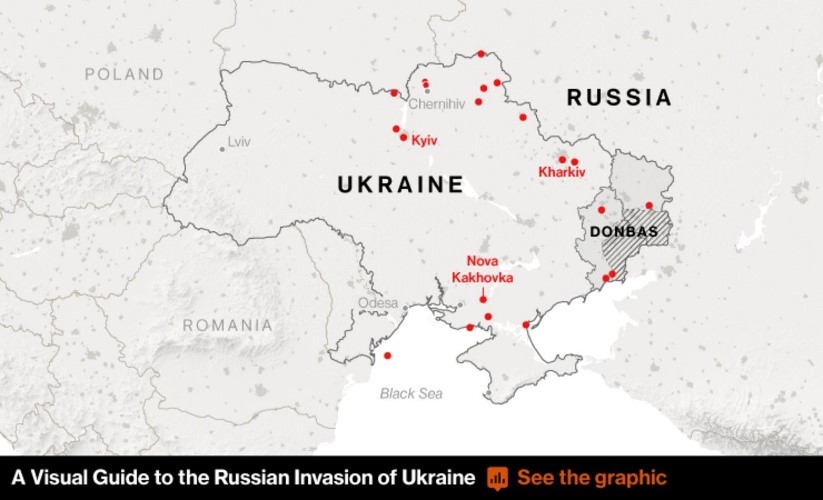
Ukrainian President Volodymyr Zelenskiy said 137 of his country’s soldiers have been killed in fighting so far since Russia attacked early Thursday.
He added 316 soldiers have been injured.
The United Nations announced that it was immediately allocating $20 million (€17.8 million) to scale up UN humanitarian operations in Ukraine.
UN Secretary General Antonio Guterres said that U.N. and its humanitarian partners “are committed to staying and delivering, to support people in Ukraine in their time of need … regardless of who or where they are.”
“With deaths rising, we are seeing images of fear, anguish and terror in every corner of Ukraine,” the Guterres said.
“People — everyday innocent people — always pay the highest price.”
UN humanitarian chief Martin Griffiths said the funds will support emergency operations along the contact line in the eastern Donetsk and Luhansk regions and in other areas of the country and “help with health care, shelter, food, and water and sanitation to the most vulnerable people affected by the conflict.”
Ukraine has requested that an urgent debate on the humanitarian situation in the country be held at the UN human rights council.
The request was made in response “the extremely grave deterioration” of the situation in the country, Ukraine’s UN envoy Yevheniia Filipenko said.
The EU delegation to the UN tweeted that it “fully supports” the request.
The council is made up of 47 countries, including Ukraine and all five permanent members of the UN security council.
The council is set to meet on Monday and is expected to be in session for five weeks.
Russian Foreign Minister Sergei Lavrov and US Secretary of State Antony Blinken are scheduled to speak at the council on Tuesday.
French President Emmanuel Macron called Vladimir Putin on Thursday demanding Russia stop military operations in Ukraine.
The French president phoned his Russian counterpart after he spoke telephonically with Ukraine’s Volodymyr Zelenskyy.
Macron undertook strenuous diplomacy in recent weeks to avert a Russian invasion of Ukraine, including holding direct talks with Putin.
The Kremlin says there was a “serious and frank exchange of views” during the Thursday call.
Putin explained “in detail his reasons for the invasion, but Macron warned him of “massive sanctions.”
Ukraine’s border guard has said that males aged 18-60 are not allowed to leave the country in a statement posted on its Facebook account.
The border guard said that this restriction will last for the duration of the period of martial law in Ukraine.
Ukrainian President Volodymyr Zelenskyy declared martial law earlier on Thursday shortly after it was reported that Russia had attacked Ukraine.
An estimated 100,000 have fled their homes and are uprooted after Russia’s invasion, the UN refugee agency (UNHCR) said on Thursday.
Shabia Mantoo, a spokesperson for the UNHCR, told the Reuters news agency several thousand Ukrainians have crossed into neighboring countries, mainly Moldova and Romania.
Poland said it would open nine reception centers to deal with the influx of refugees.
Interior Minister Mariusz Kaminski said Poland will take in “as many as there will be at our borders.”
The centers would offer arrival meals and medical care, and a place to rest and receive information.
Three out of four Germans are in favor of taking in Ukrainian refugees
Only 15% oppose admitting refugees, according to a Forsa survey commissioned by broadcasters RTL and ntv.
European Union leaders have announced new sanctions against Russia.
A joint statement from the 27-nation bloc said the sanctions would target Russia’s energy, finance, and transport sectors and restrictions on exports and financing.
“The European Council today agrees on further restrictive measures that will impose massive and severe consequences on Russia for its action,” they said after an emergency summit in Brussels.
The bloc also also wants to draw up sanctions against Belarus because of its close links to Russia.
Ukraine announced that is had lost control of the exclusion zone around the Chernobyl nuclear power plant, where radiation is still leaking from history’s worst nuclear power disaster in 1986.
“After the absolutely senseless attack of the Russians in this direction, it is impossible to say that the Chernobyl nuclear power plant is safe. This is one of the most serious threats to Europe today,” said Mykhailo Podolyak, advisor to the chief of the presidential administration.
The Vienna-based International Atomic Energy Agency (IAEA) said that according to its information, ”there were no casualties or destruction at the industrial site.”
IAEA Director General Rafael Mariano Grossi called for ”maximum restraint” to avoid actions that could put Ukraine’s nuclear facilities at risk.
”In line with its mandate, the IAEA is closely monitoring developments in Ukraine with a special focus on the safety and security of its nuclear power plants and other nuclear-related facilities,” he said in a statement.
Germany’s Russian foreign policy famously focused on diplomacy instead of confrontation, given its own history with the Soviet Union during World War II. But Russia’s invasion of Ukraine changes ties between the countries.
Russian President Vladimir Putin’s decision to send troops across the border of a sovereign nation threatens European security, especially security of smaller eastern European states that aren’t members of the EU or NATO.
Meanwhile, anti-war protests took place in numerous countries on Thursday, from Tokyo to Berlin to Madrid and even Moscow, until police intervened.
Police have detained at least a thousand people at anti-war protests in cities across Russia, rights monitoring group OVD-Info said. The group has documented crackdowns on Russia’s opposition for years.
The protesters staged small and single-person demonstrations against Russia’s invasion of Ukraine.
Earlier Russian authorities warned anti-war sympathizers from gathering for protests. Russia outlawed demonstrations without a permit in 2014, though freedom of assembly is anchored in its constitution in theory.
In a televised addressed, US President Joe Biden said that “for weeks we have been warning that Russia was preparing an attack. We saw staged political theater in Moscow, that Ukraine was about to launch a war with Russia…that Ukraine committed a genocide. Without any evidence.”
“Putin declared his war,” Biden continued, “and within moments missiles began to fall on historic cities in Ukraine.”
“We’ve been transparent with the world, we’ve shared intelligence…so there could be no confusion about what Putin is doing. Putin is the aggressor. Putin chose this war.” seconds of 0 seds
Biden then announced a new raft of sanctions, which targeted Russian banks and industry.
“We have purposely designed these sanctions to maximize the impact on Russia and minimize the impact on our allies…We are not acting alone. We have built a coalition representing half of world’s economy.”
The president said that the effects of global sanctions could already been seen, “earlier today, the ruble hit its lowest level in history.”
He then made clear that US soldiers currently being moved to Europe were to defend NATO allies, and would not be mobilized inside Ukraine.
Antonio Guterres said the UN was scaling up its humanitarian operations in Ukraine.
The UN Secretary-General spoke to reporters at the UN head office in New York, stressing, “the protection of civilians must be priority number one.”
The UN was releasing $20 million (€17.9 million) for immediate aid, he said.
He repeated his call to President Vladimir Putin to stop the military operation and pull back troops.
“It is not too late to save this generation from the scourge of war. We need peace,” Guterres said. – DW.