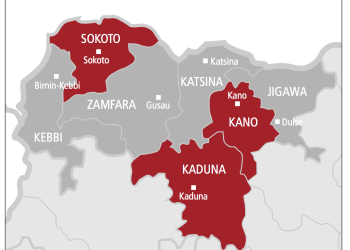
Apprehension that the insecurity sweeping across northern Nigeria might spread to the South is rising by the day. The panic is further fuelled by the December 1 attack on the Federal Prisons in Ado-Ekiti, during which 320 prisoners escaped. The motive of the attackers has yet to be unravelled. Armed with AK 47 assault rifles and explosive devices, bandits, numbering about 60, stormed the facility in a caravan of Hilux pickups, bombed the place and escaped easily. The assault has the same blueprint as the Koton-Karfe jailbreak in Kogi State in November that preceded it, and the Minna, Niger State, prison attack that followed on December 6.
There is, therefore, the need for states to take deliberate steps to insulate the South from the violent jihadist campaign in the North. Beyond the issue of self-preservation, a spell of insurgency for instance, on Lagos, the economic hub of the country and the nine oil-producing states, will be disastrous.
The dreaded insurgents, who began their evil campaign in 2009 in Maiduguri, Borno State, have not hidden their agenda to gravitate to other areas. Lagos has for long been on their radar. On June 25, an improvised explosive device ripped through the Folawiyo Energy Depot in Apapa, a dastardly act, which the United States intelligence attributed to a female Boko Haram suicide bomber. In a video released in July, according to Agence France Presse, Abubakar Shekau, the blood-thirsty leader of the group, claimed responsibility for the bombing.
Just last week, the Commissioner of Police in charge of Western Ports Command, Hilda Ibifuro-Harrison, drew the attention of stakeholders to the need to have all hands on deck, following intelligence reports the command received three months ago, of Boko Haram’s plan to attack the Apapa seaports. A church in Owerri, the Imo State capital, was bombed in June, this year, just as 42 suspects were rounded up and paraded in Lagos last year, by the then General Officer Commanding, 81 Division of the Nigerian Army, Lagos, Obi Umahi, a major general.
The general had declared that the influx of these vandals was as a result of “their plan to unleash terror on some parts of South-West.” One of the suspects, Ibrahim Abubakar Bori, whom the Army interrogated, said, “We were involved in several major operations in Maiduguri, where several security agents and civilians were killed.”
In the face of these ominous signals, what are the southern states expected to do? Insurgency spiralled out of control in Borno State where it began five years ago because the Nigerian leadership did not take preemptive measures, coupled with the fact that the northern state governors failed to appreciate the enormity of the danger they faced. Governors of the 17 southern states should avoid the same hell-hole. There is an overriding need for them to respond to this real challenge concertedly. Those with contiguous territories could hold joint-security meetings for result-oriented strategic planning.
Already, states in the South-West, South-East and South-South zones periodically meet to discuss economic integration and development. This is laudable. But the economic platform could also be used to build enduring security bulwarks against terrorism and associated lawlessness. Indeed, where insecurity is on a roller-coaster, economic development takes a back seat. There is a big lesson to be learnt in Japan Gasoline Corporation’s refusal to handle the Port Harcourt Refinery’s Turn Around Maintenance in 2012 due to a travel advisory from the Japanese Embassy in Nigeria, warning its nationals to steer clear of the Niger Delta region because of kidnappings and killings, of which many foreigners had been victims.
As the chief security officers of their states who should guarantee law and order, governors spend heavily on the police commands in their states by procuring hundreds of vehicles for patrols and communication gadgets for operational efficiency and effectiveness. Exigencies of the moment dictate that they should also demand results from the police. Intelligence gathering is crucial if security personnel are to stay ahead of criminal or terror cells. Unfortunately, this is not the case.
The involvement of local vigilantes in fighting the insurgents in Borno, Yobe and Adamawa states, and the modicum of success it has achieved so far, make a strong case for a brew of orthodox and unconventional strategies to be adopted. States could guide communities to form anti-terror committees to boost the intelligence gathering of the police and other security agencies. This is critical, as local residents know the hoodlums that operate in a given area. Dedicated hotlines could be provided, domiciled in each governor’s office, where reports of suspicious persons or activities could be filed by natives to avoid the police trifling with them.
As President Barack Obama told Americans last Friday while nominating Ashton Carter as the new Defence Secretary, “we face no shortage of challenges to our national security,” Nigeria’s case is even worse given the government’s cluelessness about how to rein in the jihadists who have killed more than 15,000 innocent citizens.
The sequential bloodbath and mayhem in a Kano mosque, Damaturu, Ado-Ekiti and Minna between November 28 and December 6, should remind all of us the need for eternal vigilance.