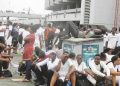
Workers and residents in Apapa, the sea port town in Lagos, including other commuters that have anything to do with that area, had hectic times in recent weeks accessing the axis because of the horrible traffic jam that has become the trademark of the port zone. The road to the area is either permanently decrepit or under endless repairs, while trucks and fuel tankers waiting to be loaded constitute unimaginable nuisance to other road users. As a result of the recent gridlock on the road, reports had it that the Federal Government directed the Nigerian National Petroleum Corporation (NNPC) and its subsidiaries, the Pipelines Products Pricing and Marketing Company (PPMC) and the Directorate of Petroleum Resources (DPR), to cut supplies to tank farms in Apapa. Senior Special Assistant to the President on Maritime Services, Mr. Leke Oyewole, was quoted as saying that the directive was intended to check the influx of trucks and tankers into Apapa, since they compound the already embarrassing traffic situation.
The order reportedly followed a closed-door meeting the Presidency hosted in Lagos, which had representatives of the Federal Ministries of Defence and Works, the NNPC, PPPMC and DPR in attendance. Also at the meeting were officials of the Nigerian Ports Authority (NPA), the contractor handling the Apapa end of the Mile 2-Apapa Expressway, Association of Maritime Truck Owners (AMATO), members of the National Association of Road Transport Owners (NARTO), Nigerian Union of Petroleum and Natural Gas Workers (NUPENG), port operators and business managers in Apapa, as well as the Senior Special Adviser to the President on Compliance and Monitoring, Prof. Sylvester Monye.
At the meeting, according to reports, it was agreed that the NNPC and PPMC should channel the distribution of fuel to private jetties outside Apapa, especially those in Mosimi, Ejigbo, Ibadan and Ilorin, from where tankers would lift fuel to other parts of the country, this way, it is believed, the road congestion in Apapa would ease. The hundreds of fuel tankers that line up in Apapa to lift fuel are also to be relocated away to allow for the completion of a trailer park under construction in the area, a development that would help accommodate many of the tankers which park along the roads and obstruct the free flow of traffic. But hardly had the agreement been reached than stakeholders cried out that the NNPC and PPMC failed to comply with the FG directive. Reports even claimed the Presidency denied giving the order.
However, Governor Babatunde Fashola of Lagos State, who has been grappling with the traffic chaos, says monumental corruption among government agencies at the ports, poor maintenance of road infrastructure by the FG and negligence by the NNPC are responsible for the traffic crisis Apapa is suffering. “If NNPC pumps to Mosimi, Ibadan, Ejigbo, Ilorin and other oil depots, Apapa will decongest. So, why are they not doing it? You will see even the bridge coming into Apapa now is threatened. It is just incomprehensible to me… Certainly somebody in the ports prefers to do checking and clearance at a time at the gate. There are, perhaps, some financial benefits in doing that. There is some corruption suggested in that process. But why will any official not make things efficient except there is a personal benefit attached to it? … Probably, many agencies of the FG are not talking to one another or not coordinating,” Fashola said. The governor, perhaps, forgot to add that vehicles and commuters are often robbed by hoodlums once trapped in the gridlock.
We think that Fashola is on the ground. He also understands the problem better, having been battling same, using law enforcement agencies over the years. Our fear is that the Apapa traffic predicament might end up being politicised. But leaving it to linger this long because of government’s failure to maintain the road leading to the nation’s major sea ports, or relocating the trucks and tankers to a location where they can be better accommodated, buttresses how insensitive some governments can be, especially for a country that has sold its conscience to petroleum products importation, instead of refining its own crude. It is really incomprehensible, how economic activities are being grounded in Apapa, with spill-over effects on other parts of Lagos, without any concrete effort to arrest the trend. How long will it take the FG to act?