- CBN’s new Labour policy for banks calls for collaboration with the Federal Ministry of Labour and Employment
The Central Bank of Nigeria (CBN) has warned all banks to seek its approval before sacking staff in excess of five. The warning came in a communique just released through the Bankers Committee.
The circular directed the banks to notify, and receive approval from the apex bank, ahead of staff layoff exceeding five, at any time. The banks are also required to provide the CBN with copies of contract letters to staff.
Although a little belated, the intervention of the CBN in what has been a notorious practice in the Nigerian banking sector for several years, is a welcome development.
Mass sacking of bank staff, in the name of ‘restructuring, ‘right-sizing’ ‘cost-cutting’, has been routine in the last few years.
For example, the National Bureau of Statistics (NBS) confirmed that Nigerian banks sacked 2,929 workers within three months in 2019. NBS added that 18 bankers were sacked daily between January and September 2019.
It is, therefore, reassuring that the CBN has decided to stop commercial banks’ culture of impunity, by providing some baseline for terminating or retrenching staff, to avert turning a banking career into mere casual jobs.
That makes it easy for employers to throw workers in the unemployment market at will and without empathy — also without notice and severance, after several years of service.
We urge CBN to follow its new policy with regular monitoring of the banks. That should prevent cynical bank directors from sacking piecemeal — lower than five at a time — but increasing the velocity, thus cynically subverting the new policy.
This feared subversion could be real, since banks under the present regulation do not need CBN’s clearance to sack up to four workers.
In addition, the apex bank should use this new directive to give fresh guidelines to ensure banks don’t use the concept of contract staff to evade their responsibilities to their work force.
It is common knowledge that many banks are fond of sacking regular staff with many years of experience, just to hire contract workers on lower wages: no leave, no medical benefits etc.
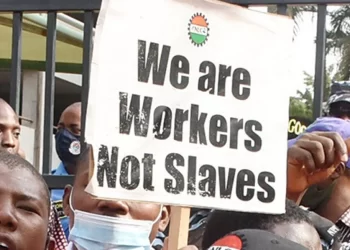
For example, in July 2019, Ecobank workers under the auspices of the National Union of Banks, Insurance and Financial Institutions Employees (NUBIFIE), shut down the headquarters of the bank following the disengagement of about 1200 workers.
The workers protested at the bank’s head office against their disengagement, insisting that the employer pay them commensurate benefits.
To ensure that the CBN policy does not become a paper tiger, the apex bank ought to work in collaboration with the Federal Ministry of Labour and Employment, on upgrading the country’s Labour laws, to give Nigeria’s Labour relations the human face it deserves.
That should not hamstring banks’ efforts to sustain productivity and make profit on their investment. Therefore, unfair Labour practices should be as much the concern of the minister of Labour and Employment as it is now of the governor of the Central Bank.
With increasing growth of the country’s private sector, Labour laws need to keep up with the best practices elsewhere.
This should enhance fair Labour practices, motivate workers and enhance their productivity. That should also positively impact investors and boost the bottom line.
So, fairer Labour practices and thumping profits are not mutually exclusive. All you need is to strike the right welfare-productivity balance.
Banks should know that fairness to Labour does not necessarily chip away at the bottom line.
On the contrary, it could stimulate staff satisfaction and boost productivity. That would turn a win-win of high turnover and booming profit.