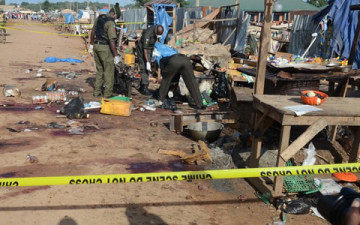
ISLAMIST terrorism is far from being tamed in Nigeria. Last Friday, just a day after the 55th Independence Day anniversary was marked without a major incident, Boko Haram jihadists carried out coordinated suicide bombings in Abuja. They also struck in Niger, Borno, Plateau and Yobe states. The most horrific explosions occurred in Kuje and Nyanya on the outskirts of the Federal Capital Territory, leaving 18 people dead and over 40 injured. This is a wake-up call for the security agencies to be alert to the ever-increasing threat posed by the violent Islamists.
It is hard to come to terms with the resurgence of suicide bombings in Abuja. The Nigerian capital has enjoyed relative peace since the April 14, 2014 suicide attacks at the Nyanya bus terminus, in which 100 people died, and the May 1, 2014 attacks close to the scene of the initial incident. A witness said, “Hands and legs were cut off, human flesh scattered all over the area.” This is traumatic.
The FCT has suffered immense collateral damage from the Boko Haram terror campaign, which was initially limited to its North-East roots at inception in 2009. All that changed during the 2010 Independence Day anniversary when suspected Niger Delta militants detonated three car bombs in Abuja, one close to the Eagle Square, killing eight people. Other acts of terror ensued. In August 2011, Boko Haram struck at the United Nations headquarters in Abuja, killing at least 21 souls. The group also bombed a media house. The evil acts have been traced to Boko Haram, a part of the Islamic terror network wreaking havoc across the world.
This shows once more that the sceptre of terror does not wane easily. In an ever complex world, driven by technological advancements, jihadists exploit different methods to perpetrate their savage acts. Therefore, their resolve to establish an Islamic caliphate in Nigeria must not be taken lightly. Nigeria and its security agencies must respond with similar gusto, inventiveness and determination in order to neutralise the extremists.
Of paramount importance is the place of intelligence gathering in stopping suicide bombers in their tracks. Since the 9/11 attacks in the United States, and the 7/7 attacks in London, security agencies in those countries have revamped and retooled their intelligence gathering capacities in line with escalating terror threats. Through the initiative, they have thwarted several plots against their countries.
According to The Heritage Foundation, a US-based policy research institute which tracks terror attacks, American security forces have foiled 73 terror attacks on the US following al-Qaeda’s September 2011 attacks. In New York alone, the authorities have nipped “more than 20 terror attacks” in the bud, as Bill Bratton, the New York Police chief, testified before federal lawmakers last month.
In France, Germany, Israel, Belgium and Britain, security operatives are permanently on full alert against Islamic extremists. In 2014, Britain’s Metropolitan Police, according to its Chief, Bernard Howe, foiled different attacks on the country through pre-emptive intelligence network. Yet, these countries are aware that they cannot rest on their laurels because the risk of a devastating attack is greater than ever from radicalised Islamic groups and lone wolf attackers. Israel has just foiled an attempt by seven terrorists to unleash mayhem on its soil.
“In many respects, we currently face a greater likelihood of attack than we have seen in years,” Bratton told the US Congress during an inquiry. Howe echoed similar sentiments last August. He said, “Over the last year we have interrupted we think about five different operations that people are now in the process of being prosecuted for. So that’s an increase because probably we had about one a year in previous years.”
To win this borderless, asymmetric terror war, we must rebuild, not only the military – which has recently made gains in the North-East and recovered previously lost territories – but also the police, the Department of State Services and other civil security agencies using infiltration, technology, forensics, DNA testing, telephony and CCTV to a great effect. At the same time, a virile coordinating organisation is essential in thwarting the malcontents. Equally important is collaboration between our security agencies and their foreign counterparts.
The Boko Haram campaign, which has claimed about 20,000 lives in the last six years, has also created dysfunctional families, with international agencies putting the number of Internally Displaced Persons at 1.5 million. The IDP camps are located all over Nigeria, with six of such centres in Abuja. These camps can also serve as a breeding ground for extremists, who might hide there. This calls for a thorough screening and monitoring of the IDP camps by security operatives.
The public must also be constantly updated on the tricks of the extremists. Parked cars, gas cylinders, sweating, uncomfortable-looking elements, and hijab-wearing females can often serve as bomb-bearing emissaries. The incident in Abuja was traced to an unsuspecting crowd that allowed the bomber to leave his bag of explosives unattended in a meat seller’s kiosk, while he pretended to be looking for change to pay a commercial motorcyclist.