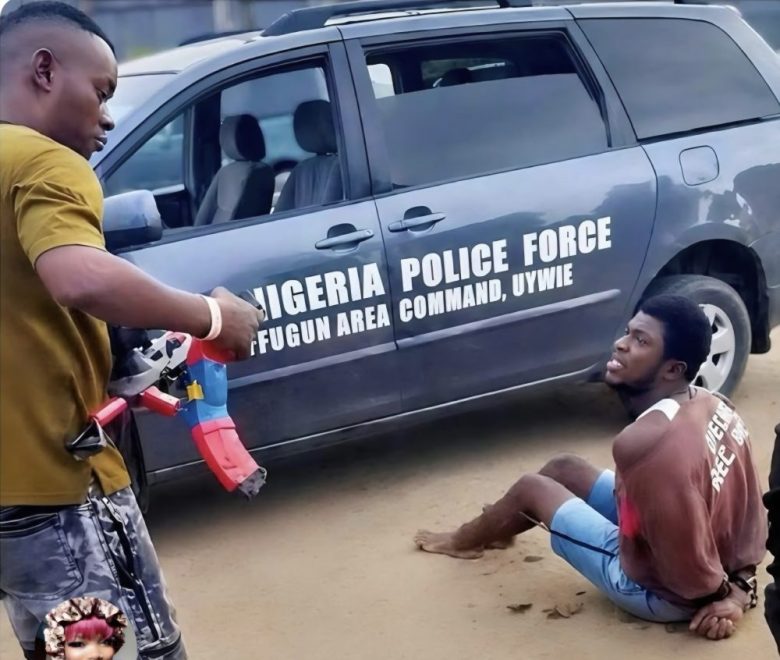
It is another season of official violence in Nigeria, reinforced by the senseless and tragic killing of 28-year-old musician, Oghenemine Ogidi, by a police officer, Nuhu Usman, in Effurun, Delta State.
The outrageous killing is not merely another grim headline; it is an indictment of a policing system that too often operates outside the bounds of law and reason.
So, the Nigeria Police Force must go beyond merely dismissing Usman. He and his accomplices must be prosecuted to the fullest extent of the law. The force must also look deep within its turbulent soul in finding answers.
An activist, Harrison Gwamnishu, brought the incident, which occurred on April 26, to public attention after he released the disturbing footage. The content of the video and the presence of other officers at the scene capture what should never occur in a society governed by rules.
That a restrained, apparently cooperative suspect was executed in cold blood amounted to plumbing the deepest of depths by those sworn to uphold justice.
By every account, including the gory visuals, Ogidi posed no immediate threat. He had been detained, handcuffed, and was pleading for his life while offering to assist the police in tracking down the sender of a parcel he insisted he knew nothing about.
Yet, Usman chose – not a path of justice, but to brazenly kill – an act that has shocked the conscience of the country. Indeed, this raised questions about complicity and an attempt to destroy evidence.
That the police have since moved to dismiss the officer and initiate disciplinary proceedings, under the directive of the Inspector-General, Olatunji Disu, is commendable. But Nigerians have seen this script before: swift outrage, promises of accountability, and then, a slow fade into institutional amnesia. This time must be different.
The questions raised by this incident are as urgent as they are unsettling. Why was lethal force deployed against a suspect who was neither fleeing nor resisting? Why was due process so casually discarded?
And why does such conduct continue to recur, despite years of public outrage as demonstrated in the #EndSARS rebellion, and supposed reforms to walk back the wanton, deadly injustices?
Amnesty International, Human Rights Watch, and Open Society Foundations reiterate that police officers kill suspects and innocent citizens recklessly.
The attempt by the state police spokesperson, Bright Edafe, to attribute the act to “spirituality” is baffling, if not outright silly.
Law enforcement cannot be excused by superstition. This suggests a lack of professionalism in both PR and policing.
Worse, such reasoning trivialises a grave abuse of power and distracts from the real issues: poor oversight, weak accountability, and a culture that too often shields errant officers.
Indeed, the killing of Ogidi is not an isolated tragedy. It sits within a troubling pattern of extrajudicial violence that has persisted despite national reckoning.
The 2020 killing of Jimoh Isiaq during protests in Ogbomoso remains fresh in public memory. He was reportedly shot by police while demonstrating against brutality – the very abuse that would later ignite the aforementioned nationwide #EndSARS protests movement.
In 2022, the case of Gafaru Buraimoh in Lagos further underscored the problem. Buraimoh, a young motorcyclist, was allegedly shot dead by a police officer, sparking protests and renewed demands for reform. His death, like many others, highlighted the routine misuse of firearms by officers in non-life-threatening situations.
More recently, in 2023, the killing of Efe Onoyake in Warri, Delta State, added to the grim tally. Reports indicated that he was fatally shot under questionable circumstances. This, again, raised concerns about trigger-happy policing and the absence of consequences.
Tragically, these cases are not aberrations; they are symptoms of systemic failure. When officers act with impunity, it reflects an institution that has failed to enforce its own rules.
Allegations that Usman, whose visuals on social media portray that of a thug, had a history of misconduct, including extortion, only deepen the concern that warning signs are routinely ignored until it is too late.
The implications are profound. It is an unacceptable collapse of law enforcement standards. It shatters the baleful image of the Nigeria Police further.
Every extrajudicial killing erodes public trust, fuels anger, and undermines the legitimacy of the state. A police force feared by the people cannot effectively serve them. Justice cannot thrive where due process is treated as optional.
If the NPF is serious about reform, then accountability must extend beyond the dismissal of errant officers.
There must be a transparent prosecution, not a quiet administrative closure or attempts to sweep the real motive behind Ogidi’s murder under the rug.
Under extant Nigerian laws, wilful, premeditated murder guarantees a date with the hangman. This is what happened in Ogidi’s case. Mitigating circumstances can be adduced, but the video evidence suggests that it will be difficult to sustain.
Supervisory officers who enabled or ignored misconduct must also be held responsible. Internal disciplinary mechanisms must be strengthened and made more transparent.
Ultimately, the lesson of Ogidi’s death indicates, unfortunately, that without systemic change, this cycle of impunity will continue.
Justice for Ogidi must be paired with thorough reforms within the police force. These must be grounded in respect for the sanctity of life, departure from tunnel vision assumptions, forensic policing, and psychological, indeed, the psychiatric evaluation of special duty officers.
Nigeria cannot afford enmity between the police and citizens. NO. Not at this time, in which the real enemies are being increasingly embedded as bandits, insurgents, and outright criminals hiding behind religion to disrupt lives and livelihoods.
The Nigeria Police MUST redo itself. Disu, make that difference. Rebuild that trust.