- Proposed Economic Stabilisation Bill is necessary to fast track economic development
Monday last week, the media was abuzz with the plan by the Buhari administration to introduce a bill to grant special powers to the President to enable him tackle some of the issues hobbling the economy more frontally. Although one presidential spokesman later clarified that the proposal remained, at best, tentative since it had neither been passed to the President nor to the Federal Executive Council, the proposal has nonetheless sent tongues wagging as to whether what the nation requires at this time are such extraordinary powers.
Among the many highlights in the public domain, the bill seeks to fast track the procurement process to support stimulus spending on critical sectors of the economy; make orders to favour local contractors/suppliers in contract awards; abridge the process of sale or lease of government assets to generate revenue; allow virement of budgetary allocation to projects considered as urgent, without going back to the National Assembly. It also seeks to amend certain laws, such as the Universal Basic Education Commission (UBEC) Act, so that states that cannot meet the counterpart funding to access the cash, can do so; bring radical reforms to the visa issuance process at Nigeria’s consular offices, and to compel some agencies of government like the Corporate Affairs Commission (CAC), the National Agency for Food and Drug Administration and Control (NAFDAC) and others to improve on their turn around operation time for the benefit of business, among others.
In more specific terms, there is about N58bilion trapped in the UBEC coffers that many states cannot access because they cannot raise the 50 percent counterpart funds; the proposed bill intends to reduce this to 10 percent to enable the states have easier access to the money with which they can create jobs through contract awards. With regard to contracts, the extant law provides for 15 percent mobilisation fee. In a time like this, especially with the stringent measures of banks on loans, it would be difficult for government to make contractors move at the desired pace to take care of exigencies. The proposed bill intends to raise mobilisation fee to 50 percent. The none-core assets that the government intends to lease or sell are expected to fetch about $50billion that could be used to shore up the country’s foreign reserves and the value of the naira.
Similarly, the government plans to truck gas from source to the power plants to enable them get what they need for generation, instead of the present system of using pipelines to do same. This is costlier but it would facilitate power generation which is critical to economic development.
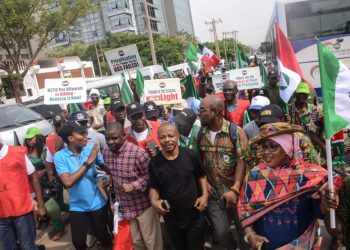
We are not surprised that a sizeable number of Nigerians have voiced alarms at the proposal. Aside the fact that Nigerians generally loathe the idea of untrammelled powers to the President in a democracy still struggling to inject life into its institutions, many more wonder whether the President actually needs any additional powers, given the awesome powers already granted the office by the constitution – powers, they insist, have neither been deployed in any structured sense to deal with the economic problems nor tested to any serious challenge. Moreover, for a President who took nearly six months to put his cabinet together, it would seem particularly incongruous that he will now require extraordinary powers to put his administration on some assumed fast lane.
Are the powers being sought by the President unnecessary – or are they necessarily bad? We would agree that a lot would still depend on the specifics of the bill being proposed. Many have also argued that the powers being sought could have been achieved through the normal legislative process. Again, that may be true to an extent. What is also true is that some of the powers being sought have become necessary or inevitable in the light of current exigencies.
First, it cannot be gainsaid that these are indeed extraordinary times. The indices are everywhere for all to see – from the fiscal crisis in the states the result of which many are in arrears of salaries and pensions by several months; the soar-away inflation and with it the steady decline in consumer purchasing power; the unprecedented level of unemployment, especially of youths; the acute foreign exchange crisis that has seen the naira on a free fall with no signs of respite imminent but rather possible prospects of foreign reserves depletion; the acute infrastructure deficit that continues to leave small and medium scale industries endangered – a situation now compounded by their inability to access foreign exchange to bring in spares and raw materials at a time the nation is counting on them to boost their operations to save jobs and cut back on imports.
Only last week, for instance, the Manufacturers Association of Nigeria (MAN) reported 272 firms as drawing shutters on their operations in the last one year. While the problems have been with us for as long as anyone would care to remember, to the extent that the latest plunge in global oil prices has brought the crisis out in bolder relief, we cannot agree more with the view that the dimensions of the latest crisis have become such that would require some additional tools to solve.
Secondly, such powers, rather than being necessarily alien have in reality, tended to be an inescapable aspect of the democratic practice. Here, copious examples can be drawn from the United States where it is not uncommon for the President to issue executive orders made pursuant to Acts of Congress that explicitly delegate to the President some degree of discretionary powers. Nigerians would certainly recall a similar law made by the Shehu Shagari administration in 1982 to manage the crisis of that era. The least we expect the National Assembly to do if and whenever the President decides to send the bill is to put sufficient safeguards to ensure that it does not become so expansive as to be abused. After all, the powers are supposed to last for only one year. Moreover, nothing stops any aggrieved citizen from challenging the exercise of such powers, particularly when they are deemed to be either arbitrary or in conflict with the constitution.
All said, we have no reason not to support the bill when it eventually comes. We can only hope that it will meet the yearnings of Nigerians for the change they have long clamoured for, in terms of injecting speed and dynamism into governance and delivering real substance to the people