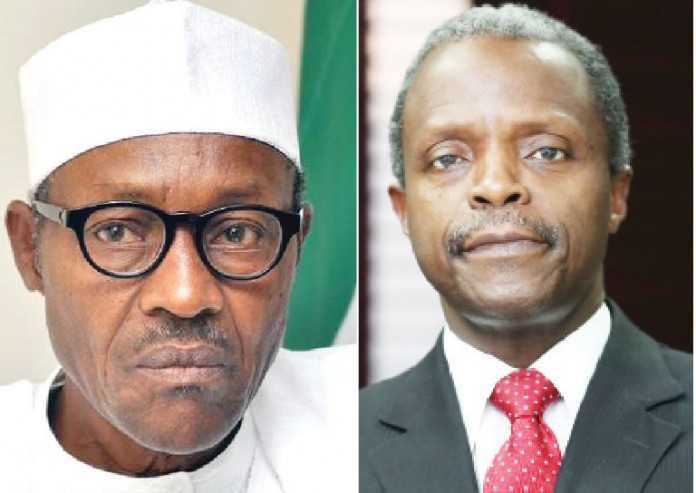
As the Muhammadu Buhari administration enters its ninth month, Nigerians and analysts at home and abroad are still awaiting its economic plan. Of late, the President has continued to reiterate his stated goals of rescuing the economy and lifting millions out of poverty. We insist, however, that the country needs a comprehensive economic strategy, with stated goals and clearly defined targets to achieve this.
The need for such a plan is all too obvious. In Abu Dhabi, United Arab Emirates, where he secured far-reaching trade and consular agreements, Buhari reaffirmed his commitment to creating jobs and restructuring the all important oil and gas industry. At home, he unfolded a plan to establish grazing reserves and routes across the country. At the World Economic Forum in Davos, Switzerland, Vice-President Yemi Osinbajo spoke of ongoing reform of the tax system and how the government intended to tackle poverty. Some ministers too have been unfolding sector-specific plans. But where is the cohesion?
We hold however that a developing economy in transition like ours requires an economic programme linking all sectors and with specific time lines, targets and objectives clearly set out. Economic planning has different models; while socialist style central planning is no longer in vogue outside a one-party system like China, mature industrialised democracies nevertheless utilise fiscal, monetary and other policy instruments to steer their market-led economies in a specific direction in line with national development objectives. The United States, for instance, directs substantial research funding and grants to defence, health and technology to retain its global competitive leadership. Some other countries take the path of public investment in infrastructure-driven growth strategy.
In forging their transition from under-developed, poverty-wracked economies to export-oriented industrialised powerhouses, the UNDP has detailed how the South-East Asian Tigers, South Korea, Hong Kong, Singapore and Taiwan, adopted economic planning programmes and state-managed investment − a hybrid of free markets described variously as state development capitalism or the East Asian Model. Since unification in 1971, successive leaders of the seven-emirate UAE federation have adopted holistic plans to diversify and drag the economy into the 21st century to make it the second largest economy in the Gulf Cooperation Council area, with its non-oil trade growing 28-fold between 1981 and 2012.
With barely three years left in his four-year mandate, Buhari, to succeed, must roll out a plan with linkages to all sectors of the economy. The Lagos Chamber of Commerce and Industry had noted since last September that some measures being taken by the Central Bank of Nigeria on forex access veer towards fiscal policy decisions that should normally fall under the framework of an overall national policy.
Buhari came at a critical period when national security and the economy were in dire straits and corruption was threatening national survival. While he is confronting the security issue and has reignited the war on corruption, the economy has remained the weak link. The 2016 budget may not fly because its major anchors − average oil price of $38 per barrel, 2.2 million barrels of oil per day, exchange rate of N197 to $1 − are already threatened by lower oil prices, sabotage of oil facilities and a global glut, and the accompanying exchange rate volatility.
Yet, the government has large ambitions. Apart from tax reforms and its proposed N6.08 trillion budget – with the highest non-oil receipts of N1.45 trillion and another N1.51 trillion from its ministries, departments and agencies, most of which have proved inefficient and corrupt over the years – the government also expects to spend N1.8 trillion on capital projects. It aims, according to Osinbajo, to create 1.14 million new jobs within the year, raise food production by 530,000 metric tonnes per annum, attract N980 billion in new investments, and use its cash transfer programme to support the 25 million poorest households. How it intends to achieve all this without a holistic restructuring plan is knotty.
Rather than the disparate sectoral and sub-sectoral initiatives, however, we believe the government needs an overall economic programme. Nigeria is not new to planning: five-year development plans guided our growth from 1960 till the early 1980s. The succeeding rolling plans and medium term expenditure plans have been poorly implemented. We urgently need a plan that will set realisable production targets in key sectors like steel, agriculture, mining, transport, power, oil and gas and social sectors. Ministers and MDAs should be aligning their policies with this overall plan instead of rolling out seemingly contradictory programmes. Buhari should appoint a hands-on economic czar to translate his vision into concrete action.
On being inaugurated as Malaysia’s Prime Minister in 2009, Najib Rasak ramped up a new economic model to replace the 40-year-old NEP with the goals of transforming the country to a high income, industrialised and knowledge-driven economy by 2020. Singapore’s visionary leader, Lee Kuan Yew, created the Ministry of Trade and Industry and a Research Innovation and Enterprise Council to drive strategy and mobilise investment from around the globe. To restart the economy, Spain’s Prime Minister, Mariano Rajoy, set targets and unveiled an $8.59 billion stimulus package to tame high unemployment and deflation. Nearer home in Rwanda, President Paul Kagame unveiled Vision 2020 to “transform the country from a low-income agriculture-based economy to a knowledge-based, service-oriented economy with a middle-income country by 2020.”
Our government should urgently commit to a programme of privatisation as part of a general policy of private sector-led development. There should be a target of self-sufficiency in food production and in refined petroleum products. The major objectives should be diversifying the economy and exports, dragging millions out of poverty and creating millions of jobs. That is how leaders overcome economic adversity.