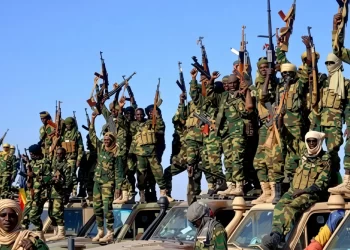
The Boko Haram terror campaign may still be raging, but no one doubts that the strategy in combating it is changing. President Muhammadu Buhari began from the day of his inauguration to make encouraging moves to fulfil his campaign promise to make security his top priority. The new government should quickly tap into the groundswell of local and international offers of support to crush the insurgency with ruthless efficiency. Today’s summit on terror war holding in Abuja offers a new opportunity for the Nigerian government to harness regional and international assistance needed to “degrade” the evil sect.
Terror attacks have continued unabated in parts of the North-East zone, but there are encouraging signs that the inertia, incoherence and indifference of the immediate past administration have since given way to a renewed sense of purpose. Buhari just returned from Germany where he attended a summit of the G7 club of seven top industrialised nations and rubbed minds with world leaders on the terror war. Agency reports quoted him as reaffirming his commitment to crack down on violent Islamists, for which he requested regional and global support.
His avowed strategy of building “a more efficient and effective coalition” with neighbours is the right stuff. Defeating terrorism requires broad local, sub-regional, regional and international support. Rand Corporation, a United States think tank, in a January 2014 report, said terrorism in any part of the world is a potential threat to the entire planet as terrorists respect neither national borders nor the lives of anyone.
Buhari should step up his diplomatic offensive with our neighbours onto whose territories the Boko Haram menace has spread. Failure by Nigeria to respond decisively when the terrorists surfaced six years ago enabled them to wreak horrendous havoc with random gun attacks, massacres, wanton destruction of towns and villages, suicide bombings and mass abductions. With a tepid response by the then President and his security chiefs, the emboldened salafists expanded their ambitions to include the seizure of territories and at one time, controlled a large swathe of ground in Borno, Adamawa and Yobe states, often described by news agencies to be as large as Belgium.
The figure of 17,000 persons killed in the wave of terror by aid agencies is viewed as grossly understated by locals, while the National Emergency Management Agency estimates that over 981,416 persons had been displaced by January this year. Cameroon is playing host to more than 70,000 Nigerian refugees, while 200,000 others who took refuge in Chad have been returning in trickles, following the sudden reawakening of Nigeria’s military in February as Goodluck Jonathan desperately sought reelection.
Terrorists have made the earth unsafe, striking in every continent and piling up a mounting body count. The Religion of Peace, a non-profit organisation that tracks jihadist activities, reported that 26,066 “deadly” attacks had been carried out worldwide by Islamist terrorists since September 11, 2001 till Monday. In the seven days to June 5, 2015, it recorded 51 attacks in which 506 persons were killed and 445 critically injured. Terror attacks have been recorded in Australia, Canada, Europe, China, Russia and its traditional “home,” the Middle East and India.
Forging a formidable coalition with our regional partners – Chad, Niger Republic and Cameroon – is only one part of the strategy. The cooperation should be strengthened so that the Multinational Force tackles them as an effective fighting machine. Foreign contingents had complained bitterly in the past of lack of cooperation and coordination by Nigerian commanders, leading to setbacks, reversal of gains and avoidable coalition casualties.
Our military need to be properly equipped and motivated. The government must address the persistent complaints of inadequate weapons and ammunition, lack of rations and unpaid or short-paid allowances. And unlike in the past, allegations of treachery and enemy infiltration of the army need to be investigated to ensure quick victory and fewer casualties.
Buhari must find out how the humongous funds allocated to the war effort were spent. Apart from the N364 billion and N340 billion allotted to the Defence Ministry in 2013 and 2014 respectively, it is important also for the office of the National Security Adviser to account for the N82 billion and N117.7 billion it received in those two years.
As for foreign help, all options should be on the table. Buhari should not buy the outworn, ignorant mantra of national security to reject or circumscribe external assistance. With Nigeria ranked fourth on the Global Terrorism Index in 2013 (after Iraq, Afghanistan and Pakistan), the North-East infrastructure and economy devastated and with Boko Haram linking up with global terror champions, ISIS and al-Qaeda, we cannot afford any false flag of misguided nationalism. The impetuous discarding of the US training programme of a Nigerian Army battalion by the Jonathan government should be immediately reversed and the Americans and other nations that have offered help should be invited to do much more.
Crucially, it is intelligence that leads the war on terror and our intelligence services have, like our current service chiefs, failed woefully and need total overhaul and regime change. Buhari has no reason to retain these failures. The Nigerian military should be rebuilt as an efficient fighting force from which corruption, cowardice and incompetent commanders should be uprooted. Their unsuitability for the task ahead is reflected in the fact that until Buhari ordered them to move the command and control headquarters to Maiduguri, they did not demonstrate any purposefulness and our troops suffered humiliating defeats in the hands of the insurgents, with Chadian troops occasionally coming to their aid.
Nigerians and the entire world will also hold Buhari to his word that the war on terror won’t be over until the remaining 219 abducted Chibok girls are found.