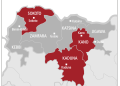
The various internal security problems in various parts of the country such as kidnapping, armed robbery, banditry and insurgency point to one irrefutable fact: Nigeria is sitting precariously on a keg of gun powder. Daily, bandits sack communities in Zamfara and Kaduna states, killing residents in their hundreds even as screaming headlines in the media tell of mass kidnap of commuters, both high and mighty.
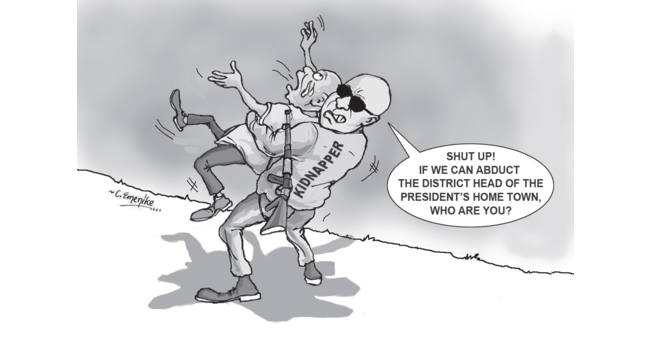
In share bravado, even the District Head of Daura, President Muhammadu Buhari’s hometown, (Magajin Garin Daura), Musa Umar, was abducted from his palace last week. Just last Sunday, gunmen kidnapped Prof. Olayinka Adegbehingbe of the Obafemi Awolowo University (OAU), Ile-Ife, at Ikire, Osun State, when the marauders stormed the ever-busy Ilesha-Ife- Ibadan highway. Adegbehingbe, an orthopaedic surgeon at OAU Teaching Hospital, was freed a day after. Also, on Monday, armed men invaded Plateau State Polytechnic staff quarters located at Heipang in Barki Ladi Local Government Area and abducted a relation of the Assistant Registrar of the institution.
Over 681 people have been kidnapped this year according to the acting Inspector-General of Police, Mohammed Adamu. When juxtaposed, the protracted Boko Haram attacks, which have defied all solutions, the continuous killings by rampaging herdsmen in many parts of the country and the communal clashes in Benue and Taraba states, they have relentlessly questioned the ability of the Buhari administration to fulfil its constitutional duties of ensuring welfare and security of the people.
One cannot discountenance the fact that the Buhari-led administration had responded positively to the security needs of the country earlier by reclaiming about 12 states hitherto in the stranglehold of the insurgents. Then, the fiendish incursion of the terrorist into the Federal Capital Territory was curtained and Nigerians heaved a sigh of relief. But that seemed a flash in the pan as the nation is once again practically brought to its knees and, paradoxically, the security agencies are canvassing for alternative ways of funding military operations to enable them meet contemporary warfare and ensure more effective performance of their constitutional roles. While we agree with the claims of the Chief of Defence Staff, General Abayomi Olonisakin, that such funds are in order to acquire requisite platforms and regularly upgrading of equipment, we hasten to say that there is more to the Nigerian security problems than increased funding.
The facts remain that several budgetary and extra-budgetary allocations to the security agencies in the past had not elicited any major improvement in our internal security.Arguably, President Buhari, whom security formed a major plank of his three-point agenda, has never starved the security agencies of requisite funds for this vital duty. Less than a year ago, he approved the sum of $1 billion extra-budgetary allocation to the security agencies from the Excess Crude Account (ECA) as a matter of urgent national importance.
Viewed against the prism of the fact that the most simplistic way to attempt to solve a problem, especially one as complex as security of over 200 million people, is to hurl billions of naira at it, it goes without saying that a security quandary of this nature has not only exposed the incapability and incompetence of the security agencies, it underscores the fact that the service chiefs have run out of ideas about the solution to these elephantine security problems.
Beyond military strategies, architectures and the proposed establishment of operational bases at the troubled spots in Kaduna, Zamfara and Borno states is the impact on socio-economic and political dimensions to security management. The cases of desperate politicians, growing army of unemployed youths currently hovering around 38 per cent in the country, geometrical rise in procreation leading to over-population, extreme poverty and illiteracy, especially in the North over the years, it is baffling that the nation’s policymakers never anticipated the current level of criminality.
Be that as it may, we posit that central to this crime control measures is massive investment in infrastructure, strong in manufacturing, technological development, education and entrepreneurship, productive workforce, thriving agriculture and stable enabling policies. Hence, a deliberate revival of the over 800 industries, which have either shut down or relocated from the country, is of great essence to absorb the youth in order to channel their robust energy into productive developmental purposes.
These can be complemented with enhanced intelligence gathering, including utilization of artificial intelligence like drones, moral rearmament and imperativeness of professionalism among law enforcement agencies. An improved criminal justice system and inter-ministerial collaboration in addressing cases of juvenile crimes are also key components of effective crime control.
Of greater importance is the need to address crippling poverty in the country, check porosity of the borders, population control and conceiving of futuristic developmental plans, while government at all levels ensure good governance and accountability as mitigating factors against criminality.
We frown at current government’s lacklustre approach to security and evidential denial of the glaring failure of the service chiefs and call for their replacement in the overall interest of the nation. Otherwise, this nose-diving security is a child’s play as the nation might well be sitting on a keg of gun powder