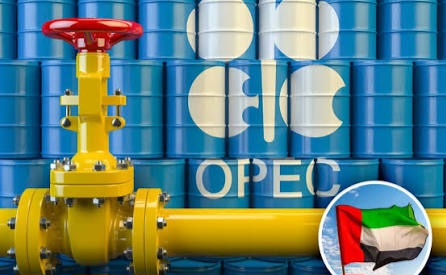
The United Arab Emirates (UAE) announced on Tuesday that it would withdraw from the OPEC and OPEC+ oil cartels on May 1, after being a key member of the world’s largest energy body for five decades.
“This decision reflects the UAE’s long-term strategic and economic vision and evolving energy profile,” the official WAM news agency said.
Announcing the decision, the Minister of Energy and Infrastructure Suhail bin Mohammed Al Mazrouei, in a statement on X, said, “The UAE’s decision to exit Organisation of the Petroleum Exporting Countries reflects a policy-driven evolution aligned with long-term market fundamentals. We thank OPEC and its member countries for decades of constructive cooperation. We remain committed to energy security by providing reliable, responsible and lower-carbon supply, while supporting stable global markets.”
The UAE, one of the world’s top oil producers, has previously pushed back against production quotas set by OPEC countries. It cited “national interest” and a commitment to meeting “the market’s pressing needs” as the basis for its decision.
“This decision follows a comprehensive review of the UAE’s production policy and its current and future capacity. It is based on our national interest and our commitment to contributing effectively to meeting the market’s pressing needs,” a statement carried by the official Emirates News Agency said.
It added that the move reflects a policy-driven evolution in the UAE’s approach, enhancing flexibility to respond to market dynamics while continuing to contribute to stability in a measured and responsible manner.
Describing the Emirates as a “trusted producer of some of the world’s most cost-competitive and lower-carbon barrels,” the UAE said it would act responsibly by bringing additional production to the market in a gradual and measured manner, in line with demand and market conditions.
The statement also highlighted the UAE’s significant contribution and “even greater sacrifices” for the collective benefit during its time in the OPEC and OPEC+ alliances. However, it said the time has come to focus on national interests and commitments to investors, customers, partners and global energy markets.
The decision follows long-standing tensions between the UAE’s large-scale investment in production capacity and the cartel’s policy of strict output cuts aimed at supporting prices. The move allows the country to pursue its target of raising capacity to 5 million barrels per day by 2027, free from OPEC+ quota constraints.
Having joined OPEC in 1967, the UAE’s exit marks the end of nearly six decades of membership and comes after a series of disagreements over production quotas and capacity targets. – WION.