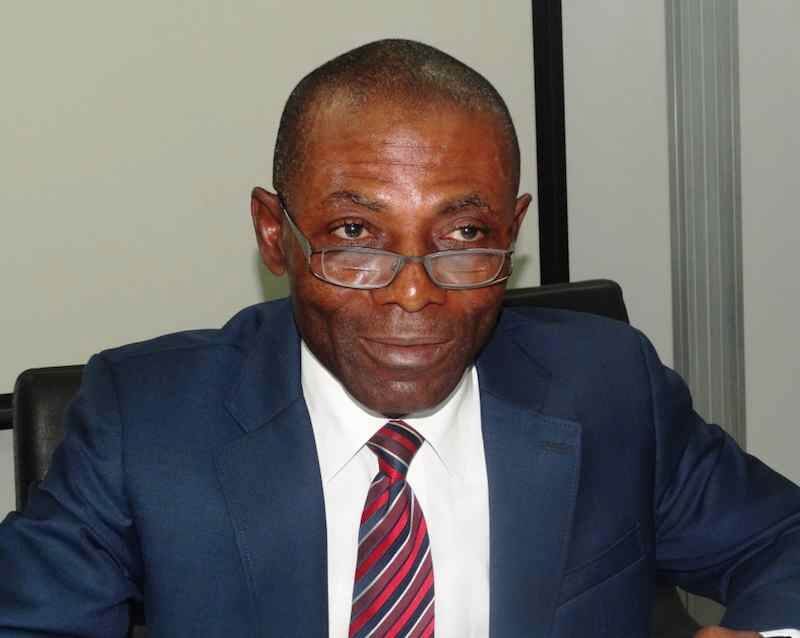
In this interview, the Auditor-General for the Federation, Mr. Anthony Ayine, says since the Office of the Auditor-General for the Federation is the only watchdog established by the constitution, it can fight corruption better than any other anti-graft agency, provided the Senate passes the Audit Bill.
Could you tell us exactly what your office is all about?
It’s an office that has been doing much, but it appears as if it’s not visible. Section 85 of the Nigerian Constitution is very clear about the function of the Office of the Auditor-General for the Federation. We have a mandate to audit all public accounts of the federation, that is, all public offices, including the courts. Basically, our function is to protect the public interest by carrying out detailed examination of the national accounts and submitting reports to the National Assembly and the essence of it is for the purpose of accountability. Quite often, people talk about good governance without knowing the critical ingredients that make good governance. Before you can have good governance, you must have transparency and accountability, and so basically, the Office of the Auditor-General for the Federation is to ensure transparency and accountability. Once you have these, you can be sure of good governance being in place.
So what is the difference between the Office of the Auditor-General for the Federation and that of the Accountant-General of the Federation?
The difference is that the Accountant-General’s office is concerned with maintaining accounts, carrying out transactions and drawing up accounts and financial statements. The Auditor-General’s work is to examine accounts prepared by the Accountant-General and to give an unbiased and objective opinion whether these accounts present a true and fair view of the transactions of the government and to also confirm if the financial position as disclosed by the Accountant-General reflects the true position of the state of affairs at a particular time. So, the two people’s functions are different. While the Accountant-General prepares accounts, the Auditor-General gives an assurance that the accounts are true. Now, when foreign investors want to invest in Nigeria, they will look at the financial statements prepared by the Accountant-General, but what will give credibility and assurance that they can invest in the country is the assurance that is provided by the Auditor-General. And this is exactly why we have been clamouring for the independence of the Office of the Auditor-General for the Federation because when investors or analysts or other stakeholders are interested in the accounts of a nation, they would expect to seek the opinion of the Auditor-General, whether he had carried out a solid work and certified the accounts.
Could this mean that the Accountant-General and the Auditor-General must not be close friends?
I don’t think so. It’s not really that way; they could be friends, but this is where the question of integrity comes in. The Auditor-General must have integrity because if there is no integrity, you are empty. Being an Auditor-General doesn’t mean isolating yourself. If the friendliness is not there, you will even face challenges because the data, information and explanations you will work on are being provided by the Accountant-General. So if there’s no friendliness — which shouldn’t be translated to “compromise” — you might have some challenges. There must be a sort of friendliness with the people you supervise, otherwise, you may not be able to get every information you need for the purpose of your audit. The key thing is that the Auditor-General must be conscious of their integrity and be ready to preserve it at all times. This is again why we have been clamouring for the Office of the Auditor-General’s independence because when you are not, you are constrained and it affects your work.
Talking about independence, for quite some time, your office and stakeholders like the Institute of Chartered Accountants of Nigeria have been asking the Senate to pass the Audit Bill, which has already been passed by the House of Representatives. Why do you think the Senate has been hesitant to pass the bill?
Perhaps they don’t have the proper perspective of the importance of the independence of the Auditor-General’s office and that is why at a recent retreat, we considered it necessary to interact and exchange ideas on what if the Auditor-General’s office is independent? How will it affect the relationship between the Senate and the Office of the Auditor-General? They need to understand what benefits will be accruable not only to the Senate, but also to the country. Second, perhaps we need to do more enlightenment in terms of the contents of the bill, the benefits therein. I have the conviction that the Senate should, by the time it gets to understand exactly what the country will benefit when the Office of the Auditor-General is independent, pass the bill. I think what we need to do is to interact more and have a more robust relationship with the Senate and explain these issues to them should there be some areas they don’t understand in the bill. It’s a little bit sad that Nigeria, being the giant of Africa, is still at the bottom of a rating by the African Supreme Audit Institutions in the English-speaking countries, popularly called Afrosai-E. We have a rating from levels 1 to 5. Nigeria is currently at level 2. Smaller African countries are at levels 4 and 5.
One key element is that the Supreme Audit Institution must be independent, both legally, administratively and financially. This key element has been holding down the SAI in Nigeria. There’s an Afrosai-E monitoring committee which comes to assess to what extent every country’s SAI has gone. They do check whether there is independence at three aspects of legal, administrative and finance. Here, we have a situation whereby our personnel still have to go to the Federal Civil Service Commission and the Head of Service is the one posting staff to the OAuGF. This is not acceptable by the Afrosai-E. That is a minus as far as the audit institution is concerned. What about funding? This is a challenge: For instance, in the 2017 budget, what the OAuGF got is very discouraging. Outside the personal emolument, we have about N700m. I mean, this is too paltry. With this kind of funding, the international community just looks at us as if we are not serious. What can you do with that? So, independence must not only be legal, which we already have, administrative and financial independence are also key and there is no way we can move to level 3 with our current situation. However, I believe that the Senate, by the time it understands all these issues, will pass the Audit Bill. There are many African countries asking us, ‘Nigeria, what’s happening? Take the leadership.’ Unfortunately, we can’t because we don’t have the independence which they have. The House of Representatives has passed the bill, but we hope the Senate will see the reasons why the Auditor-General’s office must be independent through the passage of the Audit Bill to law, even if it means amending certain aspects of the bill.
You assumed the position of the Auditor-General in January 2017. What should Nigerians be expecting from you and how do you intend to achieve those goals?
My vision right from time is to run an Office of the Auditor-General that will deliver its services effectively and ensure that we have credible audit reports. So far, in the office, what we have is what is more of compliance and regulatory audit, but globally, the audit profession has moved away from compliance and regulatory to aspects like performance audit. If you look at Nigeria today, there are quite a number of areas where we have environmental challenges. Now, we should be able to branch into this specialised area. The government is carrying out a lot of programmes, but it is not enough to keep asking questions whether they are complaint to so-so regulation or not. What about the impact of those programmes on the lives of the people? What can measure the impact of government programmes is performance audit. We should be able to carry out performance audits on government programmes and say boldly that a so-so programme introduced by the government achieved a so-so level of impact. Was the programme carried out economically-effectively and efficiently? These are the three Es in performance audit or value-for-money audit. Are we getting value for all these programmes? For instance, in Nigeria, we are not lacking in terms of programmes, for example, Operation Feed the Nation, National Directorate of Employment, and so on. But at the end of all these programmes, do we really have the desired outcome or impact? If we can branch into specialised area of audit, we should be able to measure the use of the resources we have. If you look at our environment, it is so sad and that is why President Muhammadu Buhari has been firm in terms of fighting corruption. Being aware that we are in a corruption-infested country, we need to also begin to look at forensic audit because you would discover that a lot of fraud cases go to court. Forensic audit will help us to gather evidence that can stand a legal test so that we don’t have to wait until matters have gone to court before gathering evidence. We need to be proactive and think of having a forensic laboratory. I have this in view already because the Nigerian people should be getting value from the resources deposited in the country and the efforts of government.
Are you going to see to it that this idea is implemented?
Yes, but the key thing is having the personnel, which is where capacity building is necessary. Training is key; we need to get the required staff. And by the way, another aspect of audit that we need to implement is Information Technology Audit. The world is digital now and so we need to have a robust IT audit because quite a number of Ministries, Departments and Agencies are going into electronic processing and we should not be talking of manual audit in this age.
Recently, I was discussing with my data centre consultant that we should have a situation where the Auditor-General can sit on his desk and assess accounts of MDAs. Anywhere there are red flags, I can then move in to carry out the audit task and stop monitoring physically. With technology, this is possible. I should be able to see suspicious transactions right from the computer. Let me give you a scenario: We have seen clearly that in this country, once somebody has taken out money, the chances that you will recover 100 per cent of the fund is very low, considering the cost of litigation, the efforts at recovering the money and so on. So we have to use technology to prevent certain things from happening. Preventive measure will pay off handsomely rather than wait until the money is gone and then start looking for how to recover it.
If the country is able to implement all these ideas, then fighting corruption would be made easier…
Definitely. If you look at it, the Office of the Auditor-General for the Federation is the only office constitutionally empowered and mandated to address the issue of corruption. Agencies like the Economic and Financial Crimes Commission and the Independent Corrupt Practices and Other Related Offences Commission are Acts of the National Assembly and as you are aware, the Constitution is superior to Acts. So, the OAuGF is the foremost institution that, if properly empowered, can fight corruption effectively.
In 2014, a former governor of the Central Bank of Nigeria, now the Emir of Kano, Sanusi Lamido Sanusi, raised the alarm that over $20bn was missing from the Federation Account, saying that the Nigerian National Petroleum Corporation had failed to remit the amount between 2012 and 2013. Then-President Goodluck Jonathan government denied that any money was missing and Sanusi was afterwards fired. If you say the OAuGF is the only office constitutionally empowered to fight corruption, could we say the Auditor-General at that time was incompetent not to have discovered the disappearance of such amount of money?
I don’t think so. Problem usually comes from the treatment of audit reports. Some of the major alarms about missing funds being published in the media are already in audit reports. That’s the truth. If you have access to the audit reports, some of these discoveries, even the missing $20bn alarm then, were already in the audit reports. The problem is that these findings are not available to the public, but only before the National Assembly. The way the Office of the Auditor-General for the Federation works is just to report our findings to the National Assembly, which now has the responsibility of considering the reports and taking actions on them. Recently at a retreat, we reached an understanding with the National Assembly that once audit reports are submitted, they should be made available to the public as it is done in the advanced countries. By the time this agreement is finalised, audit reports will be made available to every citizen.
Is your office collaborating with the EFCC and ICPC in fighting corruption in the country?
Yes. In fact, we have so far identified 16 critical stakeholders to work with in fighting corruption in Nigeria. We can best fight corruption when there is a synergy among stakeholders. We have also moved ahead in identifying contact persons in these agencies for free flow of information so that we can help the President in fighting against graft.
As you are doing this at the national level, are you also collaborating with Auditors-General in states so that the fight against corruption can be across board?
Definitely. In fact, we have made an arrangement so that the Auditor-General for the Federation can be having an interface with those at the states and local governments. We are discussing and planning, if budgetary provision permits us, to be having an annual conference, where we can discuss matters of common interest to our works, and as the Supreme Audit Institution in Nigeria, we should be able to develop training programmes at both the local and international levels for everyone. The fight against corruption has to be holistic because if we are only fighting it at the federal level and we are neglecting states and local governments, there will be problems. While you are making progress at the national level, states and local governments will drag you down if they are not also fighting it. So the best approach is to move together. If you even consider the fact that the majority of the population is in the rural areas, it is simply wise to work together.
It is believed that you as the Auditor-General should be advising the Federal Government on the management of public funds. As the government has been on a borrowing spree, what are you doing to ensure we don’t choke our nation with huge debts?
Borrowing as a concept is not wrong; it is utilisation of the borrowed funds that is the critical aspect that people should be concerned with. If you are borrowing to address infrastructural problems like the present government is doing, if you are not borrowing for consumption, I don’t see anything wrong with the borrowing. I think people are only looking at the figures being borrowed as huge, but if you look at the international yardstick for borrowing, what is the relation of borrowing with our Gross Domestic Product? Recently, during the budget analysis by the Minister of Budget and National Planning [Senator Udoma Udo Udoma], it was shown very clearly that we were at around 2.4 per cent as compared to the minimum international benchmark of three per cent, meaning that we are still fine. So the questions we should be asking before getting worried is: Is the Federal Government borrowing to consume or to address critical infrastructure like power and roads?
So, what is your role in ensuring that the government is doing exactly what it said it would do with the borrowed funds?
Our role is to look at the purpose of the borrowing (What are the projects the money is borrowed for?) and the terms of borrowing, whether they are favourable to the country or not. So at the point of auditing, we are going to see whether the funds were used to execute the projects they were meant for. If there is any red flag at the stage of auditing, we can then raise the alarm, draw the attention of the government if there is any diversion and make recommendations.
Since you resumed office, what moves have you made to block revenue leakages in the country’s agencies?
As you know, oil has been the major revenue earner for the country, then the Federal Inland Revenue Service and then the Customs. You earlier raised the issue of the missing $20bn at the NNPC in 2014. Right now, what we are looking at for the NNPC is the cost of collection. I have yet to meet with the Group Managing Director [Dr. Maikanti Baru] to discuss this issue, though. For similar issues that are in our audit reports, our advice is that like what’s happening at the FIRS and the Customs, where there is an approved percentage that is paid for cost of collection, around four per cent or so, we are recommending a similar thing for the NNPC, because their own cost of collection is deducted at source. We are suggesting that revenue from the sale of crude oil should be paid into the federation account, then there should be an agreed percentage accruable to NNPC as cost of collection. I think this will be a better approach to ensure transparency.
Based on the current audited accounts of the federation, do you think foreign investors are confident of investing in the Nigerian economy?
I think from available information, there is very clear confidence in the Nigerian economy because many investors are showing interest in the various sectors of the economy, including mining and agriculture.
Would you say independence of the Office of the Auditor-General for the Federation will enable you to fight corruption better?
Definitely. Let me give you an example: When we say this is the foremost institution that can fight corruption better, when we go to any ministry or agency, we do system review, control and transactions. Now for other anti-corruption agencies, their activities are mostly based on petitions. The question is, what happens if there is no petition? That means they would have nothing to do. On the other hand, the Office of the Auditor-General doesn’t work based on petitions; the office investigates all accounts of public agencies, so it is better placed to fight corruption. But the handicap is proper funding and this independence we are talking about. I have a personal conviction that once these matters are addressed, we will deliver results.
Better than the EFCC and the ICPC?
Definitely.
– Culled from Punch.