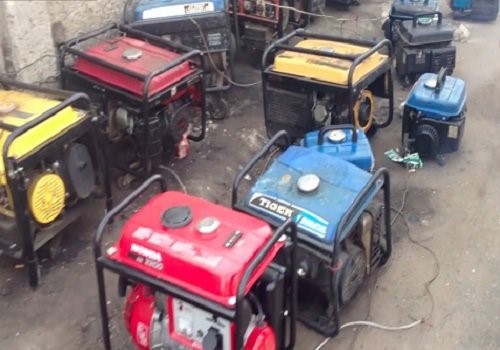
The Federal Capital Territory Administration (FCTA) has reportedly begun the implementation of its policy imposing annual levies on business organisations that use power generating sets as a source of power supply in the Federal Capital Territory (FCT), Abuja. The administration has reportedly contracted the services of the staff of the Abuja Municipal Area Council (AMAC) and the latter have reportedly commenced the distribution of payment notices to the affected businesses in the FCT. Specifically targeted under the new and controversial tax initiative are business organisations like industries, banks, warehouses, manufacturing companies, construction companies, petroleum and gas filling stations, among others, whose activities and operations, especially through the use of generators, result in the discharge of harmful and hazardous substances into the air, land and water within the FCT. The policy is ostensibly aimed at reining in environmental pollution by curtailing the level of toxic gaseous emissions into the environment, but it is difficult to fathom how that lofty objective of a cleaner environment will be achieved when there is inadequate supply of electricity, except the FCTA is suggesting that businesses should shut down.
Ironically, the same government that is imposing fees on users of generators is the one that has the responsibility for ensuring adequate supply of clean energy, but it has continually failed woefully in that regard. Thus, in a sense, it would appear that the government is punishing businesses for its ineptitude, inefficiency and ineffectiveness by asking them to pay a fine for using generators. The scenario is grim and confounding: many businesses rely on electricity, among other economic infrastructure, to thrive, but the official supply of clean energy is far less than the optimum requirement. Individuals and organisations resort to helping themselves by procuring and running generators at a huge financial cost in order to fill the electricity supply gap, yet the government has turned around to rub salt in their wounds by introducing an obnoxious tax policy. That is rather draconian, callous and unacceptable.
Quite a few questions beg for answers: what is the essence of imposing a levy on generator use when it is evident that the tax cannot reduce the impact of the discharge of deleterious fumes into the environment since generators will continue to be used by businesses in the face of unreliable supply of electricity? Will businesses stop seeking alternative sources of power supply, including the use of generators, when supply from the official source remains grossly inadequate? Or does the government intend to cripple businesses? And whose duty is it to make sure that there is a clean environment?
If the government provided adequate supply of electricity, would there be any need for generators? What choices do the people have if they don’t use generators—shut down their businesses? And what is the intended application of the levies on users of generators? Is the FCTA applying the revenue so generated to clean the environment and/or subsidise access to healthcare? Or is the levy on generator use just another avenue for raising revenue by the FCTA? It is rather unfortunate that oftentimes, official decisions and actions are not well-thought-out and, as such, they cannot withstand a rigorous evaluation and assessment in terms of the net benefits to the system. The government on the one hand seems to be harping on the need to improve the ease of doing business in the country which, of course, necessarily includes cutting down on the cost of doing business, but it is on the other hand inadvertently increasing the cost through such suboptimal policies like the instant case of meaningless levy on generator use.
The Gaseous Emission Permit Limit scheme under which the FCTA is taxing users of generators is inappropriate simply because there is no firesure alternative to the use of generators as a major source of power supply to businesses and homes as yet. The FCTA is, therefore, urged to limit itself to regulating the type of generators businesses should use to minimise noise pollution and perhaps advise on the orientation of the exhaust and effluent pipes of generators and other industrial equipment during installation in such a way that minimises the impact of harmful gaseous emissions into the environment. Except those who may want to play the ostrich, everyone knows that the average business owner who wishes to succeed in this country must assume the role of a municipal government providing road, water, electricity and so on. And as if that is not burdensome already, (s)he has to be penalised for playing an official role (s)he would have enthusiastically avoided if (s)he had a choice.
The FCTA should rethink its harsh policy as it is patently anti-business. Official mindless exaction from businesses can only lead to further immiseration of the operators whose enterprises are already groaning under the yoke of escalating cost of doing business. The ultimate solution lies in adequate provision of power supply; that is what can ensure that businesses make little or no recourse to the use of generators to power their operations. That way, the objective of a cleaner environment will be achieved. Also, businesses operating under a regime of cleaner energy and relatively cheaper power supply will increase their profitability and pay more taxes to the government without the latter’s recourse to official extortion of the former by subterfuge.