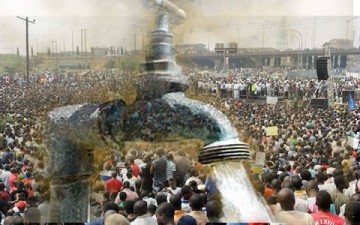
For millions of people in Nigeria, getting access to safe water for drinking and sanitation has always been a mirage. This bleak outlook was reinforced during the 2015 World Water Day when UNICEF stated that “63.2 million Nigerians have no access to safe drinking water.” This is depressing. In a population estimated at about 170 million, having this huge figure living without safe water and sanitation demands urgent solutions from the three tiers of government.
Not only do the people toil to get water, women and young girls waste valuable time in their search for water. The corollary is that many more Nigerians contract water-borne diseases from using contaminated water. Also, as a result, “over 110 million people (in Nigeria) do not have access to improved water sanitation,” the UNICEF report on the event, which had “Water and Sustainable Development,” as the theme, said.
“(About) 150,000 children die in the country (annually) largely due to diarrhoea-related diseases that are mostly associated with unsafe drinking water,” Kanaan Nadar, UNICEF’s representative in Nigeria, said. Although Sarah Ochekpe, the Minister of Water Resources, says that the Federal Government has improved access to water by 67 per cent, her enthusiasm is mitigated by the harsh reality on the ground.
According to a 2014 research conducted by U-Reports, 30 per cent of the Nigerians polled said they depended on sachet water as their source of drinking water, while 41 per cent said they were not sure about how safe the water they were drinking was. Another 38 per cent said they did nothing to improve the quality of the water they drank. This is unhealthy.
Ochekpe admitted the culpability of government, saying that even public water supply agencies across the country “distribute water that is inadequately disinfected to the people.” To check water-borne diseases like guinea worm, typhoid and cholera, it is imperative for radical solutions on the part of the three tiers of government, a fact underscored when the minister said, “Seventy per cent of common tropical diseases are water-related and can be eliminated if adequate supply of water … is provided to the public.” Consequently, many Nigerians who can afford it have resorted to digging boreholes, not minding the impact on the environment.
Statistics from the World Health Organisation indicate that citizens of Nigeria and other developing countries will continue to suffer grave health hazards because of water-related problems. It is a common sight in our urban centres to see girls and women with buckets searching for water every morning. In a joint report in 2015 by WHO and UNICEF, the two organisations said “38 per cent of people in 54 low- and middle-income countries lack access to even rudimentary levels of water, and 19 per cent are without sanitation.”
It is a cruel fact of life in Nigeria that a majority of our public hospitals lack basic running water for washing after minor procedures, sanitation and hygiene. According to UN Water, an estimated “748 million women, men and children lack access to an improved source of drinking-water” in the low-resource countries of the world. This fact was corroborated by the joint report, which said, “More than one in three health care facilities in low-resource settings do not have any access to water at all.”
Experts say that unsafe water has serious implications on hygiene, child mortality, poverty, hunger, maternal health and diseases. The water problem is compounded as more and more people migrate from the rural areas to cities. UN Habitat, in a 2015 report, said that because of “rapid urbanisation, increased industrialisation, and improving living standards generally combine to increase the overall demand for water.” The effect is that “about 2.5 billion people – or more than one-third of the global population – live without basic water,” according to UN Water estimates.
But water is important to life. This was acknowledged by Leonardo da Vinci, who said, “Water is the driving force of all nature.” With a concerted effort by the three tiers of government, the water situation in Nigeria can improve dramatically, as happened in Zambia in 2010, when it faced a similar water conundrum. In that African country, its Ministry of Health, with support from the Tropical Disease Research Centre and other aid agencies, installed small water stations for safe drinking and hand-washing in 150 health care facilities, and drastically reduced diarrhoea among its populace.
Nigeria, which raked in $45 billion in 2011 and $32.3 billion in 2014 as oil income, according to figures just released by the International Monetary Fund, could follow such a lead from Zambia and even improve on it since the country has a better resource base.
Projects like the $273 million Third National Urban Water Sector Reform Project, which is backed by the World Bank, should be fully implemented to the benefit of the citizens. Through these kinds of projects, UN Water said it was able to provide access to water for 2.3 billion people across the world between 1990 and 2012, making deaths from diarrhoea among children to fall from 1.5 million to 600,000.
One way to re-draw the map is for our local, state and federal governments to commit to the construction of micro and macro waterworks at a steady pace. If every local government area in the country builds mini waterworks annually, it would provide a huge relief for our teeming population. Their efforts should be supplemented by the 36 states, and the Federal Government.