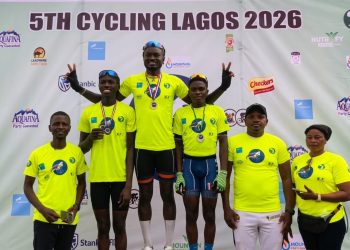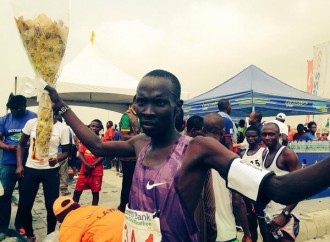
As Kenyan runner, Abraham Kipton, breasted the tape at two hours 16 minutes 19 seconds to win the grand prize of $50,000 of the Lagos Marathon yesterday, many Lagosians were trapped in traffic gridlock that built around alternative routes provided for commuters.
Though there was awareness campaign on partial restriction of movement to make way for marathoners that took to the highways, Lagos residents were stuck at bus stops at affected routes, complaining of the inconvenience experienced in navigating around the city.
Many motorists crowded the alternative routes from 6:30am when the marathon routes, such as Ikorodu Road, Third Mainland Bride, Falomo, Lekki-Ikoyi Link Bridge and Ozumba Mbadiwe, were closed. The Guardian observed that the entire stretch linking Ikorodu Road and many adjourning roads were blocked, leaving motorists, who had set out at the wee hours to get to their destinations before kicked off time, wedged in the snarl for hours.
At Oworoshoki end of the Third Mainland Bridge, many motorists had to turn off their engines and waited till mid-day before the road was reopened for movement. There was slow, chaotic traffic from Toyota to Anthony bus stop, where the road had been shut for marathoners that were connecting the Third Mainland Bridge from the axis.
The Guardian observed that some commercial drivers heading for Ketu and Ikorodu from Oshodi picked passengers on the opposite lane, navigating through the inner streets in Oshodi to circumvent the slow traffic. Beside, commuters had to pay more as commercial drivers inflated fare from between 50 and 100 per cent.
A commuter, Segun Adebisi said though the Lagos Marathon tournament is a nice idea, the state government needed to ensure that residents do not suffer unnecessarily. He suggested that the next edition should be held on an environmental day, so that the traffic burden would be less, adding, “any disruption in the traffic flow of Lagos always results in negative implication.”
Some Lagosians, who were not aware of restrictions on movement, said they had to suspend whatever business they had for the day because of the delay in getting to their offices. Bolanle Johnson, who resides in Gbagada, said although the restriction may have benefitted the state in some measure, many businesses have suffered for the time that the roads where closed, adding “I think the tournament would be a big tourist attraction in years to come, but government has to plan carefully, such that businesses would not suffer adversely from the closure of roads.”
The state government explained that it had announced the road closure, saying the roads were blocked for the teeming marathoners to move freely without being knocked down by moving vehicles. Lagos State Governor, Akinwunmi Ambode, said the Lagos Marathon has come to stay, assuring that the state would work towards making the competition the best of its kind in the world.
In a statement by the Chief Press Secretary to the Governor, Habib Aruna, Ambode was said to have expressed delight in the massive turn out of international and local athletes for the Marathon, adding that Lagos was proud to join major cities in the world to promote the Marathon.
“Lagos State is glad to host athletes from different parts of the world today as we flag off the Lagos City Marathon. The last time this event held was 30 years ago. I stand here to tell you today that this event is here to stay. We are committed to sustaining this event and ensuring consistent improvement to make it one of the best marathons in the world,” he said.
He said that government combined entertainment, sports and hospitality with the Marathon, to create jobs for the people and allow the youths to engage themselves positively. One of the athletes, Lekan Taiwo, said, “I am really impressed with the Lagos State Government. From the take off point, it was obvious that a lot has been put into the planning of this event. I saw ambulances; traffic control officers at strategic locations and even street sweepers were on ground to clear the waste generated from the participants. We had people coming out to cheer us up. This is commendable”.
Another Kenyan, Kipkemboi Hosea, came second posting a time of 2 hours 16minutes 34 seconds and cart home the $40,000 prize. Debebe Tolosa of Ethiopia finished third with a time of 2 hours 16 minutes 40 seconds and went home with $30,000.
In the female category, Halima Huseen Kayo of Ethiopia finished first 2 hours 38 minutes 32 seconds, while Alice Timbilil from Kenya came second in a time of 2 hours 38 minutes 49 seconds and Aberash Feyase from Ethiopia finished third in a time of 2 hours 39 minutes 9 seconds. The Guardian