Advocates of restructuring were told yesterday to take it easy.
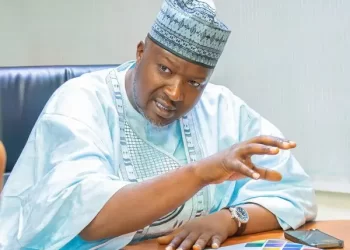
Their “agitation” and “provocative rhetorics” cannot achieve their dream, Minister of Justice and Attorney-General of the Federation Abubakar Malami (SAN) said.
He warned those behind the quest for restructuring to avoid demonstrations because “it is a complex process”.
He said although Nigeria’s federal system had been experiencing challenges, its reforms could not be done in one fell swoop.
Besides, democratic means should be deployed to reform the federal system, according to Malami.
In his view, the abolishment of states through restructuring will have multiplier effects on the nation.
Such effects, according to him, include downsizing of the National Assembly and abolishing State Houses of Assembly.
Malami made the submissions in an address at a one-day think tank conference in Abuja , which was organised by the National Institute for Policy and Strategic Studies (NIPSS).
The theme of the conference was “Federalism and the challenges of dynamic equilibrium in Nigeria: towards a national strategy”.
The AGF’s speech to the nation’s think-tank(NIPPS) was the first official reaction to the agitation for restructuring.
Malami said: “In Nigeria today, there are demands for restructuring, for deconstructing the excessive concentration of powers at the Centre, for a dispersion of power to the lower levels of government along with special provisions for the empowerment of women and other socially disadvantaged groups for the country to move away from the cooperative federalism of several decades to a more competitive form of economic federalism, for a fiscal federalism that presents the challenges of addressing regional inequalities and of balancing the concerns of equity and efficiency in intergovernmental fiscal relations, among many others.
“Federalism is imbedded in our constitution as contained in sections 2,3 and 5. It is not out of place to state that as far as our constitutional democracy is concerned, the idea of restructuring is not a function of advocacy or agitation. It is about constitutional accommodation and or alternative constitutional amendment.
“As things stand, restructuring requires amending the constitution to accommodate referendum or, in the alternative, a constitutional amendment to the 1999 constitution, which in this case must be supported by majority of legislators in 24 states of the federation as enshrined in Section 9 of the constitution.
“Whether that process is going to be an easy sale is a conjecture that should be left for deliberation. But one thing that is certain is the inevitable implication that abolishing states through restructuring process will certainly translate to the eventual multiplier effect of abolishing the state house of assembly and perhaps downsizing the National Assembly and probably the civil service and other related federal institution.
“This indeed is a tall order that cannot be achieved through advocacy, emotional outburst or provocative rhetorics and demonstrations. The beauty of democracy is in the process and legislative process is in our case the only answer.”
Malami, who admitted that the nation’s federalism was facing challenges, said restructuring cannot be achieved overnight.
He added: “It is true that Nigeria’s federal system has been experiencing challenges and there have been agitations and prescriptions to reform and modify it. Reforms and modifications, institutional arrangement, systems and processes are normal in festoons, but are not done in single swoop as being advocated in Nigeria. Mega changes are not healthy for federations.
“Change is a gradual process that must be democratic and subjected to legislative and administrative processes as provided by law. We must use democratic means to reform our federal system. We need to recognise that both federalism and democracy are mechanisms for managing diversity.
“Indeed, while federalism provides the Institutional framework for managing diversity, democracy makes possible the negotiation for diverse identity claims by providing them with representation, voice and political mechanisms by which the competing claims are balanced and reconciled.
“There is no true or false federalism. Indeed, there is no single, pure ideal federal model that is universally applicable everywhere. Each federation reflects the particular conditions and circumstances that produce it.
“We cannot wish away the particular conditions and circumstances that have produced the challenges in our federal system. We must use democratic means to find solutions to these numerous challenges. It is democracy that articulates citizens’ preferences and places limits on arbitrariness.
“As political realities and experiences across the world have shown, all federations, whether established by a coming together or holding together process, experience deep rooted conflicts and ours cannot be an isolated case.” – The Nation.