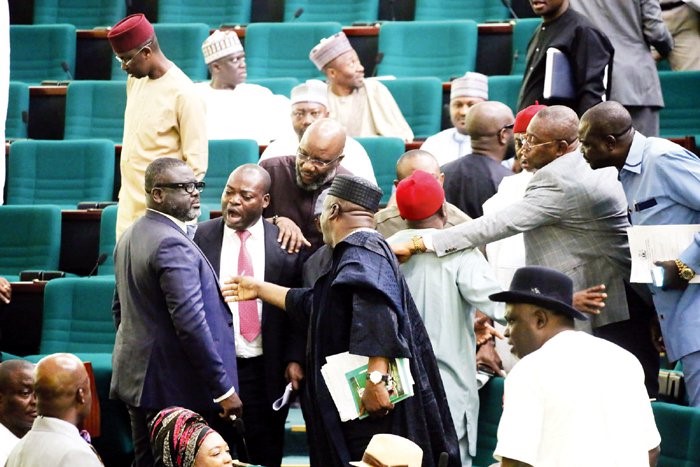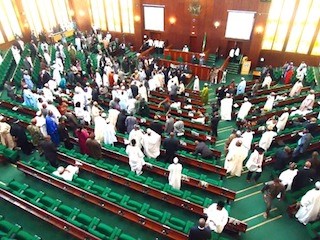
A Bill proposing six months’ imprisonment for persons who distort queues in public places on Thursday scaled second reading at the House of Representatives.
The Sponsor of the bill, Rep. Abubakar Amuda-Kannike (Kwara-APC), while leading debate on it, said that it sought to ensure that Nigerians conducted themselves orderly in public places.
Amuda-Kannike said that it was normal practice for some Nigerians to shunt or distort queues and go unpunished.
He expressed worry that recent events had shown that Nigeria was on the verge of losing its cherished sense of nationalism, cultural identity and hospitality.
“The bill underscores the need to re-awaken a derailed national culture by proposing disciplinary measures to guide Nigerians in their daily behaviours.
“In our society today, out of total disregard for other persons, who strive to do the right thing by conducting themselves orderly in public places, a large number of Nigerians distort queues and go unpunished.
“The bill if passed shall provide a starting point of value and cultural re-orientation in Nigeria,” the lawmaker said.
He expressed optimism that the bill if passed, future generations would have a more sane society that would help to shape morals, principles and respect for each other in addition to adequate awareness on what constitute nationhood.
He decried the prevailing level of corruption, indiscipline, disrespect to elders and the rule of law in the country.
“The bill underscores the need to re-awaken the derailed national culture by proposing disciplinary measures to guide Nigerians in their daily behaviours.
“Any nation that is not organised cannot have rapid growth.
“We should be seen as organised people from point of entry but we have accepted that anything goes.
“Every school should have civic education in its curriculum to instil patriotism and orderliness in the country,” Amuda-Kannike said.
Contributing, Rep. Sam Onuigbo (Abia-PDP) said that the bill would also ensure orderliness, equity, fairness and justice in the distribution of services in the country.
“It will be nice for us to be seen as orderly people from the point of entry into the country,” Onuigbo said.
Rep. Ayo Omidiran (Osun-APC) said “by being orderly in all our activities, we will be transmitting good behavioural pattern to generations and this will promote a better society”.
After the debate, the bill was passed for third reading through a unanimous voice vote.
Meanwhile, the Senate is proposing the return of tolls on federal roads and the setting aside of 0.5 per cent of transport fares paid by mass transit passengers for inter-state trips to generate funds for the rehabilitation and maintenance of roads in the country.
A levy of N5 will also be imposed on every litre of Premium Motor Spirit (petrol) and Automobile General Oil (diesel) imported or refined in the country for the same purpose.
These were part of the recommendations of the Senate Committee on Works on the National Roads Fund Establishment Bill, 2017 “for the purpose of financing the maintenance and rehabilitation of national roads.”
Consideration of reports by the committee on the National Roads Fund Establishment Bill and the Federal Road Authority Establishment Bill, 2017 was listed on the Order Paper of Thursday.
The lawmakers, who began with the consideration of the Federal Road Authority report, however, stepped down the consideration of the National Roads Fund report to another legislative day.
In the report on the National Roads Fund, the panel listed the sources of funding to include a fuel levy of N5 chargeable per litre on any volume of petrol and diesel products imported into the country and on locally refined petroleum products.
Other sources are axle load control charges and tolls not exceeding 10 per cent of any revenue paid as user charge per vehicle on any federal road designated as a toll road, which will not be applicable to roads under public-private partnership plans.
The panel also recommended international vehicle transit charges and inter-state mass transit user charge of 0.5 per cent deductible from the fare paid by passengers to commercial mass transit operators on inter-state roads.
It also proposed a roads’ fund surcharge of 0.5 per cent chargeable on the assessed value of any vehicle imported at any time into the country, as well as lease, licensing or other fees, which shall be 10 per cent of the revenue accruing from the lease or licensing or other fees pertaining to non-vehicular road usages along any federal road and collected by the federal roads agency.
The National Roads Fund is also expected to generate revenue from grants and loans as well as “gifts of land, money or other property.”
The Senate Committee on Works listed the objectives of the bill to include the establishment of the National Roads Fund “to be a repository of revenues from road user related charges and other sources for financing, which shall be managed and administered for routine and periodic maintenance works on roads in Nigeria.”
It said the proposed fund would provide “predictable and sustainable funding for road maintenance and promote the sustainable management of the road networks; establish the governing board, which shall be responsible for the management of the fund; and create an enabling environment for private sector participation, management and financing in the road sector.”
The lawmakers recommended that the National Roads Fund be established with high level of independence under the jurisdiction of the Federal Ministry of Finance, which would only oversee it for policy direction.