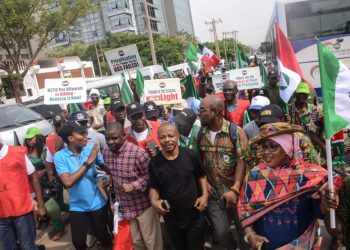
For the past one week, the relative peace previously enjoyed by all and sundry in Oyo State has been arrested by the confrontation between the organised labour and the state government following the latter’s new policy on public secondary schools. Citing what it called the “deteriorated state of our education,” the state government had unfolded an initiative which it said aimed at participatory management of public secondary schools, some of which had been taken over by the government from their original owners, including religious missions and private individuals, during military rule. The decision, coming on the heels of a fast approaching recession in the economy, general hike in the price of goods and services and festering unemployment, naturally aggravated the rank and file of the Nigeria Labour Congress (NLC), which mounted protests calling on the Governor Abiola Ajimobi-led administration to reverse its decision.
Ironically, a stakeholders’ meeting convened by the government to iron out issues on Wednesday, June 1, was aborted by members of the state chapter of the Nigeria Union of Teachers (NUT), the main umbrella body of teachers in secondary schools and an affiliate of the Nigeria Labour Congress (NLC). Miffed by the action of the labour leaders, the state police command promptly charged them with unlawful assembly and assault on the Secretary to the State Government (SSG), following which they were remanded in Agodi Prisons, pending the application for bail. Those incarcerated are the state chairman of the NLC, Comrade Waheed Olojede; the NLC deputy chairman, Comrade Sodo; the NLC state secretary, Comrade C.K Ogundeji; the state chairman of the Nigeria Civil Service Union (NCSU) Comrade Kehinde, and three others.
A medley of human rights groups and public commentators have since condemned the ordeal of the labour leaders. For instance, in a statement issued by Publicity Secretary of CDWR, Chinedu Bosah, the Campaign for Democratic and Workers’ Rights (CDWR), alleged that the detention of the labour leaders was a reminder of the dark period of the military dictatorship. In a similar vein, renowned legal practitioners and activists including Mr Femi Falana (SAN) and Mr Femi Aborisade, among others, called for the immediate release of the labour leaders.
On its part, the Committee for the Defence of Human Rights said the protest embarked upon by the labour leaders was peaceful, and in pursuit of the public interest and the good of the generality of the people, while the National president of the NUT, Mr Micheal Olukoya and the national leadership of the NLC stormed the state to examine the ongoing impasse and dialogue with Governor Ajimobi on the crisis.
To be sure, education is a critical issue, particularly in the South-West geopolitical zone where the policy of free education initiated in the First Republic by the legendary Chief Obafemi Awolowo and his Action Group remains the standard political and ideological gospel. It is in this connection that issues relating to it demand greater delicacy, particularly in the context of the prevailing anomie in the polity, than has been demonstrated in the present case. We are indeed saddened by the rather physical approach deployed by Labour in pursuing its case. How does the assault on the Secretary to the Oyo State government and the abortion of a meeting called to iron out the festering issues advance the rightness of Labour’s cause?
Still, for a government widely acknowledged as fostering a climate of peace and virtually abolishing the violence and brigandage previously fuelled by members of the National Union of Road Transport Workers (NURTW), the Ajimobi-led administration ought to have consulted more adequately with all the relevant stakeholders before announcing the new policy. We also condemn the orgy of violent disturbances unleashed on the state by students who were supposedly acting in solidarity with their teachers. They must be told in clear terms that mindless violence is not the democratic method of resolving conflicts.
Given the foregoing, therefore, we urge the state government and the labour unions to embrace dialogue and interface more productively on the issue. Needless to say, nothing can demonstrate government’s readiness for dialogue better than the immediate cessation of the ongoing litigation.


The government/Labour face-off over schools in Oyo – Nigerian Tribune

Leave a Reply

















GLOBAL NEWS








Plugin Install : Widget Tab Post needs JNews - View Counter to be installed
- Trending
- Comments
- Latest