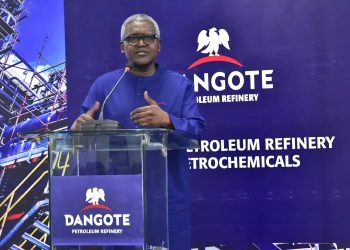
Following the outcry that has trailed the advocacy for the sale of the country’s national assets as a quick measure to fund the 2016 budget and boost the country’s foreign exchange reserves, the President/Chief Executive of Dangote Group, Alhaji Aliko Dangote, has dismissed insinuations that his advocacy for the sale of the assets was self-serving, saying he was not interested in any of the assets.
Dangote, who spoke in an exclusive interview with THISDAY, stressed that if the Nigeria Liquefied Natural Gas (NLNG) Company or any other national asset was offered to him, even on credit, he would not be interested in acquiring them.
Dangote, who is Africa’s richest man, said his advocacy for the government to sell down some of its interest in some of the national assets was to help boost the economy as well as to stabilise the naira exchange rate, which has been under attack in the past few days.
According to him, he offered his proposal as a way out of Nigeria’s present economic recession because he is “a true Nigerian who really wants the issues about the economy to be sorted out”.
He added: “You know the issue, once your reserves are low, the banks, entrepreneurs, including external forces, would definitely attack your currency. They would speculate on your currency.
“We all know that the exchange rate of almost N500 to the dollar is not a true reflection of the value of the currency – the naira cannot be almost N500 to the dollar!
“But you see, if this thing is not handled properly, it can get out of hand. It can get to N600 to the dollar, or even N700 to the dollar.
“But the issue is, why did I suggest that we should sell some of the assets? I know the touchy one is the NLNG. I want to make it categorically clear that even if the government is selling NLNG on credit, I am not interested in buying.
“I don’t have any interest in NLNG and I will not buy it. It is not a business that I want to invest in. It is a mature business; that is what people don’t understand.
“You see, we should have invested heavily in all these Brass LNG, Olokola LNG, etc, when former President Olusegun Obasanjo started work on the projects, but we missed the opportunity.
“Today, you have massive LNG projects that have been done by Qatar, Australia and the United States is also exporting. But right now, all the gas that we have is even in the ground. Even Mozambique has a massive amount of gas and also Tanzania, and they are nearer to the markets than we are.
“So, if somebody is even going to invest in LNG, he would go to those areas and invest there and not here in Nigeria, because the investment here daunting. So my own suggestion is that even if we must sell, it doesn’t have to be 100 per cent of our interest in NLNG.”
Dangote maintained that even if NLNG was bringing in $1.5 billion into the federal government’s coffers, once the government reduces its stake in the company and it is run more professionally, Nigeria would generate more funds from it.
“People are just saying it is better to go and borrow, but I don’t know where they are coming from. You see, with borrowing, if I have issues with my business today, the bankers who would lend me the money would want to see me doing something first to see how the business can survive. There would be conditionalities.
“But if you are not shedding weight, how do you expect somebody to help you with funding? You have to start first by trying to shed weight and showing the person (lender) who wants to help you with the assets you want to sell,” he explained.
Dangote maintained that Nigeria requires about $15 billion to jumpstart its economy, saying that if the amount were added to Nigeria’s foreign exchange reserves of about $25 billion, this would help attract foreign investors.
“I can assure you that if our forex reserves get to $40 billion, you will be shocked at how people will reject even buying dollars. So, is it worth it for us to keep assets that we are not using? Even the oil assets that I am suggesting for sale, they are not the producing assets. We have a lot of non-producing assets.
“The producing assets only form about 73 per cent of Nigeria’s portfolio. We can also unlock shut-in oil production because today we are losing about 700,000 barrels, be it through negotiations or whatever with the militants. These 700,000 barrels can easily give us about $1 billion a month. So, I am not saying that you should touch the producing assets.
“I am talking about the sale of the marginal fields and all those non-producing and capped oil wells that we have not even touched in the last 50 years. They have not been touched at all. They are there, just dormant.
“These assets form about 14.7 per cent of Nigeria’s portfolio. Some of those assets were bought by Shell and others. These are assets that you are not earning anything from.
“But the moment that you put these assets into use, the money that you will start getting from them, we will be talking about an additional $4 billion to $8 billion, and you can go and borrow money against that,” he added.
Sale Will Ease Borrowing
Furthermore, Dangote argued that it is easier to borrow when you have substantive collateral, than going to the International Monetary Fund (IMF) or World Bank.
This, he reiterated, is because the “medicine” the World Bank and IMF would prescribe to Nigeria, “we might not be comfortable taking those types of drugs”.
“Today, anything you say in Nigeria is turned into politics. If you look at it, based on the plan, we had a production target of four million barrels per day by 2015, which we have never achieved. So, both in oil and also in gas, we have never been able to achieve the gas master plan, which we have had for years.
“Some are saying don’t divest, but you see, five or three years ago, I would not have been talking about divestment from NLNG. But as we speak today, it is a mature business. Right now, the business has already plateaued and is sliding. Even the earnings, gas prices are coming down.
“Countries like Qatar and others are nearer to the market. Australia has massive gas. Everybody that signed LNG purchase contracts have renegotiated them with gas producers.
“Even those that have 20-year contracts have renegotiated. So, talking about sale of the assets, I am just wondering why we should hold on to these assets?
“Besides, every single thing that we touch in Nigeria is affected by the exchange rate. Even the persons selling garri or yam are watching the exchange rate. So, they would look at their produce and when they hear over the radio that the dollar is N500, they would change their prices without any justification.
“So we are not advising government to just sell its assets. For example, we have the joint ventures where government owns an average of 57 per cent stake in the oil blocs and what we are saying is that government should go below 49 per cent. When they go below 49 per cent, they would be able to raise $5 billion to $8 billion.
“And if they go below 49 per cent, they can go and borrow money because with that they can borrow money cheaper. Today, to go and borrow money abroad, for the likes of Shell, it would not exceed two and a half per cent. But today, Nigeria cannot borrow money at a single-digit interest rate,” he said.
He recalled that when the international oil companies (IOCs) sold their Nigerian assets, they did so when oil prices were high. He said: “People always forget why the Shell and ConocoPhillips sold at the time they sold, they sold at the time when they saw that the price was at the highest, because they track prices.
“Honestly speaking, that was when our government should have known that portfolio-wise than the best time for them to get the best value from the assets.
“So today when you still need that liquidity, you should still consider it as an option.”
Oil Firms Still Interested
When he was reminded that Nigeria needs to boost it foreign reserves immediately and the sale of the assets could take much longer, possibly two years or more, to be concluded, Dangote disagreed, stating: “No, let me tell you something, some of these assets that we are talking about, the oil companies would pay immediately.”
He also held the view that low oil price environment and militancy in the Niger Delta would not deter investors from acquiring the assets if they are offered for sale.
“They would pay, people are still investing. It is only here that people are not investing. For example, we (Dangote Group) still went ahead and bought our own oil block. We just closed the deal in July.
“So it depends on how you manage the situation. The benefit to those buying is that they now have majority stake, so that they would be able to fund the operation, rather than waiting for cash calls.
“Right now they own minority stake and if they own minority stake, they are not going to jump at going in there,” he said.
But when he was informed that minority stake in the oil assets does not preclude investors from still funding their share of the assets, Dangote said: “Let’s say you have to spend $1 billion, which does not mean you are going to put up the entire cash. Instead of making cash call payments for $1 billion, they may now do cash calls based on $250 million.
“With the $250 million, the portion of government may be about $100 million. And the investors would have more capacity to borrow because they would run the business professionally.
“Just to elaborate: you know government has always had problems with cash calls and it has been going on for between 10 and 15 years. There are two ways to go about it. Government had said it would go into Incorporated Joint Ventures (IJVs), that means the parties form a company, and as a company, together you can raise money.
“If they are going to do that, NNPC cannot hold its interest at 55 or 60 per cent, it has to drop below 50 per cent, just because of what is required to make the IJV bankable when you get to the international market.
“So that dilution would have to happen. The model the NNPC has also accepted is such that if you turn it into an IJV, it can actually go to the market and borrow money and then the whole cash call thing goes away.
“The obligation to government would actually be close to zero because you will still pay your tax and royalty. So, since you are going to transit to IJVs and you know that is your sustainable funding approach, why don’t you go and start implementing that from today.
“Now, you are right by asking if the IOCs would buy. The IOCs who have been there for a long time are probably the first ones that you would try to talk to.
“An investor that comes and sees a Shell that already owns 30 per cent gets more comfortable to buy 15 or 29 per cent and when they know that the structure does not have the encumbrance of cash calls.
“The only reasons why investors run away from coming to buy assets here are just two: Does the NNPC pay its share of cash calls? And secondly, the whole NNPC approval process gets delayed. These two issues deter them.”
Nigeria Could Leverage on Its Assets
Continuing, he stressed that what the economy requires at the moment is liquidity, adding that for policy makers to be able to achieve that, “we have to fire on all cylinders.”
He explained: “If we can get the loan, fine. But we have to get something, whether it is through loans, debts or even the sale of assets. There are lots of friendly countries like Qatar, Saudi Arabia and others that have the capacity to give us money. But they would hasten to give us money when they see that we are doing something.
“When you have assets, you can raise money on your own without doing anything. You see, it is easier for me to go and tell somebody that my flour or sugar business is on sale and that I am negotiating their sale, and that the person should give me money so that I can bridge a funding gap.
“What his means is that government may not have to sell the assets out of desperation. But at the same time, you must know that when you need money, that is when people are not willing to lend you money.
“How long do you think it will take us to go to the IMF and World Bank to borrow, or even to raise money through a Eurobond issue? It would take long and there would be all kinds of conditions.
“So what I am saying is that we can now leverage on these assets to say we are negotiating with some people and that we would sell some of our stakes in NLNG and the non-producing assets.
“On this basis, you can go to a bank and strike a deal that either through our future oil sales, we would pay back, or when we sell the assets. That would be used to attract investors. Moreover, the money we are talking about, none of the local banks have the capacity to lend you that kind of money.”
Naira Value is Unrealistic
Dangote also posited that the present value of the naira exchange rate was unrealistic, saying: “Other currencies are not fluctuating the way the naira is. You know, yesterday (last Thursday) on the interbank, it went to N503 to the dollar, before it came to N496, and before its closing value.
“The biggest challenge we have in Nigeria is that it is not like other countries that are producing nations. Let me even give you an example: You know today, we are bringing thousands of people into our (refinery) site and we want to buy televisions, fridges, and other electronics. But because of the situation with the exchange rate, LG now changes its prices almost every hour.
“This means that we are actually sliding to the era in Brazil when if you stood on a queue at a shopping mall to pay, the person behind you will pay higher.
“Today, as a Nigerian, once you collect your salary, what are you going to do with it? Immediately, you will go and buy rice, garri, and other commodities, because the price will never go down.”
IOCs to Exercise Pre-emptive Rights
Meanwhile, Dangote’s position that the IOCs will be interested in acquiring Nigeria’s oil and gas assets if they are put on the block was given fillip yesterday, when it emerged that the oil multinationals will seek to exercise the right of first refusal should the government decide to sell some of the assets, THISDAY has learnt.
Officials of Shell, ExxonMobil, Chevron, Total and Nigerian Agip Oil Company (NAOC), who spoke to THISDAY, confirmed that the IOCs would insist on exercising their preemptive rights to buy some of the joint venture assets and NNPC’s stake in NLNG in order to protect their current investments and also increase their earnings from them.
Should the federal government go ahead to sell down its interest in the oil and gas assets, this would not be the first time it has done so.
The last time the federal government sold NNPC’s stake to a JV partner was in 1993, when the JV partners signed the sixth participation agreement that reduced NNPC’s stake in the NNPC/Shell/Elf/Agip JV from 60 per cent in the third equity participation agreement to 55 per cent.
While Shell and Agip respectively retained their 30 per cent and five per cent equity stake, Elf, now Total, took up NNPC’s five per cent, thus increasing its stake to 10 per cent.
The officials, who spoke to THISDAY off the record on the advocacy for the sale of some of the oil and gas assets, said that the right of first refusal is already provided in the joint operating agreements (JOAs) and shareholders’ agreement of the some of the assets jointly held with NNPC.
“Before the international partners agreed to invest in some assets, their international lawyers scrutinised the documents to find possible areas of exposure and how to block such exposure especially in a country like Nigeria that is a high-risk environment.
“Nigeria is a high-risk environment and the only thing that will keep an investment going in the country is high reward. High risk, high reward is the language of business.
“So the right of first refusal is embedded in some of those agreements to protect the existing shareholders,” an official of one of the IOCs told THISDAY.
One of the officials also wondered if the federal government would agree to dispose of some of its best performing assets, stressing that nobody sells “the family’s crown jewels”.
“Nobody sells his family’s crown jewel when he has challenges. Why did Shell not sell Bonga? Why did Shell not sell Forcados or EA or Bonny Terminal? Shell and other IOCs sold only the assets that were giving them trouble and left those ones, because as long as Shell’s terminals remain open, other operating companies will continue to use them and Shell will continue to make money,” said one of the officials.
He maintained that the IOCs would exercise their preemptive rights should the federal government decide to sell the assets, in accordance with the relevant JOAs and shareholders’ agreement.
THISDAY confirmed that the JOA between Shell, NNPC, Total and Agip provides that each partner shall give other partners “prior right” to acquire its interest in the JVs before offering the interest to a third party.
Article 19.4 of the JOA states: “Subject to Clause 19.1 and 19.2, if any party has received an offer from a third party, which it desires to accept, for the assignment or transfer of its participating interest, it shall give the other parties prior right and option in writing to purchase such participating interest as provided for in sub-clauses 19.4.1 to 19.4.2.”
Clause 19.2 of the JOA also states: “Either party may, at any time upon notice to the other parties, transfer all or its participating interest to an affiliate of such party, subject to any necessary government approval.”
If the partner is the operator, for instance, Shell, it can only transfer operatorship to its affiliate or affiliated company and Article 1.1.2 (i) of the JOA defines Shell’s affiliates as: Shell in the Netherlands; Shell Transport and Trading Company Plc in the United Kingdom, or any other company that is being controlled directly or indirectly by any of these two companies.
An official of one of the IOCs also told THISDAY that the partners would insist on acquiring the assets to reduce their exposure to NNPC, owing to its piling cash call arrears and non-remittance of NLNG dividends to the federal government.
“NNPC has a 55 per cent stake in the Shell JV but cannot provide 55 per cent of the cash calls. This exposes the IOCs to financial risks of sourcing for funds to meet the JV obligations. If NNPC sells part of its stake to the IOCs, the risk faced by the IOCs will reduce,” he said.
On NLNG, he added: “Nobody sells his best performing assets. But if the government decides to offload 10 per cent out of NNPC’s 49 per cent in Nigeria LNG, the other partners will snap it up, in accordance with the shareholders’ agreement and they will have less trouble from the NNPC when its stake is reduced.
“Anytime these partners see a story of unremitted NLNG dividends, it impacts negatively on them. It is a brand reputation problem for the shareholders of NLNG whenever NNPC fails to remit NLNG dividends to the federal government.”
To increase its participation in the oil and gas business, the federal government in April 1973 acquired 35 per cent in the assets held by oil companies operating in the country.
By 1974, the second participation agreement, which increased government’s stake to 55 per cent, was signed.
In 1979, the third equity participation agreement was signed, increasing government’s equity in the joint ventures to 60 per cent.
Also, owing to the federal government’s strong opposition to Apartheid and Britain’s support of the oppressive regime in South Africa, British Petroleum’s (BP) shareholding was nationalised, and the federal government took over 80 per cent of the equity, leaving Shell with 20 per cent of the joint venture. – Thisday.