We expect the international effort to save Lake Chad, spearheaded by the affected nations of West and Central Africa, to move by now from talk shops to real action to recharge the lake with water and arrest its massive loss of water due to evaporation, seeping and human activities.
The International Conference on Saving Lake Chad which took place in Abuja last week was a worthy one but we expect the report adopted by it to move very quickly to the stage of implementation. Last week’s conference was jointly planned by the Federal Government of Nigeria, Lake Chad Basin Commission (LCBC) and the United Nations Educational, Scientific and Cultural Organization, UNESCO. Its aim was to find workable solutions in resuscitating Lake Chad to the benefit of all LCBC member countries and ecological balance of a large area of Africa. There were two days of technical sessions with delegates, experts, researchers and resource persons exchanging ideas and sharing information on water resources development and management in a challenged environment.
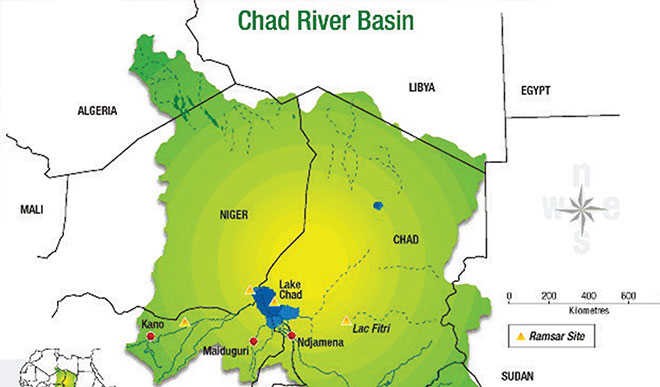
This was followed by a high level session to consider recommendations in order to garner political and global support for the restoration option identified for recharging of the Lake. The high level session was attended by Heads of State from LCBC member countries as well as top UN and UNESCO officials. In his address at the session, President Muhammadu Buhari described Lake Chad as a “former oasis in the desert” and a hub of economic activities and food security for farmers, fishermen, herdsmen and traders. Lake Chad has now shrunk by 95% since 1960 due to a combination of high evaporation, seepage of water under the lake as well as human activity, including the building of two dams on the Komadugu-Yobe river in Niger and removal of huge quantities of water from the Chari-Logone river system in Chad which feeds the lake with 80% of its water.
As a combined result, United Nations Office for Coordination of Humanitarian Affairs now says more than 7 million people in the sub-region face the threat of famine and half a million children suffer from severe malnutrition. President Buhari also pointed out that loss of fish stocks has rendered fishermen jobless; farmers and herdsmen struggle over the little water left; herdsmen migrate in search of greener pastures resulting in conflicts and youths are joining terrorist groups because of lack of jobs and difficult economic conditions, resulting in serious instability in the sub-region. He said “The time to act is now. The time to bail out the region is now.”
The envisaged solution, promoted for several years now by LCBC, is to divert massive quantities of water from the Chari-Logone River which is part of the Congo Basin in northern Central African Republic [CAR] through Chad Republic into the lake. This huge undertaking will entail building a dam, pump works and a canal that are together estimated to cost $14.5billion, money that the affected nations can ill afford on their own. Besides, it will require political will and sustained cooperation among five African nations probably without precedent. Still, it is a task that must be done and we urge President Buhari to be the chief driver of this project because the livelihoods of 17million Africans are at stake.