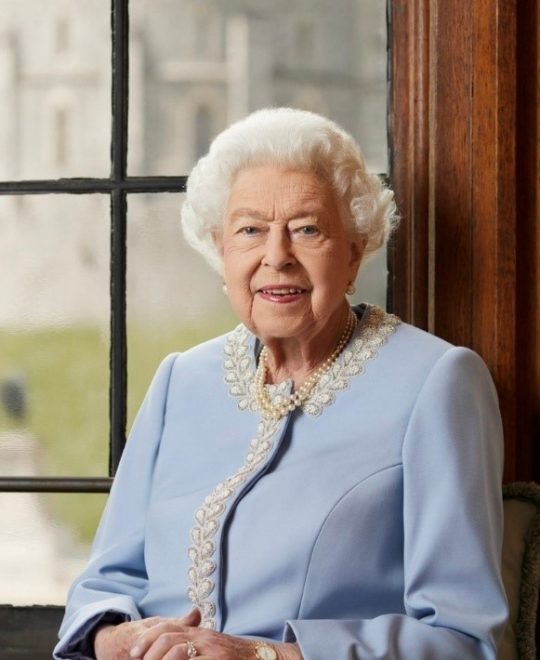
Britain’s Queen Elizabeth II, head of the Commonwealth and monarch of 15 countries, has died aged 96 after more than 70 years on the throne, Buckingham Palace announced on Thursday. Follow our liveblog for the latest updates and reactions from around the world.
Queen Elizabeth died at the Balmoral royal estate in Scotland after having steadied and modernised the royal institution through seven decades of huge social change.
She was in her Platinum Jubilee year, marking 70 years since she succeeded her father king George VI in 1952.
“Through thick and thin, Queen Elizabeth II provided us with the stability and the strength that we needed. She was the very spirit of Great Britain – and that spirit will endure,” said the country’s new prime minister, Liz Truss.
The new king, Elizabeth’s eldest son Charles, paid homage to a “cherished Sovereign and a much-loved mother”.
Tributes poured in from around the world, with French President Emmanuel Macron hailing “a friend of France who has left her mark on her country and her century forever”.
Since assuming the throne after the death of her father on February 6, 1952, Elizabeth had been a symbol of stability as Britain negotiated the end of empire, the dawn of the information age and the mass migration that transformed the country into a multicultural society.
She famously dedicated her “whole life” to the service of Britain and the Commonwealth on her 21st birthday, later ruling out the idea of abdicating.
That steadfastness was seen on Tuesday when she oversaw the handover of power from Boris Johnson to Liz Truss in a series of carefully choreographed events steeped in the traditions of Britain’s 1,000-year-old monarchy.
As recently as Wednesday, she issued a statement after the killing of at least 10 people in the Canadian province
Meanwhile, Prince Charles, the heir to the British throne, became king with Queen Elizabeth’s passing. Charles, 73, has waited decades to ascend to the British throne.
He is the eldest of Queen Elizabeth’s four children and has been first in line to the throne all his life.
The Prince of Wales’ highly mediatised marriage to Lady Diana, the couple’s messy divorce and her tragic death has largely defined his public persona but in recent years he has tried to restore his image.
Prince Charles will become Britain’s thirteenth monarch.

He has been preparing for this role his entire life. As the eldest of Queen Elizabeth’s children, he has been in line to the throne for 70 years, a record in the royal family.
When he was born on the November 14 1948, his mother was not yet queen. It was not until four years later, in 1952 when his grandfather King George VI died of a coronary thrombosis, that Elizabeth ascended the throne. The following year, the young Charles attended his mother’s coronation at Westminster Abbey.
After growing up in Buckingham Palace alongside his siblings Anne, Andrew and Edward, Charles was the first to go to school, just like any royal subject, according to his mother’s wishes.
He attended Gordonstoun School, a regular boarding school in north-east Scotland, the same institution his father, the Duke of Edinburgh had gone to as a child.
Charles did not have fond memories of the school. He went on to study at Cambridge University, where he earned a degree in anthropology, archeology and history – making him the first British monarch with a university degree.
At the age of 21, in 1969, Charles was officially named The Duke of Cornwall, the title reserved for the oldest male heir of the sovereign.
His mother crowned him Prince of Wales at a ceremony that was broadcast on national television.
After university, Charles joined the Royal Navy where he served as an officer for five years, from 1971 to 1976.
He also earned his helicopter pilot licence.
During his youth, the prince was known for his dalliances with several women from well-to-do families.
In 1981, at the age of 32, he finally decided to marry Lady Diana Spencer, who was 20 and from the British aristocracy. More than 750 million people watched the wedding on television channels around the world.
The couple had two sons, William, born in 1982, and Harry, in 1984. But the fairy tale turned into a nightmare a few years later.
The couple got separated in 1992, shortly after Diana revealed that her husband had a long-standing extramarital affair with Camilla Parker Bowles, one of his childhood sweethearts.
For several years, the princess and the Prince of Wales could no longer hide their disagreements. Charles’ image was strongly tarnished. The divorce was officially announced in 1996.
A year later, on August 31, 1997, Diana was killed in a car accident in Paris, under the Alma bridge, along with her boyfriend at the time, Dodi Al-Fayed. The news sent shockwaves around the world. Prince Charles travelled to France to retrieve the body of his ex-wife. The heir to the crown appeared close to his sons as he took part in the national funeral, walking behind Lady Di’s coffin.
Charles, who has long been perceived as an unfaithful husband, tried to restore his image. Eight years after Diana’s tragic disappearance, he finally married his greatest love, Camilla Parker Bowles.
Passionate about botany and gardening, he maintains his reputation as an environmental enthusiast and sponsors several environmental associations. In 2007, he notably created the Prince’s Rainforests Project to raise awareness of deforestation.
He is also the president of the World Wildlife Fund (WWF) in the United Kingdom.
He started an organic farm and garden at his huge country estate, Highgrove Gardens. He also campaigns for organic farming.
While waiting to become king, Charles carried responsibilities within the monarchy. On behalf of the Queen, he officiates at official openings and attends the funerals of foreign dignitaries.
In 2013, he represented his mother for the first time at a meeting of the Commonwealth Heads of Government. In 2022, for the first time and because Elizabeth II was experiencing health issues, Charles delivered the Queen’s Speech at the traditional opening ceremony of Parliament.
Considered eccentric and quirky, Charles often found himself engulfed in controversy. In 2005, during the funeral of Pope John Paul II, he aroused controversy by shaking hands with Zimbabwean dictator Robert Mugabe. Ten years later, letters made public and addressed to members of Tony Blair’s government revealed some interference by the heir to the throne in political affairs, which contradicts the tradition of royal family neutrality.
In 2017, he was also hit by the Paradise Papers scandal, which revealed that Charles, who manages his own private funds, invested around 3.5 million euros offshore in the Cayman Islands.
Last July, Charles found himself in the midst of yet another controversy, as he was accused of accepting a million euros from members of Osama bin Laden’s family for his charitable work.
His popularity then dropped from 50 to 42 percent, far behind his eldest son William, according to the polling institute YouGov.
The new sovereign chose the name of Charles III, even though his first name, Charles, is considered a curse in British history.
In the absence of his mother, and in spite of his unpopularity, Charles will nonetheless have to keep the crown afloat. His reign will also be much shorter than his mother’s, giving him little time to leave his mark.- France24.