Normally an occasion for celebration everywhere else, Nigeria marks its 61st Independence anniversary today amid a pervasive atmosphere of gloom and mass despair. Instead of grappling with the elevating issues of development, prosperity, and her place in an increasingly competitive, globalised and knowledge-driven world, the country’s 211 million population and more than 250 ethnic nationalities are seething with discontent about the present, and fearful of an uncertain future. Today, the lofty promise and hope of “unity in diversity” lie in bloody ruins, and separatist agitations have again taken a centre stage in national politics.
From 1966 till now, it has been a gradual descent into a dark tunnel. Having survived coups, violent elections, civil war, and military rule, now, state failure is not only a real possibility, but by some accounts, has already occurred. Every sector of national life has suffered, from governance to the economy, security, and national cohesion. Retrogression and deficits in every area of development define the country. Traumatised, abused and oppressed, the youth have lost hope in the land of their birth. Indeed, as it was in 1966, Nigeria is again fast marching to a point of no return.
Politically, the system is broken. In classic isomorphic iteration, institutions exist on paper but do not work. Beyond desperation to capture state power, political parties lack ideologies, policies, or direction. Reflecting a warped leadership selection process, the quality of leadership at every level is dismal, resulting as one observer put it, in “the worst of us ruling the best of us.”
Economically, Nigeria has been left behind by its peers. Diversification has given way to a mono-product mode. Agriculture, once the mainstay of the country and its defunct regions and contributing over 60 per cent to Gross Domestic Product in 1960, added 22.13 per cent to nominal GDP by June 2021. Oil and gas that contributed less than 1.0 per cent to GDP and 6.65 per cent of export earnings in 1961, according to the Central Bank of Nigeria, contributed 47.72 per cent to GDP and 98.72 per cent of export earnings in 2000.
Reflecting the glaring distortions in the economy, the sector maintains this dominance but provides only 9.25 per cent of GDP and just a few jobs. Self-sufficient in food at independence at the takeoff point, the country is now import-dependent, with an annual food import bill estimated at $3 billion by the United Nations Food and Agricultural Organisation.
Early promises of industrialisation through policies like import substitution, backward integration, vehicle and electronic products assembly plants, industrial estates and steel plants have floundered. The textile industry, once employing about 350,000 persons, has collapsed.
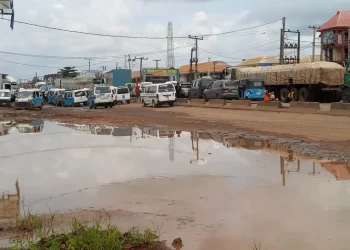
Infrastructure has not kept pace with the massive population growth assessed at 45.14 million by the US Census Bureau in 1960, to the estimated 211 million in 2021. Roads, airports, ports, and power are inadequate, requiring $3 trillion to fix, says the African Development Bank. In human development, failure is writ large. Whereas the poverty level was 15 per cent at independence, it averaged 27.2 per cent from 1980 to 2010 and reached 69 per cent by 2011.
In 2018, Nigeria captured the odious title of the world’s poverty capital from India. The World Bank forecasts that 11 million more persons will slip into poverty this year to raise the number to over 100 million. On the UNDP’s Human Development Index 2020, it dropped further by three spots to 161 out of 189 countries. The country has the world’s highest number of out-of-school children with 10.19 million; it has the 14th highest infant mortality rate. At 33.3 per cent, it has the third-highest unemployment rate. It ranks 10th of countries with the least access to safe drinking water. With 85 million persons or 43 per cent of the population lacking access to the national electricity grid, this makes Nigeria the country with the largest energy deficit in the world, declares the World Bank.
Compared with other developing countries and others marking their national days this month – like China, Cyprus, Croatia, Germany, and Austria – Nigeria’s story is pathetic. China’s GDP per capita was $89.52; in 2021, it is projected at $8,840 nominal and $17,700 at Purchasing Power Parity. And compared with Malaysia, which achieved independence on August 31, 1957, just three years ahead of Nigeria, it is clear the Nigerian project has failed. The Federation of Malaysia’s nominal GDP per capita of $234.94 in 1960 is forecast to be $12,500 and $27,220 at PPP in 2021; Singapore’s GDP per capita of $428.06 in 1960 moved to $58,902 in 2020 or $97,057 at PPP, the world’s eighth highest in nominal terms.
Comparatively, Nigeria grew its GDP per capita from $92.96 in 1960 to just $2,083 in 2020 and $5,187 at PPP.
But nothing defines Nigeria’s dysfunctionality as the high level of violence. Nigeria is ranked the third most terrorised country, with three groups, Boko Haram/ISWAP, Fulani herdsmen and bandits/terrorists, rated among the world’s five most deadly terror groups. Every part of the country is insecure. But amid this, there is no national consensus on how to tackle insurgency and crime as ethnicity and religion overshadow rational decision making. While the blood of innocent citizens spatters most cities, towns and villages from horrific violence, some power blocs insist on retaining the single policing system that has failed so spectacularly and block all efforts to make the country a truly federal polity.
The inherent contradictions and the centrifugal forces undergirding the federal contraption have erupted and coming close to boiling point. For many, two options are now on the table: restructure in line with all federal polities, or break up in the tradition of all artificial countries.
The starting point should be unambiguous: Nigeria is an artificial state, an agglomeration of over 250 ethnic nationalities, diverse faiths and cultures forcibly put together by a colonial power. Nigerians are not the same, they never were and never would be; some differences are simply too sharp to be ignored.
And truly, as the British departed, the transition arrangements of self-rule and full independence acknowledged these diversities, and a federal constitution was negotiated and put in place. The hope of shared nationhood moulded from the diverse units survived only till 1966 when soldiers overthrew the civilian government and the country embarked on an irrational centralising project by fiat. American political scientist, Francis Fukuyama, famously said that external forces can erect the skeleton of a state in an embattled country, creating police forces, administrative structures, and taxing authorities. But nation-building goes further and involves a shared sense of national identity, built on elements that tie people together – such as shared culture, language, and history – that cannot be imposed from without.
Nigeria’s lack of “shared culture, language, and history” has arrested its development and is plunging it towards state failure. While people’s loyalty lies with their different ethnic nationalities, the rulers pretend to superintend over a “united” nation for selfish reasons. Yet, diversity, even sharp ones, within a national polity is not a death knell for any country. What has caused the collapse of most artificial states in the last four decades is the inability to accommodate and harness differences for mutual benefit. A country with a diverse population must necessarily have a federal constitution that allows different components considerable autonomy and powers, control over resources and opportunities to realise their full potential. Federalism, explains the Forum of Federations, is anchored on shared sovereignty; where federating units each have exclusive jurisdictions with different constitutions of their own not defined by another level. In this, “neither the federal government nor the governments of the various constituent regions are constitutionally subordinate to one another.”
This was mostly the case up till 1966 when the federal principle facilitated development, competition, and relative peace. Its derailment has fostered endless crises and amplified fissures. While each region, like other federations, had its constitution pre-1966, absurdly, only a federal constitution operates in Nigeria today and the Federal Government acts as a colonial power. Wealth abounds everywhere in extensive fertile land, minerals, and human capital, but the abhorrent centralised system prevents the states from fully exploiting them. Instead of wealth creation through competition, fiscal federalism, and resource control, a laggard culture of sharing, entitlement and domination prevails, accompanied by impunity and a rentier system that confers advantages on the least productive.
This self-destructive system should be jettisoned: Nigerians negotiated the various constitutions adopted from 1951 to 1963; they must negotiate a new one based on the principles of federalism. The wretched human development indices hide wide regional disparities; each unit must be allowed to develop at its own pace. At 61, a country that is floundering, flailing in self-contradictory directions, should re-strategise to survive. Nigeria’s various nationalities have different values and aspirations that should be respected. The premiers of the three founding regions – North, West, and East – administered them based on the values and aspirations of the peoples. The results were the incredible achievements recorded before 1966.
With the disastrous failure over the past five decades to effectively manage the diversity and forge a truly federal united polity so glaring, Nigerians must toe the path of rationality by realistically redefining and reconfiguring the country along its natural lines to avoid inevitable state total collapse.