


President Muhammadu Buhari has assured that his administration is working hard to ensure that power supply is stabilised in the country.
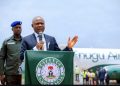
He said at a joint press briefing with visiting President of Togo, Faure Gnasingbe, at the Presidential Villa, Abuja, on Tuesday, that stabilising power supply was necessary, because of its effect on other sectors of the economy.
He assured that Nigeria had both the resources and the technical expertise to achieve the goal.
Buhari said: “We have power problem and Benin Republic has power problem because they depend on us and we are working very hard to stabilise the situation.
“The resources are available, the technology is available, we are trying to stabilise the situation.
“If we improve power, which means our productivity can be competitive and God willing, we are going to achieve our objectives.”
Buhari revealed that both leaders also discussed the situation in South Sudan and Burundi, which he said was depressing.
According to him, “we also discuss the unfortunate incidents in South Sudan, Burundi. It is an agonising situation. Several citizens are living under primitive conditions.
“We hope at the African Union (AU) meeting we will be able to stabilise the situation in South Sudan and Burundi with the efforts being made.”
Commenting on Faure’s visit to Dangote Petrochemical plant on Lagos, the president praised the efforts of private investors.
He said: “They say seeing is believing. You can see the efforts private investors is doing. We are also building pipelines, but is not as formidable as what Dangote is doing. We are improving on it.
“We also have the Nigerian Liquefied Natural Gas (NLNG) that is helping is to liquefy the gas and then turn it into gas with modern technology and modern technology is making it flexible.”
In his remark, President Faure said he was impressed by the investment of Dangote “because we have been talking of socio-economic integration and promoting trade among African countries.”
He further said: “If you want to promote trade, you have investors that are very competitive and will contribute to reduce import from non-african countries.
“I was told the gas pipeline that will be built will be buried under the sea to make it. It means if you want to promote blue economy, our ocean needs to be very safe. We need security.
“I invited him to attend the maritime summit on October 15, that will be held in Togo.”

























President Buhari certainly means well. One fails to understand how or why, given the examples that abound in successful countries – from the way society is organized to economic policies that favor innovation, etc., and given the entire resources of the nation at his disposal, the President and his administration continue to flay about seemingly without solutions. There are the five (5) items that I recommend for the federal government to focus on:
1. Borrow massively and inject spending into the economy – #1 priority is POWER, INTERNET CONNECTIVITY AND ROADS/AIRPORTS/RAILWAYS! Nigeria’s economic potential over the next 10 years is more than $1 trillion so borrowing up to that isn’t a bad thing! These investments would create massive employment and innovation and ease movement of goods to the market and ease of commerce. Local production will increase sufficiently to enable export and foreign exchange earnings!
2. Require all government service providers to have performance bonds through reputable institutions in order to ensure that the public gets good value for money. Increase consumption tax but reduce PAYE and corporate income taxes. Encourage low-interest consumer lending to drive up consumption and economic activity.
3. Start decentralizing the entire government and allow fiscal independence for states and local governments.
4. Fund massive training at the federal, state and local government levels for federal, state and local government police agencies and the judiciary. This would ensure that people get involved in their own government which would lead to more accountability and better governance.
5. Start creating minimum federal standards, e.g., for education, civil/human rights, policing, etc.