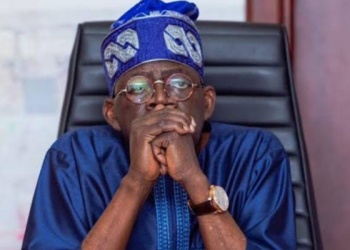
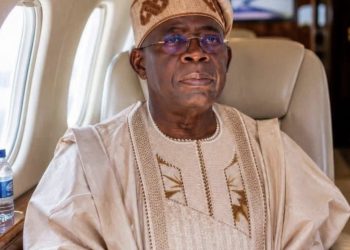
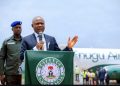
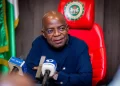
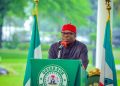
Former military president Ibrahim Badamasi Babangida, fondly called by his initials “IBB”, marked his 73rd birthday yesterday. It was a milestone for the prince of the Niger and a happy day for his family and friends.
For many an admirer, Babangida is an enigma who, like the World War II intelligence machine, is not too easy to decode. Also for many friends, political associates and particularly the media, he is a dribbler in the class of Argentine dare-devil footballer Maradona. Behind those dribbles and his ever-present toothy smile lies a steely will that influenced his every move and affirmed his conviction that history will forgive one for taking a wrong decision but will condemn one for not taking any decision at all.
Babangida is acknowledged as the only Nigerian military officer who came into office with an agenda. We recall the International Monetary Fund (IMF) loan debate that threw up the Structural Adjustment Programme (SAP), the commercialisation and privatisation programme as well as the opening up of the banking sector. On the political terrain, the slogan “a little to the left and a little to the right” defined the characters of two main parties, the Social Democratic Party (SDP) and the National Republican Convention (NRC), both sponsored by government and set up after IBB’s regime had disqualified generations of politicians. Those were tough decisions considered unpalatable and seen by many as an attempt to swim against the tide of public opinion. But they were decisions that had to be taken at that time and IBB made himself available. Right or wrong, as he said, that’s up to history.
He, however, made history by putting in place structures that midwifed the freest and fairest election in Nigeria’s chequered electioneering process. Curiously, he annulled the same June 12, 1993, election presumed to have been won by his bosom friend, Chief Moshood Abiola, and triggered off the worst political crisis in Nigeria since the civil war.
As president, he once told State House reporters that, after his tenure, Nigeria would not be the same again. How right he was, judging by a hindsight assessment of those decisions and policies! He had told the nation that Chief Obafemi Awolowo of blessed memory was the issue in Nigerian politics. But that has turned out to be a hasty assessment. IBB’s era marked a turning point in the political history of the country, making him, in the process, the real issue in Nigeria’s political history. Since leaving office, he has remained a powerful force one ignored at one’s own peril.
Then Colonel Babangida came into national limelight when he single-handedly dislodged Col. Bukar Suka Dimka from the premises of the Federal Radio Corporation of Nigeria (FRCN), Ikoyi, Lagos, and thus foiled the February 13, 1976, dawn coup that claimed the life of the then head of state, General Murtala Muhammed. He was also, notably, the brains behind the 1983 coup that toppled President Shehu Shagari and ushered in the junta of Muhammadu Buhari and Tunde Idiagbon. As chief of army staff in that administration, he was in power but not the most powerful. An opportunity for him to be No. 1came on August 27, 1985.
Born on August 17, 1941, in Minna, Niger State, he enlisted into the Nigerian Army in 1962. He was promoted lieutenant in 1963 and captain in 1968 when he became commander of the 44 Infantry Battalion. He rose to the rank of brigadier-general in 1979, and, with the military takeover of government in 1983, he became chief of army staff and member of the Supreme Military Council (SMC). IBB ruled Nigeria between 1985 and 1993.
At 73, he has lived long already. But we pray he reaches 80 reserved for the strong of whom we count him as one. Happy birthday Sir!