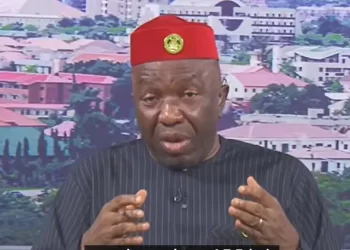
Mr Mike Igini, a lawyer, served as Resident Electoral Commissioner (REC) in Edo and Akwa Ibom states.
Igini has been in the vanguard of the campaign of transparent electoral system since he left his job at the electoral body.
In this interview, he speaks on the Electoral Act 2026, listing “dangerous” Sections that he says may undermine the 2027 elections. Igini calls for immediate amendments of the Act.
Excerpts:
At the National Summit of Opposition Political Party Leaders held in lbadan, you were one of the prominent Nigerians and you addressed the gathering on ‘Ensuring free, fair and credible elections’ in the light of the forthcoming elections. What is the summary of your presentation?
There can be no other better time than now to remind ourselves that free, fair and credible election is the bedrock of democracy. If votes do not count, elections become a mere ritual without choosing. It is free, fair and credible election that rekindles confidence of people that the ballot is the best means of the expression of the will of the people in a democracy. My job, both in and out of office, is the promotion of the rule of law, due process, and the sanctity of electoral integrity. Elections must not only be conducted; they must be transparently credible, legally defensible, and publicly trusted. This is the same message I put forward earlier before another audience, the Alumni of the National Institute.
And it is important to address the diverse sections of our society on the need to foster the democratic process, because if we don’t, the alternatives are a terrible prospect for our country, just as Karl Popper stated that one of the key advantages of democratic contestation is not necessarily that it produces the best leadership or ensures the rule of the people but that it provides a peaceful institutionalized procedure for retaining or transferring power. To truncate or telescope that procedure is to invite chaos in one form or the other.
You have expressed disappointment that you wasted ten years of your legal career in INEC, given that we are still debating over issues you said have been addressed before you left office. What are those issues?
As I stated in a recent televised intervention, I had, for some time after the 2023 elections, withdrawn from active commentary on electoral matters because I’m disappointed over the way result transmission and IREV were sabotaged, the very system that we had used successfully to conduct 105 off-season elections, including five governorship elections before l left office. Here we are again facing potential crisis with the forthcoming 2027 elections over the laws that will guide the conduct. It is out of sheer sense of civic duty that I undertook a meticulous review of the 2026 Electoral Act. What I discovered was not merely legislative imperfection, but the re-emergence of provisions which, in my considered view, constitute deliberate structural vulnerabilities, indeed, dangerous traps capable of undermining the credibility and integrity of the 2027 general elections.
It gives a sense of despair. If indeed we are all interested in the collective good of our people, how do we constantly get to that point where development frameworks that will work for the collective good get so easily undermined, and we see people who determinedly work towards that end? It gives a sense of going on and on in a fruitless cycle.
What are the specific provisions in the Electoral Act 2026 that you have publicly characterized as “dangerous” and capable of undermining the credibility of the forthcoming elections?
When we came to the Commission, we identified a whole lot of election rigging provisions such as Sections 49, 53, 68 in the 2010 Electoral Act, with wide discretionary powers given to presiding officers at the level of polling units, as well as collation/returning officers. For example, Section 49 used the word if the presiding officer is “satisfied”, he will issue ballot paper to voters. What is the objective test to determine what “satisfies” a presiding officer? That was why politicians started buying voter cards and, in some states, broke into INEC offices to cart away voter cards. With a manual voter register that requires only ticking, compromised presiding officers easily rig election. That is why we introduced the Card Reader for the confirmation and authentication of the fingers of every voter after the successful compilation of the biometric register in 2011.
We wrote to the National Assembly repeatedly to repeal these obnoxious provisions from the Act, even before l was appointed to INEC, but to no avail, until 2022 that some of them were repealed like Sections 49 now Section 47, Section 53 that promoted so much “inconclusive election” now Section 51 and Section 65 that gives power of review within seven days to the Commission, an amendment to Section 68 of the 2010 Act but, again, sabotaged in the Electoral Act 2026 to the effect that it is only the report of “official” who may have been compromised that will determine any review. The Section has now excluded candidates, political party agents and election observers’ reports from consideration by INEC. I give you this background to enable you and the public appreciate my characterization of these Sections of the current Electoral Act as retrogression.
What are your fears about the dangers that Sections 63, 65, 137 and 138 might do to the integrity of elections if they are not repealed before the elections? Can you explain the implication of each of these provisions?
Section 63 of the Act provides that ballot papers, which do not bear the official marks, security features, or authentication prescribed by INEC, may nonetheless be accepted and counted by a Presiding Officer, provided he or she is “satisfied” as to their authenticity. This is not a mere drafting anomaly, it is a fundamental assault on electoral certainty. Giving a Presiding Officer discretion to accept ballot paper, notwithstanding the absence of the official mark, what that means is that before the election, politicians who have access to the security features of INEC ballot will produce their ballot papers. Have we forgotten how the outcome of the 2007 un-serialized ballot papers in the presidential election was affirmed tragically by the Supreme Court of this country? The re-introduction of such subjective language “satisfied” creates dangerous latitude for arbitrariness. Discretion without objective safeguards is a license. The implication is stark, unauthorized ballot papers may find their way into the electoral process, clothed with a veneer of legitimacy by the unilateral “satisfaction” of an official. This is a recipe for systemic manipulation.
What about Section 138 and its implications?
Clearly, Section 138 provides some kind of legal immunity for non-compliance with INEC directives, its regulations, guidelines and manual made by the Commission pursuant to Section 160 of the Constitution that empowers the Commission in carrying out its operations, make its own rules and determine its own procedures. The Section says that any act or omission of a Presiding Officer, Collation and Returning Officer which is contrary to the instructions or directives of INEC—but not expressly in violation of the Electoral Act shall not, of itself, be a ground for questioning the election. This is a clear example of statute sabotage.
This provision strikes at the very heart of electoral governance. INEC directives, regulations and guidelines constitute the operational framework through which statutory provisions are implemented. To suggest that their breach carries no legal consequence is to render them effectively optional. In electoral jurisprudence, this creates a dangerous dichotomy between law and enforcement. It invites election officials to disregard procedural safeguards with impunity, safe in the knowledge that such breaches may not constitute valid grounds for legal challenge. This is not merely a loophole; it is an institutional vulnerability deliberately codified.
What really is the import of Section 137 in terms of individual accountability?
This Section 137 has to do with election petition tribunal. Perhaps it is most troubling as it provides that where a petitioner alleges misconduct by Presiding Officers or Returning Officers in the conduct of election and the Commission is joined as a respondent, it shall not be necessary to join such officers as respondents in the petition. This is wrong because the Chairman of INEC and Commissioners, including RECs and Electoral Officers, don’t actually on election day conduct elections, Presiding Officers and Collation/Returning officers do.
They are the ones that politicians compromise to rig election whose explanation is needed on alleged altered and manipulated election results to be determined by the tribunal, they are the best witnesses to explain how results were manipulated or not and not the petitioner or the person declared the winner usually made the first respondent in our adversarial system. That burden of proof should be upon these officials. This provision undermines one of the cardinal principles of justice that liability must attach to culpability. By shielding individual actors from direct legal scrutiny, the law effectively diffuses responsibility into an amorphous institutional abstraction. INEC, as a corporate entity, may be joined, but the specific individuals whose actions or omissions compromised the process are insulated from direct accountability. This creates a perverse incentive structure: those who perpetrate irregularities are protected, while the institution bears the burden.
Still on Section 137, you have also said that a proviso in the 2022 Act has been removed from the 2026 Act. What is the proviso and the implication of its removal?
Anyone who has followed closely and read various tribunal judgments, including those of the Supreme Court, will recall how original certified election result sheets of INEC’s documents duly certified, tendered and admitted in evidence were not reviewed on the grounds that parties did not call the makers, that is, Presiding Officers and Returning Officers, were not called to give oral evidence and speak to the document characterized by tribunal as “dumped” on the court.
These are the same set of officials that this law says shall not be necessary to be joined “notwithstanding the nature of complaints”, that is, no matter how the election was manipulated or rigged. Is that not a contradiction? To deal with this problem, and given that all INEC operation documents for the conduct of election are coded with unique serial numbers at all stages of the election value chain, a proviso was, therefore, provided in the 2022 Act to the effect that once such document is certified by INEC, it shall not be necessary to call oral evidence if the original certified copies manifestly disclose the irregularities or non-compliance alleged. And parties shall make addresses on them and the court bound to evaluate and attach evidential weight to such documents. That progressive proviso has been removed from the current 2026 Act, we are back to the argument of “dumping” because it shall not be necessary to join Presiding Officers and Returning Officers according to the law.
What are your final thoughts on these provisions you have expressed serious concern and what should be done?
Taken cumulatively, these provisions represent more than isolated defects, they constitute a coherent architecture of vulnerability. They introduce discretion where certainty is required in a very corrupt society where political elites want to buy everybody.
These provisions confer immunity where accountability is essential, they obscure responsibility where clarity is indispensable. National Assembly should take steps to repeal these provisions before the election. A stone seen coming should not blind the eyes. As the distinguished legal scholar, A. V. Dicey, famously articulated, “the rule of law requires not only the supremacy of regular law, but the equal subjection of all classes to that law”. Where Presiding and Returning Officers are permitted to act outside prescribed INEC’s regulations and guidelines without consequence and where individuals cannot be held directly accountable, the very foundation of the rule of law is imperiled. Where obedience to law is optional, the law dies.
Finally, as a resource person who addressed the political party leaders at the lbadan summit on the importance of free, fair and credible elections, what is your core message to them?
Given that the institution of representative democracy will have no hopeful future without institutionalized credible opposition political parties, I urge them to assume even greater role of urgency to approach the National Assembly for immediate repeal of the identified obnoxious provisions not only as a political demand, but as a constitutional imperative. I challenge them to show to Nigerians what they can do differently from their opponents in terms of how they will select their candidates, whether it will be transparent and devoid of corruption. They must demonstrate exemplary conduct and discipline as credibility begins at home. They should engage the process with legal vigilance, deploying agents who understand both procedure and evidence. They should avoid the allure of extra-legal remedies, for self-help ultimately de-legitimises your own claims, they should present themselves to Nigerians not merely as an alternative, but as a credible, principled, and law-abiding alternative.
This is essential because to ask for equity, you must also do equity, much of the vulnerabilities in the Electoral Act that I have pointed out are deliberate attempts to defy accountability. Election is the ultimate democratic accountability because it is a direct participation of the voters or sovereign citizens in deciding about their governance, that is why it is called a vertical accountability. For four years, they (voters) have ceded part of their sovereignty to elected representatives to make decisions on their behalf at the different legislatures. Even when they failed, they stood aside patiently from the errors of this safeguard which was supposed to be their check on elected or nominated executives, who are supposed to be the horizontal form of accountability, or where the failures were obvious, they relied on civil protest or the mainstream or social media which are diagonal forms of accountability. But on Election Day, they are supposed to have the direct power of vertical accountability.
If these intentional banana peels in the Electoral Act are not repealed, it means that even before Election Day, someone or some people have decided and determined not to be accountable to the Nigerian voters in 2027.
But the Chairman of the Committee of the House of Reps on a television programme pushed back on Section 63 to the effect that official mark refers to stamp and stamp pad, saying the same provision was in previous statutes. What is your response?
The Chairman of the House Committee has limited knowledge of what constitutes official mark of INEC on ballot paper and result sheets classified as sensitive materials. That is why he laboured so much and kept repeating stamp pad over and again in his attempt to push back on this issue. The imperative and essence of official mark on any INEC document, including ballot paper, is to verify authenticity and to avoid forgery. It includes stamps and seals, security/secret marks as well as serial numbers/coding. To be clear, official mark does not start and end with rubber stamps.
The Commission’s rubber stamps, though one of the official marks, are supplied in thousands by different artisans and vendors contracted by INEC to produce and supplied to the Commission’s state offices. They are not the real security features and do not prevent forgery, because they are everywhere. Their productions and supplies are anything but fool-proof. The real official marks are the serial numbers with codes and other features that are only unveiled when the ballot papers are opened in their sealed containers.
These are the real marks that can prevent ballot box stuffing with forged ballot papers that this Section has undermined. – Culled from Vanguard.